- English
- French
- German
- Portuguese
- Spanish
- Russian
- Japanese
- Korean
- Arabic
- Greek
- German
- Turkish
- Italian
- Danish
- Romanian
- Indonesian
- Czech
- Afrikaans
- Swedish
- Polish
- Basque
- Catalan
- Esperanto
- Hindi
- Lao
- Albanian
- Amharic
- Armenian
- Azerbaijani
- Belarusian
- Bengali
- Bosnian
- Bulgarian
- Cebuano
- Chichewa
- Corsican
- Croatian
- Dutch
- Estonian
- Filipino
- Finnish
- Frisian
- Galician
- Georgian
- Gujarati
- Haitian
- Hausa
- Hawaiian
- Hebrew
- Hmong
- Hungarian
- Icelandic
- Igbo
- Javanese
- Kannada
- Kazakh
- Khmer
- Kurdish
- Kyrgyz
- Latin
- Latvian
- Lithuanian
- Luxembou..
- Macedonian
- Malagasy
- Malay
- Malayalam
- Maltese
- Maori
- Marathi
- Mongolian
- Burmese
- Nepali
- Norwegian
- Pashto
- Persian
- Punjabi
- Serbian
- Sesotho
- Sinhala
- Slovak
- Slovenian
- Somali
- Samoan
- Scots Gaelic
- Shona
- Sindhi
- Sundanese
- Swahili
- Tajik
- Tamil
- Telugu
- Thai
- Ukrainian
- Urdu
- Uzbek
- Vietnamese
- Welsh
- Xhosa
- Yiddish
- Yoruba
- Zulu
Can Steel Formwork Construction Reduce Labor and Build Time on Site?
Yes — and the data backs it up. Steel formwork construction delivers measurable reductions in both on-site labor hours and overall project duration. Because modular steel panels are precision-engineered to interlock without custom cutting or shimming, crews strip, clean, and reposition them far faster than timber or plywood alternatives. Independent studies cited by the Construction Industry Institute show that modular steel mold systems can cut forming-cycle time by 30–40% compared with traditional timber shuttering. For EPC contractors racing against milestone deadlines, that margin is the difference between a penalty clause and a bonus payment.
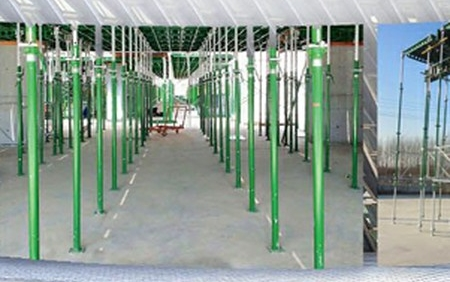
Understanding Steel Formwork Construction and Its Impact on Labor
Why Modularity Cuts Skill Dependency?
One of the most underappreciated benefits of steel formwork construction that people don't always realize is how much less skill is needed on-site. For traditional wood shutters, you need skilled carpenters who know how to measure, cut, and nail boards together to make odd shapes. When using standardized steel panel systems, a trained general laborer must follow a pre-planned order of assembly. They cannot cut or improvise. A 2019 study in the Journal of Construction Engineering and Management found that modular forming systems cut the number of on-site carpentry hours needed for mid-rise residential buildings by as much as 45%.
When steel panels made from Q235 premium carbon steel are loaded over and over, they keep their shape because Q235 premium carbon steel has a consistent yield strength of about 235 MPa. Panels made with frames formed by stamping and robotic welds keep the smoothness of the surface within a tolerance of ≤2 mm. This means that teams don't have to spend much time planning or shimming faces before a pour. Tight joining joints also stop slurry leaks, which means that grinding isn't needed after a timber-form pour, which usually takes hours of work.
The physical weight spread of standard panel sizes like 1500x300 mm and 1200x200 mm makes individual lifts doable for two-person teams. This means that workers don't have to use a crane or get tired while repositioning.
How Steel Formwork Accelerates Build Time on Site
Faster Forming Cycles Drive Earlier Completion
The forming cycle, or the time between pours, controls how fast a concrete structure moves. Every day that is cut off of stripping, repositioning, and re-bracing directly makes the program shorter. Steel mold panels, especially those with electrostatic-spray coatings that are resistant to rust, come off neatly after curing. They only need a quick wipe-down with a release agent, and they can be stacked flat for quick transport to the next lift or bay.
Using a systematic steel formwork construction system that could be reused over 50 times per panel, a bridge pier project in the Middle East finished its substructure 28 days early. This was mostly because the forming crew could do a full strip-and-reset in less than four hours per pier. Aluminum forms are light, but they bend under high water pressure. Wood, on the other hand, breaks down quickly in the humid Gulf. Steel panels with backs that are between 2.3 mm and 3.0 mm thick keep their shape perfectly pour after pour.
It's also helpful for QA checks that the process can be repeated. Because every panel face has to be ≤2 mm flat, supervisors sign off on made surfaces more quickly, and the amount of work that needs to be fixed after the pour drops sharply.
Comparing Steel Formwork with Other Formwork Types for Project Efficiency
Choosing the right forming system is never purely a materials question — it is a total-cost-of-ownership decision. Here is how steel panels compare across the criteria that matter most to procurement and site teams:
- Timber shuttering has the lowest initial cost per unit, but it only lasts 8–12 uses before it starts to warp and wear down, which means it needs to be replaced. When the cost of labor for forming, patching, and removal is added in, the per-pour cost often goes over steel by a large amount on jobs with more than 10,000 m² of formed area.
- Aluminum formwork is often used for repeated high-rise floor plates because it is lighter and doesn't rust. But aluminum bends more than steel when thick walls are poured, and it costs about 20–30% more per square meter of panel face. The higher modulus of flexibility of steel makes it a clear winner for heavy structures like bridge abutments or retaining walls.
- Plastic and composite panels work well for artistic pours that are light, but they can't hold the weight of big cast-in-place concrete buildings. They aren't often required for EPC infrastructure projects that need EN 12812 or a similar level of structural compliance.
- Steel modular systems balance all three performance pillars — structural rigidity, surface finish, and lifetime reuse — making them the most cost-effective choice for medium-to-large infrastructure and commercial building projects.
These distinctions matter significantly when ROI calculations span a multi-year project pipeline rather than a single contract.
Overcoming Common Challenges and Ensuring Safety in Steel Formwork Use
Managing Weight, Maintenance, and Compliance
Steel panels are heavier than aluminum panels of the same size, and the main reason for injuries on the job site and panel distortion is bad handling. Three things are essential for practical mitigation: structured crew training, a strict post-pour inspection protocol, and clear documentation.
Panels should be checked for cracks in the weld, frame distortion, and damage to the coating after each use. Panels whose surface flatness isn't within the acceptable range should be taken out of rotation and fixed before the next cycle. Electrostatically sprayed anti-corrosion coatings make things last a lot longer, even in seaside or humid tropical areas, but only as long as the protected layer is kept whole.
Formwork methods used on projects that have to follow EN 13670 (execution of concrete buildings) or OSHA Subpart Q guidelines need to have load-bearing verification paperwork with them. Third-party inspectors like SGS and Bureau Veritas need traceability records during project audits. Suppliers with ISO 9001, ISO 14001, and ISO 45001 certifications can provide them. Steel formwork construction projects require these load-bearing certificates and traceability documents, as EN 13670 and OSHA Subpart Q audits demand verifiable records that ISO-certified suppliers are best positioned to supply.
Procurement Insights: Choosing and Sourcing the Right Steel Formwork Solutions
What to Evaluate Before You Issue a Purchase Order?
When choosing a supplier, procurement directors in the Middle East, Southeast Asia, or Africa have to think about a lot more than just unit price. A trusted long-term partner is different from a transactional seller in the following ways:
- Certification documentation: For government infrastructure bids, you must have ISO 9001 quality management, ISO 14001 environmental management, and CE certification against EN standards. Make sure the certificates are up-to-date and cover the exact product lines being offered.
- Custom fabrication capability: Projects rarely use only catalog sizes. A supplier with 12 robotic welding stations and CNC stamping lines can make panels with nonstandard heights, radius sections, and haunch formers without slowing down standard-line lead times.
- Production capacity and delivery reliability: The plant covers more than 79,800 m² and has 4 cold roll forming lines and 6 automatic welding lines. This gives them the output they need to meet orders for multiple containers within tight shipping windows.
- Sample and technical support policy: Before placing a trial order, ask for samples that have already been made, and make sure that an engineering team can look over your structure plans and suggest panel layouts. Drawing-interpretation mistakes that cost a lot of money to fix on the job site can be avoided with quick technical support.
Sourcing steel formwork construction from a well-known company that has exported to over 100 countries reduces supply chain risk by a large amount compared to buying from local traders whose prices change with the regional steel spot market.
Conclusion
In conclusion, when they are specified, bought, and maintained correctly, steel formwork construction systems really do cut down on both the number of workers needed and the time it takes to complete a project. Precision in measurements, durability that lasts for more than 50 cycles, and standard modular shape get rid of the need for creativity that wastes a lot of time on timber-form sites. When it comes to EPC contractors with milestone-linked contracts, those savings mean protected margins and less risk of claims. The important thing is to work with a manufacturer whose quality systems, ability to make things to order, and dependability on delivery all match the speed and compliance needs of international infrastructure projects.
FAQ
How many times can steel formwork panels be reused?
Quality steel formwork construction panels made from Q235 carbon steel and having an intact anti-corrosion coating can usually be used more than 50 times in normal site conditions. With careful post-pour review and small repairs, the service life can be extended even more, which makes the per-pour amortized cost much lower than for wood options.
How much labor time can a steel forming system realistically save?
According to published research, the forming cycle can be cut by 30–45% compared to wood for structural elements that are used over and over again. That depends on how well the crew is trained, how the panels are laid out, and how well the place is organized. The most gains are made on projects that use a lot of the same elements, like columns, wall bays, and pier caps.
What safety documentation should accompany a steel formwork system?
Teams in charge of buying things should ask for load-bearing test certificates, records of weld inspections, and proof of compliance that references EN 12812 or similar national standards. As part of their ISO 45001 (Occupational Health & Safety) approval, suppliers keep internal safety rules that meet the needs of SGS or Bureau Veritas audits.
Can panels be fabricated to project-specific drawings?
Yes, reputable makers will take custom orders based on drawings provided by the customer. They can make nonstandard panel measurements, radius panels, and custom accessories within standard lead times if the order is placed through a well-known production plant.
Partner with GREEN FORMWORK for Your Next Steel Formwork Construction Project
GREEN FORMWORK, which is backed by Shandong Xingrui Building Materials Co., Ltd., sells steel formwork construction systems that are CE-certified and meet the requirements of ISO 9001, ISO 14001, and ISO 45001 to EPC companies in more than 100 countries. Our precision-welded Q235 panels are resistant to corrosion and come in custom sizes. They ship on time from our Rizhao facility, which is close to the seaport and can handle large orders with multiple containers. Our steel formwork construction supply team can give you a model kit or a quote for your project right away at: sdxingruiqp@126.com.
References
1. Construction Industry Institute. (2018). Modular and Industrialized Construction Performance Metrics. University of Texas at Austin.
2. Poon, C. S., & Jaillon, L. (2019). A guide to reduce short-term and long-term impacts of construction waste on the environment. Journal of Construction Engineering and Management, 145(3).
3. Concrete Society. (2020). Formwork: A Guide to Good Practice (3rd ed.). The Concrete Society.
4. European Committee for Standardization. (2011). EN 12812: Falsework — Performance Requirements and General Design. CEN.
5. Peri GmbH. (2022). Steel Formwork Systems: Technical Planning Guide. PERI Group Engineering Documentation.
6. World Bank Group. (2023). Infrastructure Construction Productivity Report: Emerging Markets. World Bank Open Knowledge Repository.
Learn about our latest products and discounts through SMS or email