- English
- French
- German
- Portuguese
- Spanish
- Russian
- Japanese
- Korean
- Arabic
- Greek
- German
- Turkish
- Italian
- Danish
- Romanian
- Indonesian
- Czech
- Afrikaans
- Swedish
- Polish
- Basque
- Catalan
- Esperanto
- Hindi
- Lao
- Albanian
- Amharic
- Armenian
- Azerbaijani
- Belarusian
- Bengali
- Bosnian
- Bulgarian
- Cebuano
- Chichewa
- Corsican
- Croatian
- Dutch
- Estonian
- Filipino
- Finnish
- Frisian
- Galician
- Georgian
- Gujarati
- Haitian
- Hausa
- Hawaiian
- Hebrew
- Hmong
- Hungarian
- Icelandic
- Igbo
- Javanese
- Kannada
- Kazakh
- Khmer
- Kurdish
- Kyrgyz
- Latin
- Latvian
- Lithuanian
- Luxembou..
- Macedonian
- Malagasy
- Malay
- Malayalam
- Maltese
- Maori
- Marathi
- Mongolian
- Burmese
- Nepali
- Norwegian
- Pashto
- Persian
- Punjabi
- Serbian
- Sesotho
- Sinhala
- Slovak
- Slovenian
- Somali
- Samoan
- Scots Gaelic
- Shona
- Sindhi
- Sundanese
- Swahili
- Tajik
- Tamil
- Telugu
- Thai
- Ukrainian
- Urdu
- Uzbek
- Vietnamese
- Welsh
- Xhosa
- Yiddish
- Yoruba
- Zulu
Rosette Ringlock Scaffolding vs Cuplock: Which Is Best for You?
When evaluating modular scaffold systems for large-scale procurement, the choice between rosette ringlock scaffolding and cuplock comes down to three variables: geometric complexity, rental lifecycle cost, and compliance rigor. Rosette ringlock scaffolding — defined by its eight-hole daisy-type disc welded at 500mm intervals along the standard — handles irregular and curved structures that cuplock simply cannot accommodate.
Cuplock performs reliably on repetitive, orthogonal facades. Neither system is universally superior. Your project geometry, EN 12810/12811 compliance requirements, and total cost of ownership over a 15-year rental asset lifespan will ultimately determine the right answer.
Understanding Rosette Ringlock and Cuplock Scaffolding Systems
How the Rosette Ringlock System Works
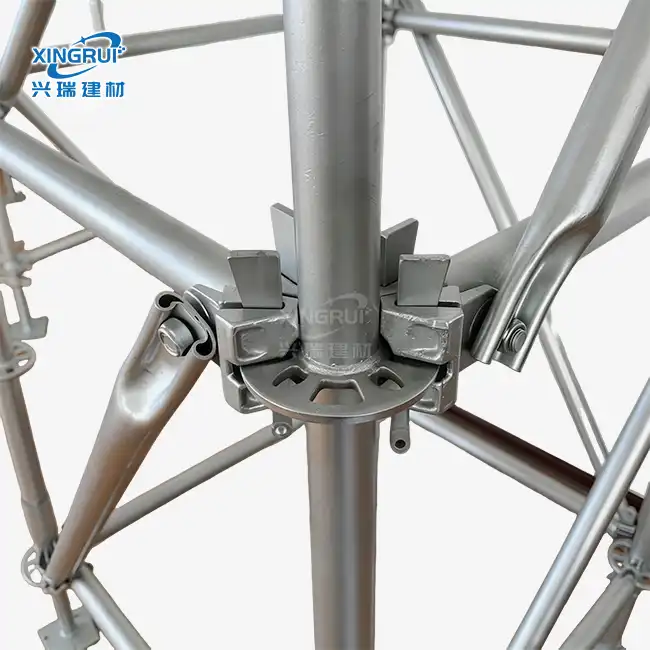
The rosette ringlock scaffolding system is based on a circle connection disk, also known as a rosette or daisy plate, that is welded onto vertical standards every 500 mm. There are eight connection places on each disk. Four smaller holes take horizontal ledgers at 90° angles, and four bigger holes take diagonal braces at different angles.
Every connection is held in place by a wedge-head locking mechanism, so there are no bolts or loose nuts. This self-locking, gravity-assisted design gets rid of the component scatter that happens with tube-and-clamp systems and cuts the time it takes to set up complex structures by a huge amount.
This system is made by GREEN FORMWORK out of premium steel Q235B/Q355B. The pipe diameter can be 48.3mm or 60mm, and the wall thickness can be between 3.0mm and 3.25mm. The hot-dip galvanization (HDG) finish gives the metal a zinc coating that is 65–80 microns thick. It has been tried in harsh marine and industrial settings and has been shown to last more than 15 years.
How the Cuplock System Works
Cuplock scaffolding has a vertical standard with built-in cups that are 500 mm apart. A bottom cup is fixed to the standard, and a top cup slides down to lock several horizontal ledger blades at once. One hammer blow is all it takes to secure the cups. This system is simple, strong, and easy for workers all over the world to understand. Cuplock is great at making rectangular building envelopes, slab shoring, and stairs towers where the shape stays straight and the same throughout the job.
Comparative Analysis — Rosette Ringlock vs Cuplock
Both systems have 500 mm between nodes and use similar grades of steel, but their performance profiles become very different after that. The following table shows the most important differences for a buying manager looking at investments in rental properties, with rosette ringlock scaffolding representing a key variant that demands closer attention due to its distinct connection design and load‑bearing characteristics.
| Criterion | Rosette Ringlock | Cuplock |
|---|---|---|
| Connection angles | 360° adjustable angle | 4 set directions |
| Geometric adaptability | Round, uneven, and curved | Straight lines only |
| Bolt/nut requirement | None (wedge-lock) | None (cup-lock) |
| Component variety | Higher | Lower |
| HDG coating standard | 65–80 microns | 45 to 55 microns is the norm |
| EN 12810/12811 compliance | Yes | Yes |
| Preferred application | Industrial, marine, and bridge | Building facade, slab shoring |
On straight runs, the two systems can put things together at about the same speed. When the building isn't a straight line, the gap gets bigger. If the facades, tank surrounds, or bridge piers are curved or tapered, the cuplock crew will have to spend a lot of time cutting, adapting, or giving up on the system altogether. A rosette ringlock scaffolding crew only needs to choose the right ledger angle from the disk shape that is available.
A lifetime view is needed to compare costs. At the same steel grades, cuplock parts cost a little less per lot. Over a 10- to 15-year rental asset pool, however, the HDG advantage of the ringlock system (65+ microns vs. the industry standard 45–55 microns on cuplock) lowers corrosion-related write-offs and insurance exposure, especially for rental fleets that work along the coasts of northern Europe.
Which Scaffolding System Fits Your Project Needs?
Project type is the primary filter. Here are the core application profiles that guide the selection decision:
- Petrochemical and industrial maintenance demands the rosette ringlock scaffolding system. Standard orthogonal scaffolding can't go around the bent edges of tank farms, refinery boilers, and heat exchanges. The eight-hole rosette disk lets the workers wrap cylindrical structures over and over again, making sure that every node can hold its own weight.
- Civil infrastructure and bridge shoring relies on the axial load capacity of the ringlock system. Dead loads build up quickly during the casting of a concrete bridge deck. The wedge-locked node spreads these loads across multiple link angles at the same time, which gives the needed geometric support for shoring calculations.
- Offshore and shipbuilding environments expose scaffolding to salt spray, vibration, and rapid assembly cycles. The 65–80 micron HDG coating on the ringlock system protects it from corrosion, which means that the asset can still be used after being sent offshore many times. When there is constant shaking, keeper-pin wedges don't move.
- Building facade and slab shoring remains the natural domain of cuplock. Repeated floor-to-floor heights, rectangular column grids, and simple horizontal deck shoring all contribute to cuplock's ease of use and the large amount of crew familiarity that cuts down on training costs for large residential or commercial projects.
These profiles reflect real operational data. Rental companies that handle mixed asset pools usually keep rosette ringlock scaffolding on hand as their main method for industrial and infrastructure clients, and cuplocks on hand for normal building work. This dual-pool approach gets the most use from a wide range of clients.
Sourcing Rosette Ringlock and Cuplock Scaffolding — Best Practices for B2B Buyers
Rental asset ROI is protected by disciplined procurement. Finding a certified rosette ringlock scaffolding supplier should be done in a structured way: get EN 12810/12811 test reports and material certifications before taking samples; check the sizes of delivered samples using go/no-go gages on wedge heads and rosette holes; and confirm the zinc coating thickness using a magnetic induction gage.
Factory-direct sourcing from a manufacturer with ISO 9001, ISO 14001, and ISO 45001 certifications makes the supply chain less opaque and meets ESG audit requirements. A 79,800-square-meter building in Rizhao, Shandong Province, is home to Shandong Xingrui Building Materials Co., Ltd. It has 12 welding robots and 6 automatic welding lines. From the arriving steel coil to the finished part, the facility keeps full material traceability. This meets the audit requirements of European rental groups and insurance companies.
You should negotiate tiered prices based on annual volume promises instead of order quantities. This method lowers the actual landed cost per part while still letting you choose when to send the goods. Check the container packing density before agreeing to the terms. The optimal stacking of ringlock standards and ledgers lowers the cost of sea freight by a unit, which has a big impact on the total cost of acquisition for transatlantic shipping.
Maintenance and Safety Guidelines for Optimal Scaffolding Performance
Post-deployment review is required and is the main way to protect the value of rental assets, especially for rosette ringlock scaffolding, whose unique connection points and wear patterns demand more thorough inspection than standard systems. Before going back to the renting pool, parts should pass an organized review at the end of each project cycle.
Inspection priorities include checking vertical standards for bow or twist greater than 0.2%, checking rosette disks for deformation or weld cracking at the disc-to-pipe interface, and making sure wedge heads keep their full geometry without bulging at the strike face. Wedges that are bent or deformed should not be used again; a compromised wedge makes the joint behave in an unpredictable way when it is loaded.
Storage protocol is important for HDG's longevity. Point loads that can damage the zinc layer at contact zones can't happen when standards are stacked horizontally on wooden bearers. In a humid building, the risk of galvanic micro-corrosion is lower when bare carbon steel parts don't come into long touch with galvanizing surfaces. The rosette ringlock scaffolding longevity depends on these strict maintenance protocols.
Conclusion
Rosette ringlock scaffolding is the better asset for rental fleets that work in the infrastructure, offshore, and industrial markets. Because it can be shaped in many different ways, it has a service life of 15 years or more under HDG protection, and the bolt-free wedge-lock unit meets practical needs that traditional cuplock systems can't.
Cuplock is still a good, low-cost way to do routine building work. The most stable rental businesses have both of these things. Choosing the right manufacturer—one that keeps a steady supply of parts, keeps records of compliance, and helps with sample verification—is what determines whether either system gives the expected return on investment over its entire operational life.
FAQ
Can rosette ringlock and cuplock components be used together on the same structure?
It's not a good idea to put the two systems together on the same structure unless an experienced engineer specifically approves the interface. Both methods usually use 48.3mm pipe standards, but the cup sizes, rosette disk thickness, and wedge-head shape can't be switched. Dimensional incompatibility at mixed nodes leads to unpredictable load paths and possible failures to meet the requirements of EN 12810/12811.
What service life should a rental fleet expect from HDG ringlock components?
Hot-dip galvanization adds a zinc layer of 65–80 microns, which means that rosette ringlock scaffolding parts should last 15 years or more in normal European outdoor rental cycles. Pre-galvanized parts have a layer of about 10–20 microns thick, and they break down much more quickly when they are handled over and over or stored outside.
How does wedge-lock performance hold up in high-vibration industrial environments?
Certified ringlock systems have wedge heads with a keeper-pin feature that keeps the heads from coming loose even when the system is vibrating continuously. Because of this, the system can be used on offshore platforms and in refineries where structural vibration is a normal part of life and not just when there is a load event.
What kind of dimensional range should buying teams check when they test samples?
A go/no-go gage test of the rosette hole diameter and wedge-head width shows that the fitting is perfect. Along their whole length, standards should stay straight within a 0.2% error range. Any change above this level impacts the load distribution at the node and the plumb line in multi-lift structures.
Partner with GREEN FORMWORK for Your Next Scaffolding Procurement
GREEN FORMWORK, which is backed by Shandong Xingrui Building Materials Co., Ltd., sells approved rosette ringlock scaffolding to builders and rental fleets in more than 100 countries. Our production is approved by ISO 9001, ISO 14001, and ISO 45001, and we have a 65+ micron HDG coating and full material traceability that meet the standards that European buying teams need. If you ask, you can get samples with all the detailed information. You can get a quote or a catalog from our team by emailing sdxingruiqp@126.com or going to sdxingrui.com.
References
1. European Committee for Standardization. EN 12810-1: Facade Scaffolds Made of Prefabricated Components — Part 1: Product Specifications. CEN, 2003.
2. European Committee for Standardization. EN 12811-1: Temporary Works Equipment — Part 1: Scaffolds — Performance Requirements and General Design. CEN, 2003.
3. Standards Australia. AS/NZS 1576.3: Scaffolding — Prefabricated and Tube-and-Coupler Scaffolding. Standards Australia, 2019.
4. Occupational Safety and Health Administration (OSHA). Scaffolding Safety: OSHA 3150. U.S. Department of Labor, 2002.
5. International Organization for Standardization. ISO 1461: Hot Dip Galvanized Coatings on Fabricated Iron and Steel Articles — Specifications and Test Methods. ISO, 2022.
6. Construction Industry Research and Information Association (CIRIA). Scaffold Design and Load Assessment: Good Practice Guide. CIRIA Report C611, 2004.
Learn about our latest products and discounts through SMS or email