- English
- French
- German
- Portuguese
- Spanish
- Russian
- Japanese
- Korean
- Arabic
- Greek
- German
- Turkish
- Italian
- Danish
- Romanian
- Indonesian
- Czech
- Afrikaans
- Swedish
- Polish
- Basque
- Catalan
- Esperanto
- Hindi
- Lao
- Albanian
- Amharic
- Armenian
- Azerbaijani
- Belarusian
- Bengali
- Bosnian
- Bulgarian
- Cebuano
- Chichewa
- Corsican
- Croatian
- Dutch
- Estonian
- Filipino
- Finnish
- Frisian
- Galician
- Georgian
- Gujarati
- Haitian
- Hausa
- Hawaiian
- Hebrew
- Hmong
- Hungarian
- Icelandic
- Igbo
- Javanese
- Kannada
- Kazakh
- Khmer
- Kurdish
- Kyrgyz
- Latin
- Latvian
- Lithuanian
- Luxembou..
- Macedonian
- Malagasy
- Malay
- Malayalam
- Maltese
- Maori
- Marathi
- Mongolian
- Burmese
- Nepali
- Norwegian
- Pashto
- Persian
- Punjabi
- Serbian
- Sesotho
- Sinhala
- Slovak
- Slovenian
- Somali
- Samoan
- Scots Gaelic
- Shona
- Sindhi
- Sundanese
- Swahili
- Tajik
- Tamil
- Telugu
- Thai
- Ukrainian
- Urdu
- Uzbek
- Vietnamese
- Welsh
- Xhosa
- Yiddish
- Yoruba
- Zulu
Crab System Scaffolding vs Ringlock: Which Is Best for Your Site?
When your site needs heavy support for tunnels, bridges, or high formwork, crab system scaffolding is the best choice. Ringlock scaffolding works better for standard access layouts and setting up over and over again. Since they both use a disc-and-wedge connection, there isn't a clear winner. With the right bracing, our 60-series crab system scaffolding can hold up to 200 kN per tower and is made of Q235 steel with a 3.2 mm wall. Before you make a choice, you should look at different load tables, bracing needs, and documents. This article tells you how.
What Is Crab System Scaffolding?
I'll start with the system I know best and let you decide how it stacks up against ringlock.
Design and Connection Principle
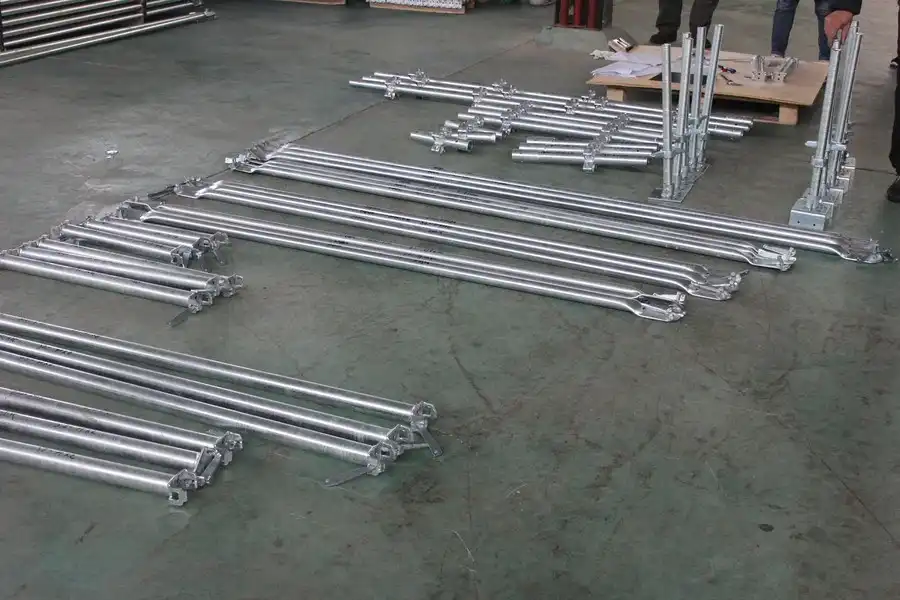
This is a modular, multi-directional support system called crab system scaffolding. There are eight-hole welded disks on each vertical standard. Through wedge-lock pins, cross bars, diagonal bars, and tie bars connect to those holes. This lets the structure branch out in eight different directions. There is no need for loose fittings because the wedge stays in place with the help of gravity. Parts also line up by themselves, which means that crews don't have to make as many mistakes when putting things together. It is made from Q235 steel by Shandong Xingrui Building Materials Co., Ltd. It's not just for access work; it's also made for heavy shoring.
Technical Specifications at a Glance
Most of the time, buyers first ask for numbers. Here are the most important facts about our 60-series.
| Parameter | Specification |
|---|---|
| Material | Q235 carbon steel |
| Standard diameter | 60 mm |
| Wall thickness | 3.2 mm |
| Connection | Eight-hole disc with wedge-lock pins |
| Connection directions | 8-way |
| Surface treatment | Hot-dip galvanizing (ISO 1461), 60–80 μm zinc |
| Load capacity | Up to 200 kN per tower, with proper bracing |
| Standards | ISO 9001, ISO 14001, ISO 45001, EN 12810/12811 |
These numbers give your engineer a place to start. Ask for a calculation report that fits your layout because the final capacity is still based on the height, bracing, and approved layout.
Where It Performs Best
Crab system scaffolding may be utilized for tunnels, bridges, huge and medium-sized constructions requiring substantial formwork support, etc. 60 mm standards are good since they can support big vertical loads like cast in situ concrete beams. Strong-duty screw jacks and U-head foundation jacks make it easy to get the site ready and level the structure on uneven terrain. The steel pieces are used for numerous purposes. We manufacture the system on order according to your plans or samples. With the use of hot-dip galvanizing, it can survive 15 years. It also costs less to reuse for every project.
What Is Ringlock Scaffolding?
Most buyers compare systems to Ringlock, so it's worth taking a close look.
How Ringlock Works
For ringlock scaffolding, vertical standards with rosettes welded at set distances are used. Horizontal ledgers end in wedge heads that fit into the holes in the rosette. Each wedge is then tapped tight with a hammer. A normal rosette has eight holes in it, which lets ledgers and diagonal braces connect in different ways. By doing this, a modular structure is made that is easy for crews to put together once they know the pattern. A lot of crews already know how to do it. Ringlock is a disc-type system, which means it is related to crab system scaffolding because they both use the same basic locking idea.
Common Uses and Strengths
Contractors create commercial buildings, factories, roads, infrastructure, and event structures using Ringlock. Rental firms and distributors can stock and create new parts easily due to its recognizable part layouts. Add-ons including stair towers, platforms as well guardrails, and toe boards meet most access demands. Workers complete quicker using standard layouts, which function well across jobs. Engineers may prepare and compare Ringlock setups to load tables for heavy-duty platforms. Since Shandong Xingrui produces ringlock scaffolding, we can compare them impartially.
What to Verify Before Buying
Not all ringlock products are the same. Before you place an order, make sure you know the rosette spacing, steel grade, wall thickness, and component tolerances. Get load tables and installation guides from the supplier. When you buy accessories, make sure they fit the parts you already have. Parts from different brands may be slightly different, which can change how they fit and how they behave when they are loaded. In the US, OSHA says that scaffolds must be able to hold their own weight plus at least four times the maximum load they were designed to hold. That rule and ANSI/ASSP A10.8 should be checked by your engineer on every system.
Crab System Scaffolding vs Ringlock: Key Differences
The two systems look the same, so the details are what make them different.
Connection and Geometry
A disc-and-wedge connection is used by both systems. For our crab system scaffolding, we use a 60 mm standard with a disk that has eight holes and wedge-lock pins. Most ringlock standards are 48.3 mm in diameter, but sizes vary from brand to brand. When it comes to shoring, a bigger standard usually means more vertical capacity per leg. Both systems can handle angled layouts, curved plans, and irregular structures thanks to their eight connection directions. Check the node sizes and tolerances against the drawings at all times, as small gaps in the connection can change how the structure moves when it's loaded.
Load Behavior and Standards
With the right bracing, our 60-series can hold up to 200 kN per tower. That number isn't the same for every layout because it depends on the height of the towers, the pattern of the braces, and the conditions of the base. When engineers design and brace it right, Ringlock can also carry heavy loads. The falsework standard EN 12812 is often used by engineers for shoring and high formwork support. The general scaffold performance standard EN 12811-1 is used for everything else. In the US, OSHA rules say that scaffolds must be checked by a qualified person before every work shift. You can ask any supplier for a calculation report that fits your exact setup.
Side-by-Side Comparison
Here is a table that shows how our 60-series and a normal ringlock setup stack up.
| Feature | Crab System (60-Series) | Typical Ringlock |
|---|---|---|
| Main focus | Heavy shoring, high formwork support | Access platforms, general support |
| Standard diameter | 60 mm | Commonly 48.3 mm |
| Connection | Eight-hole disc, wedge-lock pins | Rosette, wedge-head ledgers |
| Customization | Made to order from drawings | Varies by supplier |
| Mixing parts | Verify with an engineer | Verify with an engineer |
Start with this table and check each line against the drawings from your supplier.
Crab System Scaffolding vs Ringlock: Cost and Operational Considerations
Take a look at the big picture instead of just the price per ton.
Look at Total System Cost
You might be fooled by a low price per ton. Count all of the parts that can be used, such as the standards, ledgers, braces, jacks, platforms, guardrails, stairs, packaging, freight, and spare parts. Then, divide that amount by the total number of jobs the steel will do. Our hot-dip galvanized coating of 60–80 μm meets ISO 1461 standards and has a service life of up to 15 years. The parts can be used again and again. Distributors and rental companies should also think about how consistent each batch is, since different quality levels make it more expensive to fix and sort things.
Labor and Erection Speed
The cost of any scaffold job goes up with the number of hours of work. Because crews don't have to tighten loose clamps and bolts, our crab system scaffolding can be put up about 50% faster than tube-and-clamp methods. Even with short training on wedge locking and load paths, speed still depends on how well the crew is trained, how easy it is to get to the site, and how often the layout is done. Ringlock crews may already know how to do their job well, so they may not need as much training to do the same work over and over again. Instead of trusting a general claim, compare how long it takes to set up, take down, and inspect your own layout.
Logistics and Supply Capacity
Landed cost depends on weight, packing, and container capacity. Our site ships items to other nations via Rizhao's airport, seaport, and high-speed rail hub. Crab system scaffolding is one of our core products. Our 79,800-square-meter factory features 12 welding robots, 6 mechanized welding lines, and over 40,000-square-meter workshops. Over 100 nations and regions get our products. When getting quotations for US projects, inquire about the amount of containers, how they will be packaged, shipping conditions, and delivery date. This lets you compare all offers.
Which System Is Best for Your Site?
This is the step-by-step way I would make the call.
Match the System to Site Conditions
Pick the crab system scaffolding for jobs that need strong supports, tall formwork, or complicated shapes, like tunnels and bridge piers. If you want parts that can fit a lot of different accessories, or if layouts and platforms are the same, choose ringlock. The answer depends on the working height, the load on the platform, the condition of the ground, the skill of the crew, and the rules in the area. There needs to be a different way to do some jobs, like suspended or mobile work. No matter the system, if a supplier can't show you verified load data and installation guides, you should find another one.
Documents to Request Before Ordering
Request load tables, conjunction test results, erection instructions, product drawings, dimensions and form of the parts. If your project requires them, ask for the standard ISO 9001, ISO 14001 and ISO 45001 certifications and CE documentation. Check minimum order quantity, lead times, packing, warranty conditions, and spare parts plans. GREEN FORMWORK’s staff can assist you with technical challenges and works in your samples or designs. If you submit us your layout we will review it with you beforehand you make your purchase.
Test Before You Commit
No need to guess with sample orders, trial assemblies or load checks. Your engineer and site administrator may review samples and seek technical support before placing a large order to ensure that fit, finish and node accuracy are correct. You may timing the group, check an bracing, and during the trial verify whether it works with various jacks and platforms. At our factory, all repeat orders are identical because of thorough quality control and complete traceability. Then compare bids side by side based on the identical bill of materials, shipping conditions and delivery dates.
Conclusion
The sole difference with ringlock and crab system scaffolding is the name. Choose the proper name for your project. The 60-series crab system superstructure is built of Q235 steel with a 60 mm standard, 3.2 mm wall, and eight-hole disk. It can support 200 kN per tower with proper bracing. This profile supports high forms, tunnels, bridges, and heavy shoring. Ringlock supports common access layouts, rental fleets, and repeated erection. Ton price is not the sole factor affecting overall cost. Logistics, galvanizing, reuse, and labor time are important. Certificates, load data, calculations reports, and erection guides should support any option. To ensure fit, a sample or trial assembly should be done before ordering.
FAQ
Is crab system scaffolding stronger than ringlock?
Neither wins just because they are named. Strength depends on the type of steel, the thickness of the walls, the design of the nodes, the bracing, and the approved layout. With the right bracing, our 60-series can hold up to 200 kN per tower.
Can I mix crab and ringlock components?
Not until engineering checks are made. Different brands and systems have different sizes, tolerances, and wedge shapes. Get a qualified engineer to sign off on any mixed setup.
Can the system stand on uneven ground?
Yes. Heavy-duty screw jacks and U-head base jacks level the building on uneven ground and speed up the preparation time on the job site.
Do you supply samples?
Yes. We give you samples and technical help, and we make products based on your drawings when you place an order.
What certifications apply?
Our operations follow the rules set by ISO 9001, ISO 14001, and ISO 45001, and our goods are approved by the European Union (CE). If the project is in the US, your engineer should still check the setup against ANSI/ASSP A10.8 and OSHA rules.
Request a Crab System Scaffolding Quote from GREEN FORMWORK
You are about to start your next project and want to compare crab system scaffolding and ringlock. GREEN FORMWORK, which is backed by Shandong Xingrui Building Materials Co., Ltd., makes crab system scaffolding and offers samples, technical help, and sizes that are made to order. Send your working height, platform load, drawings, quantity, and where you want the goods to go to sdxingruiqp@126.com. For information on the product, go to sdxingrui.com.
References
1. Occupational Safety and Health Administration, Safety and Health Regulations for Construction: Scaffolds (29 CFR 1926 Subpart L), 1996
2. American Society of Safety Professionals, ANSI/ASSP A10.8 Scaffolding Safety Requirements, 2019
3. European Committee for Standardization, EN 12811-1: Temporary Works Equipment – Scaffolds – Performance Requirements and General Design, 2003
4. European Committee for Standardization, EN 12810-1: Façade Scaffolds Made of Prefabricated Components – Product Specifications, 2003
5. European Committee for Standardization, EN 12812: Falsework – Performance Requirements and General Design, 2008
6. International Organization for Standardization, ISO 1461: Hot Dip Galvanized Coatings on Fabricated Iron and Steel Articles – Specifications and Test Methods, 2022
Learn about our latest products and discounts through SMS or email