- English
- French
- German
- Portuguese
- Spanish
- Russian
- Japanese
- Korean
- Arabic
- Greek
- German
- Turkish
- Italian
- Danish
- Romanian
- Indonesian
- Czech
- Afrikaans
- Swedish
- Polish
- Basque
- Catalan
- Esperanto
- Hindi
- Lao
- Albanian
- Amharic
- Armenian
- Azerbaijani
- Belarusian
- Bengali
- Bosnian
- Bulgarian
- Cebuano
- Chichewa
- Corsican
- Croatian
- Dutch
- Estonian
- Filipino
- Finnish
- Frisian
- Galician
- Georgian
- Gujarati
- Haitian
- Hausa
- Hawaiian
- Hebrew
- Hmong
- Hungarian
- Icelandic
- Igbo
- Javanese
- Kannada
- Kazakh
- Khmer
- Kurdish
- Kyrgyz
- Latin
- Latvian
- Lithuanian
- Luxembou..
- Macedonian
- Malagasy
- Malay
- Malayalam
- Maltese
- Maori
- Marathi
- Mongolian
- Burmese
- Nepali
- Norwegian
- Pashto
- Persian
- Punjabi
- Serbian
- Sesotho
- Sinhala
- Slovak
- Slovenian
- Somali
- Samoan
- Scots Gaelic
- Shona
- Sindhi
- Sundanese
- Swahili
- Tajik
- Tamil
- Telugu
- Thai
- Ukrainian
- Urdu
- Uzbek
- Vietnamese
- Welsh
- Xhosa
- Yiddish
- Yoruba
- Zulu
Crab Type Steel Tube Scaffolding vs Frame Systems: Key Differences
When comparing Crab Type Steel Tube Scaffolding to traditional frame systems, the differences go well beyond aesthetics. Crab-type systems use a wedge-lock socket mechanism that delivers superior torsional rigidity, load capacity up to 50kN per post, and erection speeds roughly 3–5 times faster than conventional coupler methods. Frame systems, by contrast, rely on pre-welded rectangular frames that excel in straightforward, low-rise tasks but struggle under complex geometry or heavy shoring demands. Understanding these distinctions shapes smarter procurement decisions—especially for rental fleets, industrial projects, and large-span formwork support where structural redundancy and long service life matter most.
Understanding Crab-Type and Frame Scaffolding Systems
Scaffolding isn't a tool that works for everything. Modular tube-and-socket scaffolding (the crab-type) and welded frame scaffolding are the two main types of systems on the global market today. Each has its own engineering philosophy, set of rules to follow, and operational footprint.
What Is Crab-Type Scaffolding?
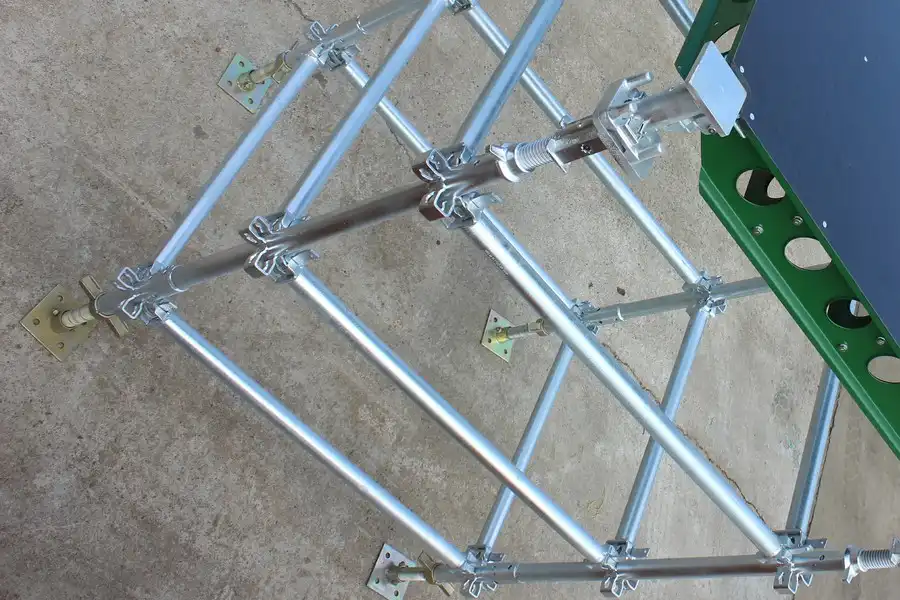
The name "Crab Type Steel Tube Scaffolding" comes from the claw holes that are welded at set intervals along each vertical standard. They can be used in more than one way. These holes can hold up to four members per node of horizontal ledgers and diagonal braces at the same time, with a hammer-driven wedge locking them in place. By its very nature, the shape is fixed and three-dimensional. The outer width of GREEN FORMWORK's 60-series is 60.3 mm, and the wall thickness is uniformly 3.0–3.25 mm. It is made of Q235 quality carbon steel. Hot-dip galvanization at ≥80μm keeps the steel from rusting over long rental periods, which meets the requirements of EN 12810-1 and AS/NZS 1576.
What Is a Frame Scaffolding System?
Frame scaffolding is made up of steel frames that are already welded together in a H or A form and are linked by cross-braces and horizontal rails. It's easy to put together and doesn't take long, so it's popular in home building and light business fit-outs. The welding frame sizes set the widths of the movable bays, which makes it hard to change the shape of the structure. Load capacity per post is usually between 20kN and 35kN, which is enough for lighter facades but not so good for basement shoring or cast-in-place concrete decks.
Core Functional Differences Between the Two Systems
When the job calls for more than a standard facade or a single-story deck, the engineering difference between these systems becomes clear.
In terms of important performance factors, the two systems are different in the following ways:
- Load capacity: The hard socket-and-wedge node in Crab Type Steel Tube Scaffolding lets it handle up to 50kN per post. This is because it spreads force evenly in several directions. Frame systems usually have 20–35kN per post. The strength is limited by how well the pre-fabricated frame is welded and the pin connections at the ends of the cross-braces.
- Geometric flexibility: The crab node can handle spans and angles that fixed-width frames just can't handle. This is very important for basement formwork, big industrial sheds, or stage platforms with uneven areas.
- Erection speed: Hammer-and-wedge assembly doesn't need power tools and a trained two-person crew can erect three to five times more bay area per shift than with tube-and-coupler methods. Frame systems work just as quickly on repeated bays but much more slowly when non-standard shape shows up.
- Lateral stability: Two-way diagonal tie bars on Crab Type Steel Tube Scaffolding standards stop racking caused by wind and swaying caused by earthquakes. Calculable horizontal resistance is required by both OSHA 1926.452 and European EN 12811-1. Crab-type shape meets this standard with built-in redundancy.
These small technical differences are very important for procurement managers who have to balance business output with safety compliance. Both incident risk and idle equipment time can be cut down with the right system.
Performance, Cost, and Maintenance: What Procurement Managers Should Know
Total cost of ownership, not price, is what makes sense when choosing an asset. A Crab Type Steel Tube Scaffolding costs more per unit at first than a basic frame set, but the numbers change when you rent it for several years.
Durability and Surface Integrity
Hot-dip galvanization at ≥80μm, which is what GREEN FORMWORK's crab-type tubes are made of, is much more resistant to salt spray, acidic concrete wash, and UV degradation than paint or light zinc coatings. Before the product ships, ISO 9227 salt spray testing makes sure that the covering is still intact. If you take care of it, it will last longer than 15 years, which means that the initial cost will be spread out over many loan rounds.
Inspection and Spare Parts
To make sure the quality of Crab Type Steel Tube Scaffolding, the carbon and manganese ratios are checked using spectral analysis of raw steel, socket welds are inspected with ultrasonic or MPI technology, dimensions are checked within ±0.5mm, and nodes are compressed to their rated capacity. With ISO 9001, ISO 14001, and ISO 45001 certifications to back it up, this traceability gives safety experts written proof for government checks. Frame systems don't have a way to track down individual nodes, so when a single welding frame fails inspection, the whole set has to be replaced.
Customization and Inventory Management
GREEN FORMWORK makes things to order and will accept drawings and samples from the customer. Rental companies that have a mix of their own trusses, stage decks, and third-party tools can use tube sizes and bay lengths that are set to work with their current system. This keeps expensive collections of adapters that don't work together from building up and making warehouse management harder over time.
How to Select the Right Scaffolding System for Your Project
There are four useful criteria that can be used to choose between these two systems:
- Project load profile: Any shoring job that needs more than 35kN per post or any concrete deck with a long span is a clear sign of Crab Type Steel Tube Scaffolding shape.
- Site geometry: Socket-based systems work best in areas with irregular shapes, bent plans, or basements with more than one level.
- Regulatory environment: Projects that need to follow EN 12810-1, EN 12811-1, or OSHA must have documented load calculations per node. Engineered Crab Type Steel Tube Scaffolding geometry makes this easier to do than welded frames.
- Rental cycle length: The galvanized Crab Type Steel Tube Scaffolding investment is worth it for assets that will be rented out over and over for 10 years or more. Frame methods may pay for themselves faster in short-term, low-rise projects.
Reliability of the vendor is also part of this estimate. GREEN FORMWORK ships to more than 100 countries from Rizhao, Shandong, a port city with direct sea, air, and high-speed rail access. They offer full container load optimization and guaranteed delivery schedules that protect rental calendars during busy season [⁺].
Real-World Applications and Validated Performance
In bridge viaduct shoring, where single-post loads from cast-in-place concrete box girders often exceed 40kN, Crab Type Steel Tube Scaffolding has been shown to be useful. The modularity of the system makes it easy to quickly and safely wrap complicated boiler shapes during industrial plant turnarounds at power plants and refineries. The clean galvanized finish, predictable geometry, and quick strip-and-reload cycle of this system make it a useful backbone for stage decks, portable grandstands, and show support towers in the event rental industry.
Frame scaffolding is still a reliable choice for home building, interior fit-outs, and any other project with even bay lengths and modest load demands. The truth is that neither system is clearly better than the other. What counts is how well the system's designed features work with the conditions on the spot.
Conclusion
Crab Type Steel Tube Scaffolding can hold more weight, be shaped in different ways, and resist corrosion for a longer time than traditional frame systems. The per-cycle depreciation strongly favors the Crab Type Steel Tube Scaffolding method for procurement managers looking for long-term rental assets or heavy-duty shoring solutions when projects have long spans, strict safety checks, or asset lifecycles that last more than one year. In lighter, more repetitive tasks, frame systems still have a place. Instead of going with the cheapest unit price, the best choice for both project safety and capital investment is to match the system to the actual engineering demand.
FAQ
What is the load capacity difference between crab-type and frame scaffolding?
Through the stiff socket-and-wedge node, Crab Type Steel Tube Scaffolding can handle up to 50kN per vertical post. Standard frame scaffolding can hold 20–35kN per post, but this depends on the quality of the frame weld and the way the cross-braces are set up.
Does crab-type scaffolding require specialized installation tools?
For the hammer-and-wedge method, all you need is a regular scaffolding hammer. This keeps the number of tools needed to a minimum and speeds up the setting up process on tight job sites.
How long does a galvanized crab-type system last?
A well-kept system will last more than 15 years with hot-dip galvanization at ≥80μm and regular inspections. This makes it perfect for rental fleets that use equipment many times a year.
Is crab-type scaffolding CE compliant?
The goods made by GREEN FORMWORK are CE-certified and meet the standards EN 12810-1 and EN 12811-1. This means they are safe to use for both building and events in Europe.
Can custom dimensions be ordered to match existing inventory?
Yes, GREEN FORMWORK makes custom orders based on client drawings or samples. This lets rental companies match up new stock with the sizes of their existing trusses and stage decks.
Get a Custom Quote from GREEN FORMWORK Today
Certified Crab Type Steel Tube Scaffolding from GREEN FORMWORK is made from Q235 quality steel and meets EN 12810-1 standards. It is also backed by ISO 9001, ISO 14001, and ISO 45001. If you need a set of matched scaffolding tubes for a rental fleet or a way to support a large span, our team can help. We offer samples, technical drawings, and full container load planning. To get prices and specs, email our Crab Type Steel Tube Scaffolding source team at sdxingruiqp@126.com.
References
1. British Standards Institution. EN 12810-1: Façade Scaffolding Made of Prefabricated Components — Part 1: Product Specifications. BSI, 2003.
2. Occupational Safety and Health Administration. Scaffolding: OSHA Standards 1926.450–1926.452. U.S. Department of Labor, 2023.
3. European Committee for Standardization. EN 12811-1: Temporary Works Equipment — Part 1: Scaffolds — Performance Requirements and General Design. CEN, 2003.
4. International Organization for Standardization. ISO 9227: Corrosion Tests in Artificial Atmospheres — Salt Spray Tests. ISO, 2022.
5. Shandong Xingrui Building Materials Co., Ltd. Company Profile and Export Capabilities. GREEN FORMWORK, 2024.
6. Standards Australia / Standards New Zealand. AS/NZS 1576: Scaffolding — General Requirements. SAI Global, 2010.
Learn about our latest products and discounts through SMS or email