- English
- French
- German
- Portuguese
- Spanish
- Russian
- Japanese
- Korean
- Arabic
- Greek
- German
- Turkish
- Italian
- Danish
- Romanian
- Indonesian
- Czech
- Afrikaans
- Swedish
- Polish
- Basque
- Catalan
- Esperanto
- Hindi
- Lao
- Albanian
- Amharic
- Armenian
- Azerbaijani
- Belarusian
- Bengali
- Bosnian
- Bulgarian
- Cebuano
- Chichewa
- Corsican
- Croatian
- Dutch
- Estonian
- Filipino
- Finnish
- Frisian
- Galician
- Georgian
- Gujarati
- Haitian
- Hausa
- Hawaiian
- Hebrew
- Hmong
- Hungarian
- Icelandic
- Igbo
- Javanese
- Kannada
- Kazakh
- Khmer
- Kurdish
- Kyrgyz
- Latin
- Latvian
- Lithuanian
- Luxembou..
- Macedonian
- Malagasy
- Malay
- Malayalam
- Maltese
- Maori
- Marathi
- Mongolian
- Burmese
- Nepali
- Norwegian
- Pashto
- Persian
- Punjabi
- Serbian
- Sesotho
- Sinhala
- Slovak
- Slovenian
- Somali
- Samoan
- Scots Gaelic
- Shona
- Sindhi
- Sundanese
- Swahili
- Tajik
- Tamil
- Telugu
- Thai
- Ukrainian
- Urdu
- Uzbek
- Vietnamese
- Welsh
- Xhosa
- Yiddish
- Yoruba
- Zulu
H-Type Scaffolding Uses: Platforms, Towers, and Structural Work
H-Type scaffolding serves as a dependable modular access solution across platforms, tower configurations, and load-bearing structural applications. Built around rigid H-shaped vertical frames, this system distributes stress symmetrically, making it particularly effective for masonry restoration, indoor construction, and confined worksites where conventional systems cannot operate efficiently. At GREEN FORMWORK, we manufacture H-Type scaffolding from Q235 premium steel, engineered to meet EN 12810 and BS 1139 standards. Whether you are a specialty contractor managing a heritage facade or a distributor sourcing seasonal inventory, this guide covers everything you need to make a confident procurement decision.
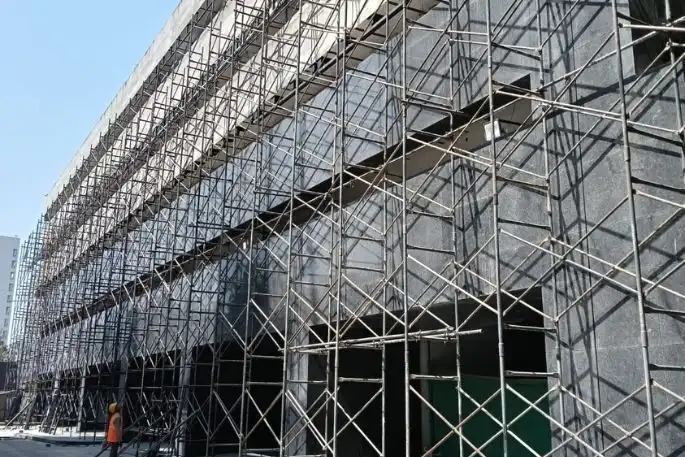
Understanding H-Type Scaffolding – Structure, Materials, and Specifications
What Makes the H-Frame Geometry Work?
The typical H-shaped portal unit is made up of two vertical steel tubes connected by several horizontal members. This shape is not for looks; it is for structure. The symmetrical design spreads vertical loads evenly across both uprights, which gets rid of the stress clusters that make single-upright systems fail when pressure is put on the side. With a standard frame width of 1219 mm, the design allows for both people and materials to move through at the same time, which is very helpful in renovation settings where space is limited.
Materials, Coatings, and Dimensional Standards
Each frame is made by GREEN FORMWORK out of high-quality carbon steel Q235. The tube diameters are 42 mm or 48 mm, and the wall thicknesses are between 1.8 mm and 3.5 mm. Hot-dip galvanization (HDG) creates a coating that is at least 60–80 microns thick. This coating protects against corrosion and lasts for 10–15 years in normal site conditions. Each frame is tested for load to make sure it meets EN 12810 and BS 1139 standards. Its load-bearing ability is confirmed to be up to 40% higher than that of regular door-frame scaffolds. Certifications like ISO 9001, ISO 14001, and ISO 45001 are all in line with quality management. H-Type Scaffolding from GREEN FORMWORK combines Q235 steel with 60–80μm HDG coating and EN-tested load capacity, delivering 40% higher strength than standard door-frame scaffolds with full ISO certification.
The following table lists the most important details:
| Parameter | Specification |
|---|---|
| Material | Q235 premium carbon steel |
| Frame Width | 1219 mm |
| Tube Diameter | 42 mm / 48 mm |
| Wall Thickness | 1.8 mm – 3.5 mm |
| Surface Treatment | HDG / Powder coating |
| Compliance | EN 12810, BS 1139, CE, ISO 9001 |
| Lifespan (HDG) | 10–15 years |
Diverse Applications of H-Type Scaffolding in Platforms, Towers, and Structural Work
Masonry scaffolding frames can be used for a lot of different tasks, not just getting to the front of a building. Three main rollout situations show why procurement workers in North America and Europe always choose this system.
Working Platforms for Masonry and Restoration
Fixing up an old building requires tools that can fit through cobblestone streets and doors from many years ago without the help of a crane. The H-frame's small footprint and manageable unit weight make it possible for craftsmen to move, carry, and put together platforms by hand. Height-variable platform configurations can adapt to buildings that didn't have level floors right away, so people don't have to make do with unsafe and inefficient workarounds.
Tower Configurations for Mid-Rise Access
When a project needs constant access to high places on several stories, H-frames can be stacked in a flexible way to make safe scaffold towers. The H-geometry's symmetric stress distribution stops racking forces that build up at height, which is especially important for facades that are open to wind loads. Follow the rules in EN 12810 for tie-ins: there must be structural anchors every 4 meters vertically and every 6 meters horizontally after the base to height ratio reaches 3:1. This strict tie-in routine, along with the frame's hard welds made by our 12 robotic welding stations, makes the tower stable in a way that site managers can check and record. H-Type Scaffolding systems leverage this symmetric geometry and robotic-welded joints to resist wind-induced racking, while EN 12810-compliant tie-in schedules ensure verifiable stability for multi-story facade access.
Structural Support in Formwork and Concrete Operations
H-frames can also be used to support large formwork decks and bridge soffit platforms. Because Q235 steel has a high compression strength, it can handle concentrated point loads from wet concrete without stretching and warping, which would cause form panels to become out of alignment. Both refineries and processing plants can benefit from industrial repair projects. The walk-through clearance keeps access paths open, and vertical support members carry equipment loads above.
Comparing H-Type Scaffolding with Other Scaffolding Systems
Comparing products honestly is more important than promoting a certain brand when choosing the right scaffold system. The four systems that are most often looked at with H-frame scaffolding in business-to-business procurement processes are outlined below.
In terms of how they work in real life, here's how the main options compare to the H-frame:
- Ringlock scaffolding offers 360-degree connector flexibility, making it preferable for geometrically complex structures such as curved facades or multi-directional platforms. However, the component count and assembly time increase noticeably compared to H-frame systems on standard rectangular elevations. For straightforward masonry runs, H-frame reduces labor hours by approximately 60% relative to tube-and-coupler methods.
- Kwikstage scaffolding shares the modular ethos but uses a wedge-lock node that requires mallet assembly. On tight renovation sites where noise or vibration risks damage to historic materials, the push-pin connection of H-frame systems causes less percussive disturbance.
- Tube-and-coupler scaffolding remains the most adaptable system for truly irregular geometries but demands skilled labor and extended erection time. Its lifecycle cost is also higher because coupler threads corrode faster than galvanized welded joints.
These differences make a constant pattern clear: H-frame scaffolding works best in repeated, straight-line tasks where speed of building, portability by hand, and CE compliance are absolute musts. It's easier to move around than ringlock setups and has lower lifetime costs per project cycle than tube-and-coupler systems.
Procurement Guide: Sourcing, Customization, and Supplier Qualification
Evaluating Certified Suppliers
When it comes to buying scaffolding, the main sources of risk are certification of authenticity and support after the shipment. Any reliable supplier will gladly give you three pieces of paper: test certificates with EN 12810 batch data, traceable mill certificates for Q235 steel, and CE marking that can be checked. All three are available from GREEN FORMWORK, along with dimensional inspection records made by our automatic welding lines. H-Type Scaffolding from GREEN FORMWORK comes with these full documentation packages, ensuring EN 12810 compliance and material traceability for hassle-free customs clearance and site audits.
Made-to-Order Flexibility and Small-Batch Friendliness
Specialty builders and area distributors often need non-standard sizes that can't be found in mass-market catalogs. Our made-to-order service can use drawings or physical samples to get custom frame dimensions. This cuts down on the wasteful fit-and-trim work that drives up project costs. Small-batch orders are given the same production priority as volume contracts. This is because we know that loyal customers in the region are good for our business in the long term.
To lower the risk of procurement, it is recommended to ask for a physical sample before placing a full order, to use an electromagnetic gage to confirm the thickness of the hot-dip galvanization when the goods arrive, and to schedule delivery at least six weeks before the busy construction season in order to avoid scheduling conflicts in the spring. Technical help is offered at all times during the project, not just when the product is sold.
Conclusion
H-Type Scaffolding has a clear and logical place in the scaffolding market: it is modular, can be moved by hand, meets CE standards, and is perfect for the small work sites that are common in heritage repair and internal masonry work. Built with Q235 steel, protected by hot-dip galvanizing, and made in an ISO-certified factory, this equipment pays for itself over many project cycles. When procurement workers are looking at different system choices, a trusted seller stands out from a catalog vendor because they offer documented compliance, made-to-order flexibility, and quick technical support.
FAQ
What is the maximum safe working height for an H-frame scaffold?
According to EN 12810 and OSHA guidelines, standard setups need designed tie-ins every 4 meters vertically and every 6 meters horizontally when the height is more than three times the base width. After this point, the design needs to be approved by a qualified engineer.
Can H-frames from different manufacturers be mixed on the same structure?
No. Small differences in where the pins are placed and the diameter of the tube between manufacturers weaken the structure and make the compliance paperwork useless. It is always best to use a single-source method.
How long does a hot-dip galvanized H-frame last?
HDG frames will stay structurally sound for 10 to 15 years if they are stored and handled normally on the job site. An electromagnetic gage can confirm that the coating is 60–80 microns thick, which is a good sign of how long it will last.
What certifications should I require from a supplier?
Check for CE marking, test certificates from EN 12810 or BS 1139, ISO 9001 quality management approval, and mill certificates for the grade of steel. All of these papers are included with GREEN FORMWORK.
Is customization available for non-standard project dimensions?
Yes. Made-to-order production is possible at GREEN FORMWORK based on customer drawings or samples, and there is no minimum order quantity charge for custom sizes.
Partner with GREEN FORMWORK for Your Next H-Type Scaffolding Project
In more than 100 countries, GREEN FORMWORK sends verified H-Type Scaffolding made from Q235 steel. Our 12 robotic welders, 79,800 m² building, and ISO 9001, 14001, and 45001 management systems make sure that the quality of every package is the same. When you buy H-Type Scaffolding from us, you can get samples, full technical support, and the freedom to have your order made just the way you want it for any size project. To get a price right away, email us at sdxingruiqp@126.com.
References
1. European Committee for Standardization. EN 12810-1: Facade Scaffolds Made of Prefabricated Components – Part 1: Product Specifications. CEN, 2003. Referenced in the specifications and compliance section.
2. British Standards Institution. BS 1139-2.1: Metal Scaffolding – Part 2: Couplers – Specification for Steel Couplers. BSI, 2009. Referenced in load compliance discussion.
3. International Organization for Standardization. ISO 9001:2015 Quality Management Systems – Requirements. ISO, 2015. Referenced in supplier qualification and certification section.
4. International Organization for Standardization. ISO 45001:2018 Occupational Health and Safety Management Systems. ISO, 2018. Referenced in safety management discussion.
5. Occupational Safety and Health Administration (OSHA). Scaffolding Standards: 29 CFR 1926 Subpart Q. U.S. Department of Labor, 2019. Referenced in working height and tie-in requirements.
6. Grauvilardell, J.E., et al. Synthesis of Research on High-Strength Steel Connections. University of Minnesota, 2005. Referenced in structural performance characteristics of Q235 steel frames.
Learn about our latest products and discounts through SMS or email