- English
- French
- German
- Portuguese
- Spanish
- Russian
- Japanese
- Korean
- Arabic
- Greek
- German
- Turkish
- Italian
- Danish
- Romanian
- Indonesian
- Czech
- Afrikaans
- Swedish
- Polish
- Basque
- Catalan
- Esperanto
- Hindi
- Lao
- Albanian
- Amharic
- Armenian
- Azerbaijani
- Belarusian
- Bengali
- Bosnian
- Bulgarian
- Cebuano
- Chichewa
- Corsican
- Croatian
- Dutch
- Estonian
- Filipino
- Finnish
- Frisian
- Galician
- Georgian
- Gujarati
- Haitian
- Hausa
- Hawaiian
- Hebrew
- Hmong
- Hungarian
- Icelandic
- Igbo
- Javanese
- Kannada
- Kazakh
- Khmer
- Kurdish
- Kyrgyz
- Latin
- Latvian
- Lithuanian
- Luxembou..
- Macedonian
- Malagasy
- Malay
- Malayalam
- Maltese
- Maori
- Marathi
- Mongolian
- Burmese
- Nepali
- Norwegian
- Pashto
- Persian
- Punjabi
- Serbian
- Sesotho
- Sinhala
- Slovak
- Slovenian
- Somali
- Samoan
- Scots Gaelic
- Shona
- Sindhi
- Sundanese
- Swahili
- Tajik
- Tamil
- Telugu
- Thai
- Ukrainian
- Urdu
- Uzbek
- Vietnamese
- Welsh
- Xhosa
- Yiddish
- Yoruba
- Zulu
Disc Lock Scaffolding Supplier Guide: Quality Checks Before Buying
When sourcing disc lock scaffolding for large-scale construction projects, getting the quality assessment right before signing any purchase order matters more than price alone. This guide walks procurement managers through every critical checkpoint — from steel grade verification to supplier certification audits — so you enter negotiations with clear technical benchmarks. Whether you manage EPC contracts in the Middle East or oversee infrastructure builds across multiple regions, the following checks will protect your budget, your timeline, and your crew on site.
Understanding Disc Lock Scaffolding: Key Components and Functionality
What the System Is Built From?
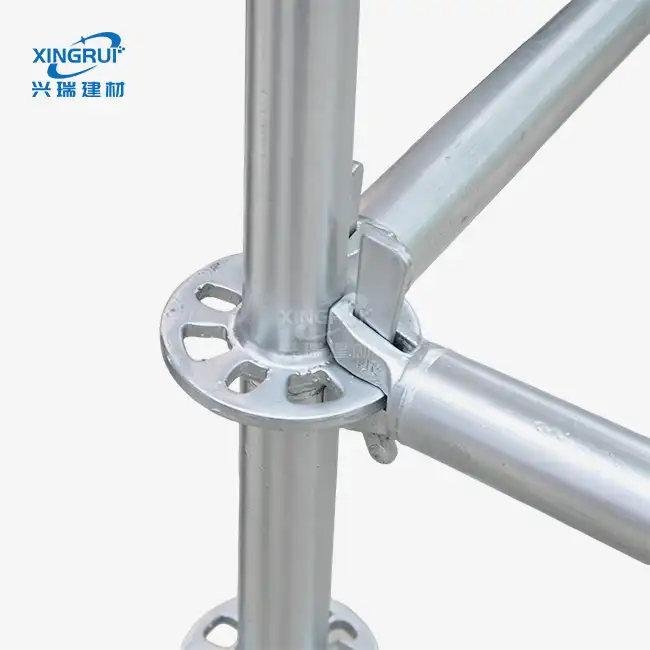
It is made up of vertical standards, horizontal ledgers, diagonal braces, base plates, and, most importantly, stamped rosette disks that are glued to each standard every 500 mm. Each rosette has eight holes that were carefully planned. There are eight holes in the board. Eight of them can be used for diagonal braces and four can be used for 90% ledger ties. You don't need to add any extra gear to set up this shape in any direction around 360 degrees.
How the Wedge-Locking Node Works?
The wedge pin goes through the ledger head and locks into the rosette disk with its own weight. The joint doesn't get looser as the vertical load goes up because gravity helps the link. Instead, it gets tighter. The method is stronger than tube-and-clamp assemblies because it locks itself. With tube-and-clamp assemblies, mistakes in force can weaken the joint.
Compliance and Safety Baselines
A good company makes them and checks that they meet the rules set by EN 12811-1 for temporary works equipment, EN 12810-1 for facade scaffolding, and ANSI/SSFI SC100-5/05 for the North American market. For those who need CE marking, make sure the provider you choose can give you load test results from a third party and a Declaration of Performance (DoP).
Critical Quality Checks Before Buying Disc Lock Scaffolding
Steel Grade and Raw Material Traceability
The performance of disc lock scaffolding depends on the grade of tube material. Carbon steel Q235 must be used for both the light-duty (48.3mm) and heavy-duty (60.3mm) kinds. Ask the steel mill for certificates that list the chemicals that make up the steel and its tensile yield. A reliable provider will be happy to give you paperwork that lets you track each batch.
Coating Thickness and Corrosion Resistance
In the business world, hot-dip galvanization (HDG) is the standard way to keep things from rusting. To find out how thick the coating is, use a magnetic gage. According to ISO 1461, the range you should aim for is 60–80¼m. Parts won't rust for 10 to 15 years at this thickness, even at the beach or in a factory. If the zinc crystals are thin, shiny, or not even, the process wasn't done right, so the batch should be thrown away.
Weld Integrity and Dimensional Tolerance
As per the rules, rosettes that are welded must go all the way through. Ask for Ultrasonic Testing (UT) or Magnetic Particle Inspection (MPI) records to see how well the weld was done. Separately, check that the standards keep the difference in height below 1/500 and that the space between the rosettes stays the same at 500mm all the way through the tube. Any misalignment is worse when it happens on more than one move, which makes it hard to align things on the job site.
Comparing Disc Lock Scaffolding Suppliers: What to Look For
Certification Records and Factory Audits
It talks about how to handle quality in ISO 9001. ISO 45001 is about health and safety at work, and ISO 14001 is about taking care of the environment. If a company has all three, it means they have power over the whole production process. There are European structure performance directives that a product must meet in order to get CE approval. Before you place a big order, ask for the certificates directly and check the dates they were issued. Certificates that have expired or aren't good anymore are a red flag.
Production Capacity and Lead Time Reliability
Power to make things is a key factor that can't be changed for EPC projects with set due dates. Someone with more than 79,800 square meters of room, 12 welding robots, and 6 automatic welding lines can handle big orders all the time. Ask for written proof of how many times in the past big orders were brought on time. Suppliers near ports, like those that can connect to Shandong's Rizhao Port, act as a cushion for logistics, which makes interior freight less volatile.
Customization Capability and OEM Support
There are a lot of EPC contractors and rental companies that need custom tube lengths, brand labels, or markings on parts that are unique to the project for disc lock scaffolding. Check to see if the seller can do unique models in 7–14 days and if they sign Non-Disclosure Agreements (NDAs) to keep node designs secret. If a seller has their own cold roll forming and forging workshops, they don't have to hire outside help to change the sizes of parts. This saves a lot of time.
Businesses that buy things can use these review factors to tell the difference between suppliers who are good at what they do and those who just offer low unit prices. You'll be taking risks later on that are much bigger than the ones you avoided at the beginning if you skip any of these steps.
Installation and Maintenance: Ensuring Long-Term Performance
Step-by-Step Assembly Priorities
First, make sure the base plate is level. It will look like the base doesn't fit right if there is a 5 mm difference. With one hit from the hammer, put the wedge pins in place. If you hit the pin too many times, it gets broken and won't be used again. A whole frame can be put together in less than 10 minutes by two people in each bay. This is about half the time it takes to use the tube-and-clamp method.
Routine Inspection Intervals
Before each project is put into action, check each wedge pin for bulging, surface cracks, or wear from being used a lot. It's important to take out a pin right away if it doesn't fit firmly into the rosette. To check rosette disks for weld-root cracking, you should look at them visually. Every 50 cycles, you should do an MPI check on high-cycle rental stock.
Cleaning and Storage Protocols
As you take apart the parts and prepare to stack them, clean up any concrete splashes and other waste that you find on the job site. It is possible for tubes to stay straight for a long time when they are stored horizontally on wooden frames. Use a little oil on wedge pins and ledger heads before putting them away to avoid galvanic stains that can stick parts together. As long as you do these things, the service will always last a lot longer than 10 years.
Decision-Making Framework: Choosing the Right Disc Lock Scaffolding Supplier
Define Your Project Parameters First
Write down the length of the project, the highest vertical load allowed by standard, the width of the tube you need (48.3mm or 60.3mm), and the safety standard that applies (EN, ANSI, or GB) for disc lock scaffolding before you talk to any providers. These things will help you figure out which product series fits your needs, what certifications are needed, and whether the supplier's production line meets those needs.
Before making a short list of buyers, these important questions should be on every buyer's list:
- Certification status: Does the supplier hold valid ISO 9001, ISO 14001, ISO 45001, and CE certifications with current issue dates?
- Load test documentation: Can the supplier provide Rosette Shear Test and Wedge Connector Slip Test reports for the specific series you are ordering?
- Sample lead time: Will physical samples reach you within 7–14 business days for pre-order inspection?
- MOQ flexibility: Can the supplier accommodate trial orders below standard minimum quantities for new product categories?
- After-sales protocol: Does the supplier have a documented process for addressing batch defects discovered post-shipment?
Balance Cost Against Compliance
Most of the time, the lowest price per unit doesn't show how much the whole job will cost. If a batch has bad welds or HDG coating, it will cost a lot more to fix, have to be replaced, and maybe even shut down the site than it saved at first. When making decisions about what to buy, technical compliance and unit price should be at least as important as each other.
Conclusion
If you want to pick the right disc lock scaffolding system, you must first understand what makes a dealer who has been checked out different from one who has not. Proof of the steel grade, records of weld inspections, details about the thickness of the coating, and active certifications are not extras that can be ignored; they are necessary for any smart purchasing decision. They can handle big orders without taking any extra risks if they offer unique sizes, quick samples, and records of their ability that can be checked. You can be sure that the scaffolding system you buy for every job will work as planned from the first lift to the last if you follow the advice in this guide before you buy anything else.
FAQ
Q1: How does this type of modular scaffolding compare to cuplock systems in load capacity?
If the tube diameter stays the same, the rosette-disc system can usually handle more weight up high than the cuplock system. Most of the force is spread out across the node in an eight-point link. In a cuplock, on the other hand, the top cup is pressed down over four set blades. It is possible for the 60.3mm series to handle up to 50kN, which is more than the normal cuplock rating.
Q2: What certifications should I require before placing a bulk order?
Check that they have at least ISO 9001, ISO 14001, ISO 45001, and CE approval.
Q3: Can components from different manufacturers be mixed on one project?
Most of the time, mixing is not a good idea unless a different expert makes sure that the sizes, especially the rosette circle and wedge angle, can work together. When joints are loaded, they can move out of place, even if the changes are small.
Q4: How do I verify HDG coating quality without lab equipment on site?
A good HDG surface has a dull silver color and a slightly grainy feel. Do not touch the parts that are shiny, flaky, or cracked. More than one small magnetic thickness gage that can check for 60–80µm thickness has been found for less than $200.
Q5: What is a realistic reuse cycle for well-maintained components?
Q235 steel parts can be used 30 to 50 times before they need to be thrown away if they are stored and checked properly. When wedge pins are checked for damage and changed before they break, this number goes up.
Request a Quote from GREEN FORMWORK — Your Trusted Disc Lock Scaffolding Manufacturer
GREEN FORMWORK, which is backed by Shandong Xingrui Building Materials Co., Ltd., makes ISO 9001, ISO 14001, ISO 45001, and CE-approved 48mm light-duty and 60mm heavy-duty disk lock scaffolding. From Rizhao Port, we can ship clothes all over the world and make clothes in any size. It takes us 7–14 days to send models. Our team can be reached at sdxingruiqp@126.com to get technical information and a quick quote for your project.
References
1. European Committee for Standardization. EN 12811-1: Temporary Works Equipment — Scaffolds: Performance Requirements and General Design. CEN, 2003.
2. European Committee for Standardization. EN 12810-1: Façade Scaffolding Made of Prefabricated Components — Part 1: Product Specifications. CEN, 2003.
3. International Organization for Standardization. ISO 1461: Hot Dip Galvanized Coatings on Fabricated Iron and Steel Articles — Specifications and Test Methods. ISO, 2009.
4. Scaffold and Access Industry Association. ANSI/SSFI SC100-5/05: Scaffolding — Safety Requirements. SAIA, 2005.
5. International Organization for Standardization. ISO 9001:2015: Quality Management Systems — Requirements. ISO, 2015.
6. Construction Industry Research and Information Association. CIRIA C703: Temporary Works — An Introduction to Their Design and Management. CIRIA, 2011.
Learn about our latest products and discounts through SMS or email