- English
- French
- German
- Portuguese
- Spanish
- Russian
- Japanese
- Korean
- Arabic
- Greek
- German
- Turkish
- Italian
- Danish
- Romanian
- Indonesian
- Czech
- Afrikaans
- Swedish
- Polish
- Basque
- Catalan
- Esperanto
- Hindi
- Lao
- Albanian
- Amharic
- Armenian
- Azerbaijani
- Belarusian
- Bengali
- Bosnian
- Bulgarian
- Cebuano
- Chichewa
- Corsican
- Croatian
- Dutch
- Estonian
- Filipino
- Finnish
- Frisian
- Galician
- Georgian
- Gujarati
- Haitian
- Hausa
- Hawaiian
- Hebrew
- Hmong
- Hungarian
- Icelandic
- Igbo
- Javanese
- Kannada
- Kazakh
- Khmer
- Kurdish
- Kyrgyz
- Latin
- Latvian
- Lithuanian
- Luxembou..
- Macedonian
- Malagasy
- Malay
- Malayalam
- Maltese
- Maori
- Marathi
- Mongolian
- Burmese
- Nepali
- Norwegian
- Pashto
- Persian
- Punjabi
- Serbian
- Sesotho
- Sinhala
- Slovak
- Slovenian
- Somali
- Samoan
- Scots Gaelic
- Shona
- Sindhi
- Sundanese
- Swahili
- Tajik
- Tamil
- Telugu
- Thai
- Ukrainian
- Urdu
- Uzbek
- Vietnamese
- Welsh
- Xhosa
- Yiddish
- Yoruba
- Zulu
Tubular Scaffolding Uses: Safe Solutions for Industrial Applications
Tubular scaffolding is a modular steel support system built from high-strength steel tubes connected by specialized couplers or fasteners. It forms the structural backbone of temporary working platforms, formwork support, and elevated access structures across construction, refinery, and industrial maintenance sites.
Unlike rigid prefabricated systems, tube and coupler scaffolding adapts to irregular site geometries, making it the most widely specified access solution across the Middle East, Southeast Asia, Africa, and South America. When sourced correctly—with verified steel grades and certified management systems—it delivers both worker safety and long-term cost efficiency.
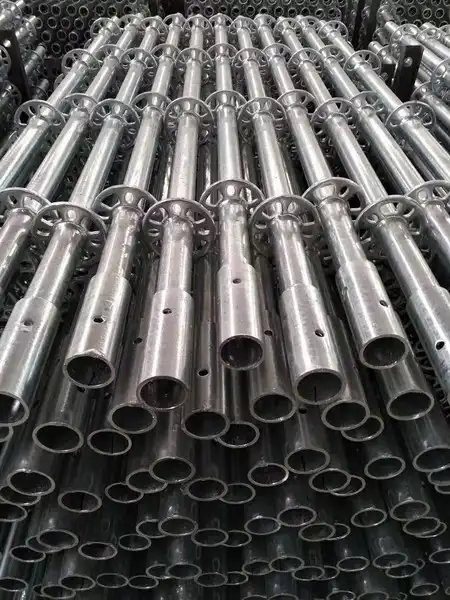
Understanding Tubular Scaffolding: Types, Materials, and Safety Standards
Core Components and System Types
There are three parts to a tubular scaffolding system: vertical standards, horizontal ledgers, and diagonal braces. These are all linked by right-angle, swivel, or sleeve couplers. This is different from frame scaffolding, which comes in bays that are already welded together, and system scaffolding like Cuplock or Kwikstage, which has its own blade and cup connections. Tubular scaffolding doesn't need any special parts because 48.3 mm tubes and universal fasteners are widely available in the building industry. This means that repair costs are low and downtime is very short.
Material Grades and Dimensional Standards
The quality of steel affects how well a structure works. The grade of carbon steel that Shandong Xingrui Building Materials Co., Ltd. uses is Q235. It meets the yield strength requirements of GB/T 700 and is similar to the S235 grade under EN 10025. The outside diameter is usually 48.3 mm, and the wall thickness is between 3.2 mm and 4.0 mm. Hot-dip galvanization puts a 40–60 micron zinc coating on both the inside and outside of the tube. This protects against corrosion longer than pre-galvanized options, whose weld seams are still open to chemical and moisture attack.
Applicable Safety Standards
The people in charge of buying things in controlled markets look at EN 12811-1 for temporary work equipment, EN 74-1 for coupler slip and failure loads, and OSHA 29 CFR 1926 Subpart Q for tubular scaffolding safety in the US. The three qualifications that Shandong Xingrui has are ISO 9001, ISO 14001, and ISO 45001. These cover quality management, environmental management, and health and safety at work, respectively. Before placing large orders, these three certifications give procurement teams a written quality baseline and production records that can be tracked.
How to Assemble Tubular Scaffolding Safely: Step-by-Step Guide
Site Assessment and Load Planning
Before putting up a steel scaffold, the ground-bearing ability must be checked and the support plates must be put in the right place. An engineer should check the biggest bay sizes and lift heights based on the expected live loads. For industrial areas that use equipment that weighs more than 2.0 kN/m², they need to add more lateral bracing and make the couplers stronger. Most partial collapses on building sites around the world happen because workers skip this step.
Systematic Erection Process
Start with sole boards and base jacks. Then, plumb the first lift of vertical standards before joining horizontal ledgers. Tighten each coupler to the torque level required by EN 74. For right-angle couplers, this is usually 50 Nm. For a basic working platform, this is the suggested way to set it up:
- Install base plates and sole boards on flat, compacted ground to distribute the weight of the structure over a larger area.
- Erect vertical standards at the right distance between bays and make sure they are level on two axes before moving on to the next part.
- Fix horizontal ledgers and transoms to make each lift, and then add diagonal face bracing every third bay to protect against wind forces from the side.
- Attach guardrails, toe boards, and decking boards before any person gets on the platform, ensuring full compliance with OSHA fall-protection rules.
The most common assembly mistakes can be avoided by following this order. After the tubular scaffolding is set up, it must be signed off by a qualified person as ready to be used. The structure must also be inspected again every seven days or after bad weather.
Real-World Case: Refinery Maintenance Project
On a petrochemical turnaround job in Southeast Asia, tubular scaffolding was chosen over system scaffolding because the shape of the reactor vessel needed 23 different bay designs. Because the structure was modular, the crew could change each bay on their own, which allowed them to finish erection 18% faster than planned. During the 14 weeks of the project, there were no structural problems.
Comparing Tubular Scaffolding Solutions for Industrial Applications
Tube and Coupler vs. Frame and System Scaffolding
Frame scaffolding can be moved quickly on simple, repeated surfaces but isn't very adaptable to industrial shapes. System scaffolding like Kwikstage and Cuplock speeds up assembly by letting you connect parts in predetermined steps. However, proprietary parts make each unit more expensive and make it harder to get them from faraway markets.
Tubular scaffolding requires more work to put together, but the global availability of parts, lower unit price per ton, and lack of dependence on a single supplier's part catalog make up for it. This is especially helpful for traders who work in more than one country.
Purchasing vs. Rental for Industrial Clients
Rental works well for short-term projects (less than eight weeks) where protecting capital is important. When the annual tubular scaffolding utilization rate goes over 60% or when the same contractor works on multiple jobs in a row, buying becomes a good financial move. When building material traders work with different contractors, keeping stock on hand lets them respond to projects faster and keep better track of their margins than renting equipment through middlemen.
Supplier Selection Criteria
When evaluating a tubular scaffolding supplier, three factors carry the most weight:
- Certified steel documentation: includes mill test certificates that confirm the grade as Q235 or an equivalent, along with chemical composition and mechanical test results.
- Production capacity: Suppliers who have their own automatic welding lines and galvanizing facilities can deliver big orders faster and with tighter standards for size.
- Payment and logistics flexibility: Traders who need to manage their cash flow across various markets need to be able to accept L/C payment terms, confirm container loading plans, and quickly file export documents.
Benefits and Industrial Use Cases of Tubular Scaffolding
Load-Bearing Performance and Adaptability
A properly designed tubular scaffolding structure can hold axial loads greater than 25 kN, which is the standard for tubes with a wall thickness of 4 mm. The system can handle multi-level loading that is common in formwork support applications and can be changed to fit non-linear facades that make prefabricated frame systems useless. Because it can be used in any shape, it is the standard choice for both heritage repair projects and complicated industrial setups.
Key Industrial Applications
A lot of different types of businesses use tubular scaffolding devices. In the following areas of application, this system consistently performs better than alternatives:
- Petrochemical and oil refinery maintenance: setting up around pressure tanks and pipe networks during turnaround projects, where frame scaffolding isn't useful because the shapes aren't standard.
- Power generation facilities: access at a high level for boiler maintenance and turbine inspections, where wind resistance and sustained load capacity are musts.
- Marine and shipyard operations: hot-dip galvanized tubes don't rust when the hull is being fixed or when structural welding is being done on offshore platforms.
- Large-scale civil construction: Support for temporary formwork for cast-in-place concrete bridges, retaining walls, and multi-story structural pours in large-scale civil projects.
These uses share one common requirement: a safe tubular scaffolding system for workers to use at heights. Investing in verified-grade steel and approved management systems leads to fewer accidents and lower insurance costs.
Workplace Safety Compliance
OSHA 1926.451 says that tubular scaffolding must be able to hold four times its original load without failing. EU Directive 2009/104/EC says that all work tools must be kept in safe working state for the whole time they are being used. Q235 hot-dip galvanized tubes meet the structural and longevity standards of these rules because they can be used more than 50 times with proper upkeep.
Purchasing Guide: How to Source Tubular Scaffolding for Your Business
Aligning Specifications to Project Scope
The cost-per-tonne and the structure grade are directly affected by the wall thickness choice. 3.2 mm wall tubes are strong enough for general access tubular scaffolding on building surfaces. When compressive loads are high, like when supporting formwork and shoring, 4.0 mm wall tubes are the right choice. Mixing wall thicknesses within the same structure is not recommended because it makes it harder to figure out loads and ensure that coupler grips are always the same.
Evaluating Supplier Reliability
Before you commit to a full container order, ask for ISO 9001 certificates, recent mill test reports, and sample units. A reliable maker will quickly send you technical documents and help with a trial shipment. As normal, Shandong Xingrui Building Materials Co., Ltd. gives procurement teams samples and expert help, providing the verification data needed before signing a supply agreement.
Negotiation and Pricing Transparency
Steel price volatility affects quoted ton prices. Set prices with a quote window that is tied to the steel index date, and make sure you know how to load each 20- or 40-foot container so you can accurately figure out the landed cost. Buyers who sign a long-term supply deal and place repeat orders usually get better per-tonne prices and priority production schedules.
Conclusion
In the industrial and building markets around the world, tubular scaffolding remains the most flexible and cost-effective temporary structure system. When you mix the right material specifications—Q235 steel, 48.3 mm diameter, hot-dip galvanized—with ISO-certified production, you give buying teams the performance confidence and paper trail that large-scale projects need. Whether you are building a regional stock position or sourcing for a single refinery turnaround, the safest path is a trial order with a confirmed, verified supplier.
FAQ
What is the maximum load capacity of a tube and coupler scaffold?
Under EN 12811-1 conditions, a single standard Q235 steel tube with a wall thickness of 4.0 mm can carry axial loads of more than 25 kN. Total building capacity depends on how the bays are set up, how dense the bracing is, and how the base bearings are made. For loads above 2.0 kN/m², you should always get a structural engineer's approval.
How does hot-dip galvanization differ from pre-galvanized tubes?
Hot-dip galvanization is used to cover the inside and outside of the tube evenly, including the weld seam. The weld zone is left open when pre-galvanized tubes are made from pre-coated strip steel. In corrosive places like chemical plants or coastal areas, there is a significant difference in how well the two methods perform over several years.
Can tube and coupler scaffolding be customized for non-standard projects?
Yes. The system uses standard 48.3mm tubes and universal couplers, so by changing the lift height, bay spacing, and bracing geometry, tubular scaffolding can be set up in any configuration. Shandong Xingrui also accepts orders based on drawings and project-specific details provided by the customer.
What certifications should I require from a supplier?
At minimum, ask for ISO 9001 for quality management, ISO 14001 for environmental compliance, and ISO 45001 for safety at work. For the European market, approvals at the product level, like the CE mark, add another level of proof for procurement teams.
Get a Competitive Quote from GREEN FORMWORK
With help from Shandong Xingrui Building Materials Co., Ltd., GREEN FORMWORK sells certified tubular scaffolding to builders and traders in more than 100 countries. Our Q235 hot-dip galvanized tubes are made in an automated workshop that covers more than 40,000 square meters. They come with full ISO paperwork, samples can be provided, and flexible L/C payment terms. To get a quote from a reliable tubular scaffolding manufacturer, email our team at sdxingruiqp@126.com or go to sdxingrui.com. Trial orders are welcome.
References
1. British Standards Institution. BS EN 12811-1: Temporary Works Equipment — Scaffolds — Performance Requirements and General Design. BSI, 2003.
2. European Committee for Standardization. EN 74-1: Couplers, Spigot Pins and Baseplates for Use in Falsework and Scaffolding. CEN, 2005.
3. Occupational Safety and Health Administration. OSHA 29 CFR 1926 Subpart Q: Scaffolding Safety Standards. U.S. Department of Labor, 2020.
4. International Organization for Standardization. ISO 9001:2015 Quality Management Systems — Requirements. ISO, 2015.
5. International Organization for Standardization. ISO 45001:2018 Occupational Health and Safety Management Systems. ISO, 2018.
6. Packer, J.A., and Wardenier, J. Design Guide for Rectangular Hollow Section (RHS) Joints Under Predominantly Static Loading. CIDECT / Verlag TÜV Rheinland, 2009.
Learn about our latest products and discounts through SMS or email