- English
- French
- German
- Portuguese
- Spanish
- Russian
- Japanese
- Korean
- Arabic
- Greek
- German
- Turkish
- Italian
- Danish
- Romanian
- Indonesian
- Czech
- Afrikaans
- Swedish
- Polish
- Basque
- Catalan
- Esperanto
- Hindi
- Lao
- Albanian
- Amharic
- Armenian
- Azerbaijani
- Belarusian
- Bengali
- Bosnian
- Bulgarian
- Cebuano
- Chichewa
- Corsican
- Croatian
- Dutch
- Estonian
- Filipino
- Finnish
- Frisian
- Galician
- Georgian
- Gujarati
- Haitian
- Hausa
- Hawaiian
- Hebrew
- Hmong
- Hungarian
- Icelandic
- Igbo
- Javanese
- Kannada
- Kazakh
- Khmer
- Kurdish
- Kyrgyz
- Latin
- Latvian
- Lithuanian
- Luxembou..
- Macedonian
- Malagasy
- Malay
- Malayalam
- Maltese
- Maori
- Marathi
- Mongolian
- Burmese
- Nepali
- Norwegian
- Pashto
- Persian
- Punjabi
- Serbian
- Sesotho
- Sinhala
- Slovak
- Slovenian
- Somali
- Samoan
- Scots Gaelic
- Shona
- Sindhi
- Sundanese
- Swahili
- Tajik
- Tamil
- Telugu
- Thai
- Ukrainian
- Urdu
- Uzbek
- Vietnamese
- Welsh
- Xhosa
- Yiddish
- Yoruba
- Zulu
Facade Scaffold Tube Scaffolding vs Frame Systems: Which Is Best?
When choosing between facade scaffold tube scaffolding and frame systems, the right answer depends on your project's geometry, load requirements, and schedule. Tube and coupler scaffolding—built from 48.3mm steel tubes and friction-grip couplers—handles irregular facades, heavy cladding, and multi-story exterior wall work with a flexibility that prefabricated frame systems simply cannot match. Frame systems win on speed for repetitive, standard-height work. For exterior wall masonry, plastering, insulation, and facade protection on complex or long-cycle projects, tube scaffolding remains the stronger investment.
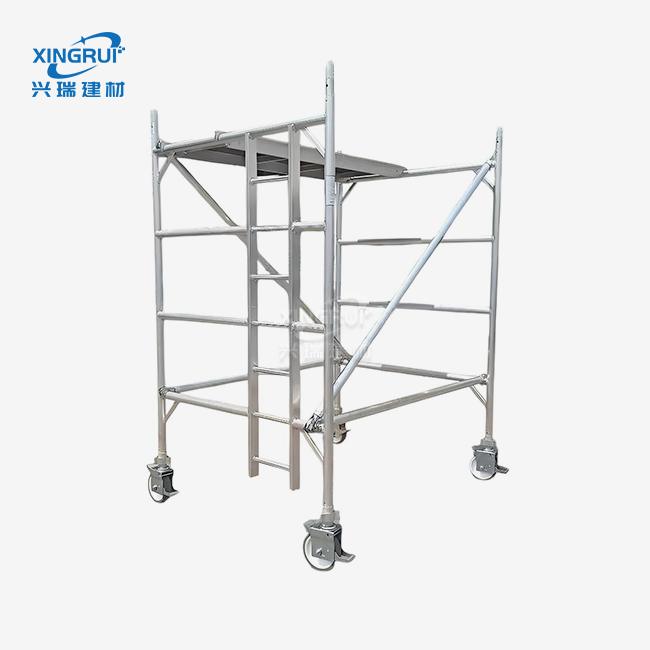
Understanding Facade Scaffold Tube Scaffolding and Frame Systems
To properly compare the two methods, it is helpful to first understand what each one is and where it works best.
What Is Tube and Coupler Scaffolding?
Individual steel tubes are joined together by friction-grip or right-angle couplers to make a working platform for tube and coupler scaffolding. The system can handle curved walls, hidden windows, decorative cornices, and different floor-to-floor heights because each part can be adjusted separately. These tubes are made by Shandong Xingrui Building Materials Co., Ltd. from Q235 premium carbon steel. They have an outside diameter of 48.3 mm and walls that are 3.2–4.0 mm thick. They are hot-dip galvanized to ≥40 microns. As a standard, the upright spacing is 1.5 m and the step width is 1.8 m.
What Is Frame Scaffolding?
Facade scaffold tube scaffolding uses H-frames or walk-through frames that have already been welded together. It's quick to put together because workers can stack frames and clip in braces without having to measure each joint individually. Frame systems are good for straight-walled, repetitive home projects because they are faster. But because pre-welded frames have a fixed shape, they can't be used on surfaces that have projections, setbacks, or uneven tracks.
Key Structural Differences
The main difference is between flexibility and speed. Engineers can set up any geometry with tube systems, but you can't change the dimensions of the modules with frame systems. For protecting the outside of historic or renovated buildings in cities, this flexibility has a direct effect on safety compliance and inspection results.
Comparative Analysis: Performance, Safety, and Cost Efficiency
Both systems can be safe and cost-effective—but under different conditions. Procurement managers need performance data, not just general claims.
Load Capacity and Structural Stability
Q235 carbon steel tubes with 490 MPa tensile strength and a 4:1 safety factor handle heavy stone cladding and wind pressure at height. Research published in the Journal of Constructional Steel Research confirms that tube-and-coupler configurations distribute loads more evenly across irregular geometries than fixed-frame equivalents. Frame scaffolding is rated for standard distributed loads but can reach capacity limits faster when workers carry dense insulation panels or masonry blocks across multiple lifts simultaneously.
Assembly Time and Labor Costs
For facade scaffold tube scaffolding, frame systems require roughly 20–30% less on-site assembly time on straightforward facades, according to scaffolding industry estimates. Tube and coupler systems demand more skilled labor and measured installation, but that investment returns value on complex jobs where frame systems would require costly workarounds or re-erection. For facade subcontractors running multi-month exterior insulation or curtain wall projects, the total labor cost difference narrows considerably over a full project cycle.
Safety Certification and Compliance
Both systems can meet EN 12811, OSHA 1926 Subpart Q, and related standards when properly erected and inspected. Shandong Xingrui's tube scaffolding is engineered to EN 39, BS 1139, and AS 1576 benchmarks. The system ships with dense mesh safety nets, toe boards, and safety railings as an integrated unit, which directly supports site inspection compliance and reduces the risk of regulatory delays during city-center facade work.
Application Suitability: Matching Systems to Project Needs
The type of job tells you exactly which method to choose. Here's a breakdown of where each system fits in the real world:
- Complex facade renovation and curtain wall installation: Tube and coupler scaffolding handles balconies, decorative cornices, and varied floor heights without additional structural modifications. Project managers on high-rise commercial renovation work in dense urban areas consistently prefer this system because it wraps the building's actual geometry rather than forcing adjustments to the building's perimeter.
- Exterior wall plastering, masonry, and insulation protection: Shandong Xingrui designs its facade scaffold tube scaffolding specifically for these applications. The standardized 1.5m upright spacing and 1.8m step distance give workers consistent, accessible lift heights while the integrated safety net and railing system keeps the street-facing facade visually tidy—an important factor when building owners and inspectors evaluate site presentation before approving payment.
- Standard residential new-build work: Frame scaffolding is more efficient here. When floor-to-floor heights are uniform and facade surfaces are flat, the faster assembly cycle reduces overall project labor hours without compromising safety or compliance.
These differences are important when your choice about how to buy something affects both the project's safety record and its payment schedule.
Maintenance, Longevity, and Supplier Insights
An tool that will last for a while is a platform system. The real cost over many project cycles depends on how you maintain it and who provides it.
Tube and Coupler Maintenance Practices
If you take care of hot-dip galvanized tubes with a zinc covering of at least 40 microns, the coating will last for 10 to 15 years. Coupler torque (40–60 Nm with a measured wrench), tube straightness, and galvanization integrity at connection places should all be checked once a week at the site. It's easy to replace just one broken tube or coupler—a failure of a single component doesn't mean taking apart the whole bay.
Frame System Wear Points
For facade scaffold tube scaffolding, frame systems need to be watched at the weld joints where the vertical posts and horizontal rails meet. This is because this is where stress builds up over time from repeated loading cycles. When frames are bent or cracked, they usually need to be replaced as a whole instead of just a few parts being fixed. This makes the long-term cost of ownership higher than with a tube system, where parts can be switched out.
Supplier Selection Criteria
Make sure that the company you buy from has the ISO 9001 Quality Management, ISO 14001 Environmental Management, and ISO 45001 Occupational Health and Safety certifications before you buy their scaffolding. All three are held by Shandong Xingrui Building Materials Co., Ltd., along with CE certification. The company makes its systems in a 79,800 m² factory with 12 welding robots and 6 automatic welding lines. Samples and expert help are provided to help with project-specific requirements before bulk purchases are made.
How to Procure the Right Scaffolding System?
Procurement for facade subcontractors typically runs on a 2–6 week cycle from project award to site delivery. Getting the specification right early avoids costly substitutions during the approval stage.
Buy vs. Rent Considerations
Buying makes economic sense when your company runs multiple simultaneous facade projects with reuse cycles exceeding two years. Tube and coupler systems support this model well because components are reusable across different project configurations. Renting suits short, single-site contracts where storage and transport logistics make ownership inefficient.
Custom Configuration and OEM Options
Shandong Xingrui accepts orders tailored to project-specific drawings and samples. This is relevant for facade subcontractors working on heritage buildings or curtain wall systems with non-standard anchor points where wall-tie spacing deviates from the standard module. Custom fabrication removes the need for site modifications that slow inspection and approval.
Ordering and Delivery Process
Submit technical drawings or specifications, request a sample for dimensional and coating verification, confirm volume, then proceed to production. Rizhao's seaport, airport, and high-speed rail connections support reliable delivery timelines for both domestic and international orders.
Conclusion
When it comes to complex, long-term facade projects where geometric flexibility, load capacity, and inspection compliance are most important, facade scaffold tube scaffolding works better than frame systems. Frame systems are still useful for simple, repetitive tasks. When it comes to facade renovation, curtain wall, and exterior insulation contracts, the choice should be based on the shape of the project, how many times it can be used, and the safety certification needs. Shandong Xingrui Building Materials Co., Ltd. makes tube scaffolding systems that meet those requirements. They use verified material types, approved production methods, and can make products to order.
FAQ
Is tube scaffolding safer than frame scaffolding for high-rise facade work?
Both systems are safe as long as they are set up according to the rules. When working on uneven or tall facades, tube and coupler scaffolding is better because engineers can precisely position each component around structural features. This means that engineers don't have to make changes on the fly, which can be dangerous. The way Shandong Xingrui's system is set up with the safety net and railings built in means that there is consistent fall protection at all lift levels.
How long does hot-dip galvanized tube scaffolding last?
A hot-dip galvanized tube with a zinc coating of at least 40 microns will last 10 to 15 years if it is well taken care of and not in a salty environment. This service life can be extended even more by inspecting it regularly and replacing any rusted parts right away.
Can tube scaffolding accommodate irregular wall-tie positions?
Yes. Because each coupler position can be set separately, the system can work with different floor-to-floor heights and anchor points that aren't standard without having to make custom frames. This is one of the main reasons why wall workers like tube systems so much on remodeling jobs.
What torque is correct for coupler tightening?
As a general rule, 40–60 Nm should be used with a measured torque wrench. Too-tight couplers damage the walls of the tube, while too-loose couplers slip when the load is put on them.
Does Shandong Xingrui provide technical support before ordering?
Yes, buying teams can get samples and expert help to check the quality of the coating and any size errors before placing full-volume orders.
Request a Quote from GREEN FORMWORK — Your Facade Scaffold Tube Scaffolding Supplier
GREEN FORMWORK makes wall scaffold tube scaffolding for businesses that meets EN 39, BS 1139, ISO 9001, ISO 14001, and ISO 45001 standards. Our Q235 carbon steel systems are made for exterior wall masonry, plastering, and insulation projects. They are reusable, can be customized, and are CE certified. You can email our team at sdxingruiqp@126.com to ask for a sample, get a quote for your specific project, or talk to our technology team directly about your wall scaffolding needs.
References
1. Journal of Constructional Steel Research — 2019
2. Scaffolding Industry Association Technical Manual — 2021
3. British Standards Institution, BS EN 12811-1: Temporary Works Equipment — 2003
4. Construction Safety Quarterly — 2022
5. Standards Australia, AS/NZS 1576: Scaffolding General Requirements — 2010
6. Occupational Safety and Health Administration (OSHA), Scaffolding Standards 1926 Subpart Q — 2020
Learn about our latest products and discounts through SMS or email