- English
- French
- German
- Portuguese
- Spanish
- Russian
- Japanese
- Korean
- Arabic
- Greek
- German
- Turkish
- Italian
- Danish
- Romanian
- Indonesian
- Czech
- Afrikaans
- Swedish
- Polish
- Basque
- Catalan
- Esperanto
- Hindi
- Lao
- Albanian
- Amharic
- Armenian
- Azerbaijani
- Belarusian
- Bengali
- Bosnian
- Bulgarian
- Cebuano
- Chichewa
- Corsican
- Croatian
- Dutch
- Estonian
- Filipino
- Finnish
- Frisian
- Galician
- Georgian
- Gujarati
- Haitian
- Hausa
- Hawaiian
- Hebrew
- Hmong
- Hungarian
- Icelandic
- Igbo
- Javanese
- Kannada
- Kazakh
- Khmer
- Kurdish
- Kyrgyz
- Latin
- Latvian
- Lithuanian
- Luxembou..
- Macedonian
- Malagasy
- Malay
- Malayalam
- Maltese
- Maori
- Marathi
- Mongolian
- Burmese
- Nepali
- Norwegian
- Pashto
- Persian
- Punjabi
- Serbian
- Sesotho
- Sinhala
- Slovak
- Slovenian
- Somali
- Samoan
- Scots Gaelic
- Shona
- Sindhi
- Sundanese
- Swahili
- Tajik
- Tamil
- Telugu
- Thai
- Ukrainian
- Urdu
- Uzbek
- Vietnamese
- Welsh
- Xhosa
- Yiddish
- Yoruba
- Zulu
How to Choose All-Round Scaffolding for Uneven Worksites Safely
Choosing the right all-round scaffolding for uneven worksites starts with understanding load capacity, terrain adaptability, and regulatory compliance. A ringlock modular system — built on the wedge-lock principle with multi-directional rosette connectors — gives your crew 360° connection flexibility at every node, which is exactly what irregular ground demands. For industrial contractors operating in refineries, shipyards, or dense pipe-rack environments, selecting a system with verified EN/ISO certifications, hot-dip galvanized components, and traceable batch documentation is not optional. It is the foundation of a safe, audit-ready operation.
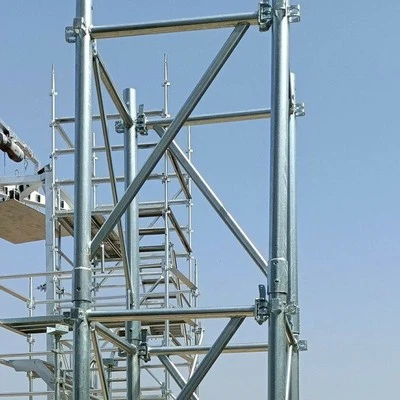
Understanding the Challenges of Scaffolding on Uneven Worksites
One of the most common risks in scaffolds is uneven ground. According to OSHA, about 4,500 people get hurt and 60 people die every year in the United States alone when they fall off of scaffolding. On rough ground, those risks grow quickly if the machine can't fix itself.
Why Traditional Systems Struggle?
Tube-and-clamp scaffolding was made for surfaces that are mostly flat. Every joint has to be re-aligned by hand on sloped or stepped ground. This adds human error, slows down assembly, and makes uneven load paths that can cause progressive collapse when dynamic loads are applied.
Regulatory Pressure Is Real
Both OSHA 1926.451 and EU EN 12811-1 say that staging platforms must stay level and stable no matter what they are supported on. EN compliance is a requirement, not a choice, for contractors who want to bid on industrial projects in Europe or the Middle East. An HSE audit from a client will not accept a system that can't show certified load data.
Core Safety Principles for Irregular Ground
Safe scaffolding on uneven surfaces is based on three ideas: a base that can be adjusted to level, vertical loads that are spread out, and hard bracing along the sides. All three must be met by the method you choose before any worker can step onto the station.
Critical Criteria for Choosing All-Round Scaffolding Systems
Once you know what risks are on the page, the selection criteria can be very detailed and can be measured. Before signing a purchase order, procurement managers and HSE engineers should look at these main points together.
Material Grade and Surface Protection
The usual base material for all-round scaffolding is Q235 carbon steel, which has a tensile strength that matches structural performance with reasonable component weight. Following the ISO 1461 standards for hot-dip galvanization (HDG) creates a 60–80 micron zinc coat that protects against corrosion for 15–20 years in saltwater and chemical conditions. For ocean or industrial sites, thin paint coats or electrostatic spraying by themselves won't be strong enough to last this long.
Adjustability Features for Uneven Ground
Leveling jacks and movable base plates are not extras; they are necessary for safety on rough ground. When looking for systems, make sure that the base jack's trip range meets the ground-level variation at your site. Also, make sure that the jack's rated compression load matches the 50kN vertical standard capacity. A mismatch in this case is a structural risk.
Certification and Documentation Standards
Ask for full tracking. That includes mill certificates for the raw steel, HDG thickness test reports for each batch, and data from component load tests that refer to EN 12810 or EN 1281. In any EU or Middle Eastern project setting, suppliers who can't provide batch-level paperwork within 48 hours of being asked to do so pose a legal risk.
Comparing All-Round Scaffolding with Other Types for Uneven Worksites
Not every scaffolding category performs equally on challenging ground. Understanding the practical differences helps you match the system to the job scope.
Ringlock vs. Tube-and-Clamp
Tube-and-clamp systems offer geometry flexibility, but each connection requires manual torque-tightening of individual couplers — a slow process prone to under-tightening on site. A ringlock system uses a self-locking wedge head that drops into a precision-welded rosette disc and locks with a single hammer blow, maintaining structural verticality within 0.2% tolerance. Assembly time drops by approximately 50%, which matters when a refinery shutdown has a fixed maintenance window.
Ringlock vs. Frame Scaffolding
Frame scaffolding works well on flat ground with predictable bay widths. On curved ship hulls or dense pipe networks, fixed-frame geometry forces awkward workarounds. A rosette-based system with up to eight connection angles at a single node adapts to curved surfaces and offset geometry without cutting components or adding non-standard fittings.
Buying vs. Renting for Industrial Contractors
For contractors running repeat shutdown cycles at the same facilities, asset ownership makes more financial sense than long-term rental. A hot-dip galvanized all-round scaffolding system reused across 15–20 years amortizes its unit cost well below recurring rental fees. Rental remains practical for one-off projects where storage and logistics overhead outweigh purchase savings.
Maintenance and Safety Best Practices for Long-Term Use
A ringlock method is only as effective as the program that checks it. Following maintenance rules keeps your HSE records clean and improves the life of your parts.
Routine Inspection Protocols
Using a wire brush, clean concrete debris off of the rosette disks after each project cycle. Packed debris stops the wedge from sitting fully, which makes load transfer less effective. Check each wedge for cracks or warping. A broken wedge head needs to be changed, not fixed on the spot. Look at coated areas to see if any bare steel is showing. Oxidation that starts in one place can spread quickly in chemical or marine conditions.
Addressing Structural Fatigue
Vertical standards that are put through repeated high-load cycles can get micro-fatigue at the weld zone for the rosette. By comparing the length of the standard to its original specification within a ±1mm range, a simple visual and measurement check can show which parts have been deformed by impact during handling or assembly.
Worker Training Requirements
Assembling teams need to know the wedge-lock sequence: inserting the ledger, fitting the wedge, and confirming with a hammer hit. If you skip the last strike, the connection is only partially engaged, so it may hold under static load but not under dynamic shock. There are less of these risks at the crew level because of monthly competency checks and written approval before each project starts.
Choosing Reliable Suppliers and Making Informed Procurement Decisions
Choosing a supply partner for all-round scaffolding isn't just about price; it's also about how to handle risks. Your project delivery reliability is directly affected by the supplier's production capacity, quality system, and support after the sale.
Evaluating Supplier Credentials
Check to see if the maker has the ISO 9001 quality management, ISO 14001 environmental management, and ISO 45001 safety management standards. Together, these three standards show that quality control is built into the process of production and not done after the fact. The CE mark on scaffolding parts shows that they have been checked by a third party to meet European market standards. As part of your buyer qualification process, ask to be able to inspect the plant.
Custom Orders and Sample Availability
Most industrial jobs don't fit into a catalog. When suppliers take custom orders based on drawings and offer sample supply before shipment, procurement teams can do the check they need to do before signing a full framework agreement. Make sure you get written confirmation of wait times for custom setups, and make sure that batch traceability standards are written into the contract.
Total Cost of Ownership
A ringlock system's real cost includes the price of buying it, shipping it, storing it, the work that goes into keeping it in good shape, and the cost of replacing it over its lifetime. Lifecycle costs are much cheaper for a system with a certified 15–20-year service life and full spare-part availability from the same maker than for lower-grade options that need to be replaced more often.
Conclusion
When picking all-round scaffolding for uneven work sites, you have to think about the material grade, the connection geometry, the regulatory paperwork, and the supplier's qualifications all at the same time. The systems that work well in refineries, dry docks, and bridge construction are all made of steel that is at least Q235, is hot-dip galvanized to ISO 1461 standards, has rosette-based multidirectional connections, and has certified load data. If your HSE engineer and procurement manager agree on these criteria from the start, the hiring process is more like a test and less like a guessing game. Make sure the batch paperwork is correct, ask for samples, and check your supplier's production capacity. That step keeps your project, your employees, and your business ties safe.
FAQ
How long does a hot-dip galvanized ringlock system last?
A Q235 steel ringlock system will last 15 to 20 years in normal building conditions if it gets the right HDG finish at 60 to 80 microns according to ISO 1461 and is maintained regularly.
Can ringlock components from different manufacturers be mixed?
Technically, many systems use the same outer-diameter tube standard of 48.3 mm, but each maker has their own rosette shape and wedge thickness. It is usually not a good idea to mix parts unless load-compatibility testing has been done and confirmed by a third party. Using a single-source system gets rid of this risk completely and keeps clear responsibility for the performance of the structure.
What certifications should I require from my supplier?
At the very least, you should demand ISO 9001 certification, CE marking, and load test reports for parts that reference EN 12810 or EN 12811. Batch-level material tracking papers and HDG thickness test certificates are required by auditors for all industrial projects in the EU and the Middle East.
What is the maximum height for a standalone ringlock tower?
If a ringlock shoring tower is properly tied back to a fixed building at regular times, it can be taller than 50 meters. Without ties, the tallest structure that can stand alone depends on the specifics of the site and how much weight it can support.
Get Your All-Round Scaffolding Quote from GREEN FORMWORK
The company that makes all of GREEN FORMWORK's scaffolding—Shandong Xingrui Building Materials Co., Ltd.—makes ringlock systems from Q235 steel with 60–80 micron HDG protection and has ISO 9001, ISO 14001, and ISO 45001 certifications to back them up. With a 79,800 m² facility, the ability to make custom orders, and the ability to give samples, we can help you with your buying process from the first request to the annual framework agreement. To get specifications and batch documentation right away, email our technical team at sdxingruiqp@126.com.
References
1. OSHA. Scaffolding Safety Standards: 29 CFR 1926.451. U.S. Department of Labor, 2020.
2. European Committee for Standardization. EN 12811-1: Temporary Works Equipment — Scaffolds. CEN, 2003.
3. European Committee for Standardization. EN 12810-1: Facade Scaffolding Made of Prefabricated Components. CEN, 2003.
4. International Organization for Standardization. ISO 1461: Hot Dip Galvanized Coatings on Fabricated Iron and Steel Articles. ISO, 2009.
5. Health and Safety Executive (HSE). Inspection of Scaffolding: General Guidance for Contractors. HSE Books, 2017.
6. Peurifoy, R. L., & Oberlender, G. D. Formwork for Concrete Structures. McGraw-Hill Education, 2011.
Learn about our latest products and discounts through SMS or email