- English
- French
- German
- Portuguese
- Spanish
- Russian
- Japanese
- Korean
- Arabic
- Greek
- German
- Turkish
- Italian
- Danish
- Romanian
- Indonesian
- Czech
- Afrikaans
- Swedish
- Polish
- Basque
- Catalan
- Esperanto
- Hindi
- Lao
- Albanian
- Amharic
- Armenian
- Azerbaijani
- Belarusian
- Bengali
- Bosnian
- Bulgarian
- Cebuano
- Chichewa
- Corsican
- Croatian
- Dutch
- Estonian
- Filipino
- Finnish
- Frisian
- Galician
- Georgian
- Gujarati
- Haitian
- Hausa
- Hawaiian
- Hebrew
- Hmong
- Hungarian
- Icelandic
- Igbo
- Javanese
- Kannada
- Kazakh
- Khmer
- Kurdish
- Kyrgyz
- Latin
- Latvian
- Lithuanian
- Luxembou..
- Macedonian
- Malagasy
- Malay
- Malayalam
- Maltese
- Maori
- Marathi
- Mongolian
- Burmese
- Nepali
- Norwegian
- Pashto
- Persian
- Punjabi
- Serbian
- Sesotho
- Sinhala
- Slovak
- Slovenian
- Somali
- Samoan
- Scots Gaelic
- Shona
- Sindhi
- Sundanese
- Swahili
- Tajik
- Tamil
- Telugu
- Thai
- Ukrainian
- Urdu
- Uzbek
- Vietnamese
- Welsh
- Xhosa
- Yiddish
- Yoruba
- Zulu
Frame Scaffolding System vs Tube and Clamp: Which Is Better Overall?
When comparing a frame scaffolding system to tube and clamp, the frame system wins for most standard masonry and commercial construction scenarios. Its prefabricated, modular design enables assembly speeds 50–70% faster than tube and clamp, directly reducing labor costs on site. Standardized components eliminate guesswork during erection, while engineered load capacities align with OSHA and EN 12810 requirements. Tube and clamp retains an edge on irregular structures requiring custom geometry. For procurement managers sourcing high-volume, repeatable inventory, the frame system delivers a stronger total cost of ownership.
What Are These Two Scaffolding Systems?
Frame Scaffolding: Modular Efficiency Built for Speed
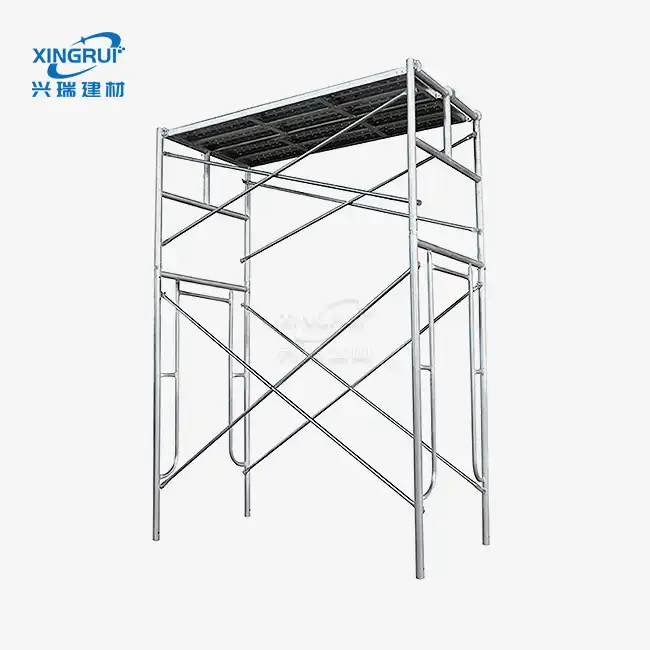
A frame scaffolding system, which is also known as mason frame or portal scaffolding, is made up of vertical frames, horizontal cross-braces, and decking platforms that are already made. Using gravity pins or flip-lock mechanisms, each part fits into the next, so there is no need for loose hardware on the job site. The shape of the walk-through door frame lets workers and tools move freely along the platform, which is especially useful for brickwork and facade work.
Tube and Clamp: Flexible but Labor-Intensive
Individual steel or metal tubes are joined by swivel or fixed couplers in tube and clamp scaffolds. Every joint is put together by hand with a wrench, so it can fit almost any form or surface that isn't straight. That freedom comes with a price: it takes a lot more work to set up, there is a higher chance that the clamps will be too tight or too loose, and there is a longer list of things to check after every storm or earthquake.
Key Differences Between Frame Scaffolding and Tube and Clamp
Both systems give you access, but they don't work at all the same way when it comes to the measures that matter to a buying manager. Frame scaffolding system offers greater speed and predictability in assembly, while tube and clamp scaffolds provide unmatched adaptability to irregular surfaces. Here is how they compare in the areas that matter most to your sourcing choices.
- Assembly Speed: Frame systems cut the time it takes to set up by 50–70% compared to tube and clamp. For a normal home brickwork job, it takes a group of four people less than two hours to set up about 1,000 square feet of frame scaffolding systems. Tube and clamp needs exact pressure on every coupler, which slows things down a lot.
- Dimensional Consistency: High-quality frame systems, like those made to ±1mm pin-to-pin tolerance, stop eccentric loading during vertical stacking. This is a very important safety factor that OSHA inspectors often notice when clamp placement is guessed rather than measured.
- Corrosion Resistance: Frame parts that are hot-dip galvanized (HDG) and have a coating thickness of at least 60μm last for more than 15 years, even in coastal or industrial settings. Tube and clamp systems with couplers made of bare steel or thinly painted steel rust more quickly, which means they need to be replaced more often and cost more overall.
- Safety Compliance: In the U.S., ANSI/SSFI SC100-5/05 and in Europe, EN 12811-1 both say that modular frame systems meet a 4:1 structural safety factor as long as the parts are in good shape and stacked correctly. Individual coupler force has a big effect on tube and clamp compliance, which makes quality assurance harder to standardize.
- Total Cost of Ownership: Frame systems cost more per unit to buy, but they need less work, fewer replacement parts, and easier inspection procedures. Tube and clamp may look cheaper at first glance, but it ends up being more expensive in the long run because of lost labor, couplers, and extra time needed for inspections.
Best Use Cases: Frame Scaffolding vs Tube and Clamp
Knowing what makes each system great helps you match the right product to the job conditions of your contractor customers.
A frame scaffolding system works best in situations with a lot of repetition. The most common type is exterior wall stonework on multi-story homes or businesses. Bricklayers who work at height need stable, flat platforms that can be raised in stages as the course goes on. Because of the walk-through doorway design, MEP workers (mechanical, electrical, and plumbing fitters) can move conduit and pipe horizontally without taking down the bracing. It's easy for interior decorators to quickly set up and take down platforms for painting or putting up ceiling drywall.
Tube and clamp is useful for projects with complicated shapes, like curved walls, historic renovations with non-standard bay widths, or industrial tank maintenance where the structure being scaffolded is round or can go in more than one way. However, for more straightforward vertical or repetitive structures, a frame scaffolding system offers faster assembly and greater load consistency. If some of your contractors are specialty restoration or process plant maintenance companies, it makes sense to keep some tube-and-clamp frames on hand in addition to your main frame range.
For weather performance, HDG frame systems can handle the humidity of the ocean, the freeze-thaw cycles that happen during the Southeast's sometimes harsh winters, and the wet conditions of a brick pour that is still going on. Tube and clamp joints, on the other hand, can freeze or corrode where the coupler meets the tube if they are not kept regularly. This can cause safety issues on the job site that cost a lot to fix.
How to Choose the Right Scaffolding System for Your Business
At the category manager level, choices about purchases need to be based on a structured plan instead of gut feelings. The following factors should help you decide how to evaluate something.
Start with a profile of your contractor customer. If most of your clients are general and masonry builders working on jobs that aren't higher than four stories, a frame scaffolding system will meet more than 80% of their entry needs. Make sure your inventory budget is correct, and keep tube-and-clamp as an extra SKU instead of your main stocking unit.
Before committing to a company, check their compliance qualifications. The frame scaffolding system needs to meet the standards set by ISO 9001 for quality management, ISO 14001 for the environment, and ISO 45001 for health and safety at work. Supported scaffolding must be able to hold four times the maximum intended load, according to OSHA 1926 Subpart Q. Make sure your supplier confirms this in writing and backs it up with test reports from a third party.
Early on, look at your OEM and private-label capabilities. If you want to sell under your own name, the maker must show that the tolerances for size are the same from batch to batch. Before you place a trial container order, ask for a sample set, measure the lengths between the pins, and cross-stack frames from different production runs to make sure they can be used together.
Instead of unit price, look at the total landed cost. Think about the CIF price, any applicable tariffs, the packaging's suitability for direct warehouse receiving, and the supplier's ability to keep extra stock on hand for your busiest times. A slightly higher CIF price from a reputable, certified maker with packaging that is ready for barcodes will almost always do better than a cheaper invoice that leads to getting mistakes, customer complaints, and safety returns.
Conclusion
A frame scaffolding system is clearly a better overall option for most masonry and general construction distribution companies in North America than a tube and clamp system. Lower total ownership cost and fewer customer complaints are the results of faster assembly, more reliable structure performance, better corrosion resistance, and easier OSHA compliance paperwork.
Tube and clamp are still useful for unique or irregular-shaped jobs, but they shouldn't be the main thing that distributors keep on hand. You can protect your margins and build long-term account loyalty by making sure you get the right system for your contractors and buying it from a manufacturer whose quality credentials have been checked.
FAQ
What makes a frame scaffolding system safer than tube and clamp on standard masonry jobs?
Coupler torque is not a human element in frame systems because they use standard, premade parts that lock into place. No matter which crew member puts together a pin-and-lock connection, it works the same way. This makes OSHA compliance more predictable and speeded up the inspection after a storm.
How long does a properly galvanized frame scaffold last?
A well-kept frame system that has been hot-dip galvanized to a coating thickness of at least 60μm will keep its structural integrity for more than 15 years in most conditions in North America, even in wet coastal areas. This service window is extended even more by inspecting and replacing broken cross-braces as soon as they are found every year.
Can frame and tube-and-clamp components be mixed on the same structure?
According to industry standards, mixing systems on the same scaffold bay is not recommended without the approval of a licensed professional engineer. Small differences in the outer diameter of the tube and the shape of the locking pins between manufacturers make the load transfer paths unpredictable, which can weaken the 4:1 safety factor.
What should I check when sourcing a certified frame scaffolding supplier?
Check that the seller has ISO 9001, ISO 14001, and ISO 45001 certifications, ask for paperwork on pin-to-pin accuracy and dimensional tolerances, look over third-party load test results, and make sure the supplier has product liability insurance. For long-term marketing relationships, both the ability to do factory audits and experience with OEM and private name products are important.
Partner With GREEN FORMWORK for Certified Frame Scaffolding Supply
With the help of Shandong Xingrui Building Materials Co., Ltd., GREEN FORMWORK offers industrial-grade frame scaffolding system products made from Q235 premium steel. These products are molded into one piece, have a ±1mm dimensional tolerance, and have HDG corrosion protection that lasts for more than 15 years. Our systems are fully compliant with ISO 9001, ISO 14001, and ISO 45001 standards.
They also offer full OEM/private labeling and barcode packing that is ready for the warehouse. As a well-known company that makes frame scaffolding systems, we can handle both large container orders and yearly supply deals. Email sdxingruiqp@126.com or go to sdxingrui.com today to get samples or a CIF price.
References
1. Occupational Safety and Health Administration (OSHA). Scaffolding Standards: 29 CFR 1926 Subpart Q. U.S. Department of Labor, 2022.
2. Scaffold & Access Industry Association (SAIA). ANSI/SSFI SC100-5/05: Safety Requirements for Supported Scaffolds. 2019.
3. European Committee for Standardization (CEN). EN 12811-1: Temporary Works Equipment — Scaffolds — Performance Requirements and General Design. 2003.
4. International Organization for Standardization. ISO 9001:2015 Quality Management Systems — Requirements. 2015.
5. Peurifoy, R. L., & Oberlender, G. D. Formwork for Concrete Structures. McGraw-Hill Education, 2011.
6. Construction Industry Institute (CII). Scaffolding Safety and Productivity Research Report. University of Texas at Austin, 2018.
Learn about our latest products and discounts through SMS or email