- English
- French
- German
- Portuguese
- Spanish
- Russian
- Japanese
- Korean
- Arabic
- Greek
- German
- Turkish
- Italian
- Danish
- Romanian
- Indonesian
- Czech
- Afrikaans
- Swedish
- Polish
- Basque
- Catalan
- Esperanto
- Hindi
- Lao
- Albanian
- Amharic
- Armenian
- Azerbaijani
- Belarusian
- Bengali
- Bosnian
- Bulgarian
- Cebuano
- Chichewa
- Corsican
- Croatian
- Dutch
- Estonian
- Filipino
- Finnish
- Frisian
- Galician
- Georgian
- Gujarati
- Haitian
- Hausa
- Hawaiian
- Hebrew
- Hmong
- Hungarian
- Icelandic
- Igbo
- Javanese
- Kannada
- Kazakh
- Khmer
- Kurdish
- Kyrgyz
- Latin
- Latvian
- Lithuanian
- Luxembou..
- Macedonian
- Malagasy
- Malay
- Malayalam
- Maltese
- Maori
- Marathi
- Mongolian
- Burmese
- Nepali
- Norwegian
- Pashto
- Persian
- Punjabi
- Serbian
- Sesotho
- Sinhala
- Slovak
- Slovenian
- Somali
- Samoan
- Scots Gaelic
- Shona
- Sindhi
- Sundanese
- Swahili
- Tajik
- Tamil
- Telugu
- Thai
- Ukrainian
- Urdu
- Uzbek
- Vietnamese
- Welsh
- Xhosa
- Yiddish
- Yoruba
- Zulu
How to make a rosette ringlock scaffolding
Making rosette ringlock scaffolding starts with selecting certified Q235B or Q355B steel tubes, cutting them to precise tolerances, and welding eight-hole daisy-type rosette disks at 0.5-meter intervals along each vertical standard. Wedge-head ledger ends are then cold-forged and welded to horizontal members.
The entire assembly receives a hot-dip galvanization coating of 65–80 microns to protect against corrosion. Every finished component undergoes dimensional verification using go/no-go gauges before packaging. This bolt-free, wedge-locking modular system delivers structural rigidity, rapid field assembly, and measurable lifecycle advantages for rental fleets and large-scale construction procurement.
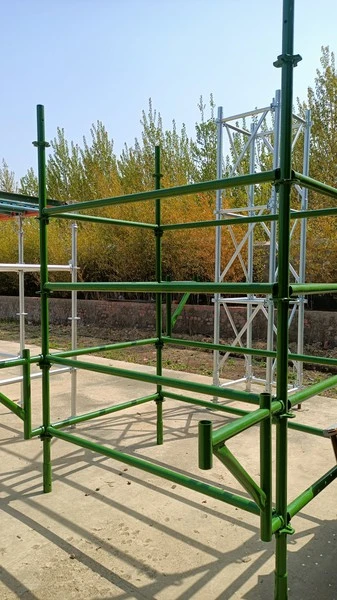
Understanding Rosette Ringlock Scaffolding: Basics and Components
The rosette node, which is a round disk welded right onto the vertical standard, is what makes a rosette ringlock scaffolding unique. This disk is the most important part of the whole structure.
Core Components and Their Roles
Each component in the system carries a specific structural function, and understanding what they do helps procurement teams specify orders with precision:
- Vertical standards: Q235B/Q355B steel tubes with an outside diameter of 48.3 mm or 60 mm and a wall thickness of 3.0 mm to 3.25 mm. They hold the rosette disks at a 500-mm pitch and take axial compression loads.
- Rosette disks (eight-hole daisy design): These have an eight-hole daisy pattern. Four small holes are spaced 90° apart to fit ledger wedge heads, and four big holes are spaced at different angles to fit diagonal braces. This shape makes a node that is structurally stable and can spread loads in more than one way without just using friction.
- Ledgers and transoms: When you hammer a ledger or transom into place, the cold-forged wedge heads of the horizontal members drop into the rosette holes. There are no nuts or other loose hardware.
- Base plates and screw jacks: These move loads from the ceiling to the ground and make it possible to level surfaces that aren't level.
- Diagonal braces: With diagonal braces, you can make the frame stronger against lateral racking forces, which is very important for tall buildings and open sites.
The system is made to meet the requirements of EN 12811, AS/NZS 1576, and ANSI/SSFI SC100, and it is specifically configured as rosette ringlock scaffolding. This gives procurement managers proof of load-capacity compliance that they can use for insurance and regulatory purposes.
Step-by-Step Guide on How to Make Rosette Ringlock Scaffolding
Making a rosette ringlock scaffolding that works well is an organized business process. Anywhere you cut corners, you end up with dimensional errors that make it impossible to swap out with current rental inventory. This is a real problem for asset-fleet owners that costs them money.
Raw Material Selection and Tube Preparation
Arriving materials are checked as the process starts. The Q235B or Q355B standards are compared to steel mill papers that show the amount of carbon and silicon in the steel. ±0.5 mm CNC cold saws are used to cut tubes to the right length. At this point, out-of-round tubes are thrown away because they make the wedge-heads stick together during field assembly.
Rosette Disk Welding
Plate steel is used to press rosette disks, which are then put on the standard using a special jig that sets the 500 mm pitch and rotational alignment. Robotic MAG welders make the circular filet weld in a single pass, which ensures a uniform entry depth that can be checked with ultrasound. Shandong Xingrui has 12 welding robots working on 6 automatic welding lines. This gets rid of weld variations between operators, which is a frequent reason for rejections during third-party checks.
Surface Treatment: Hot-Dip Galvanization
After being welded, each part is pickled in acid, fluxed, and put into a bath of melted zinc that is about 450 °C. The coating that forms then mechanically adheres to the steel base, covering the inside of pipes and weld seams—areas that pre-galvanized sheet just can't reach. The thinnest coating that can be used is 65 microns, and Xingrui aims for 65–80 microns, which has been shown to last more than 15 years in sea or petrochemical settings.
Dimensional Inspection and Quality Traceability
Every batch goes through go/no-go gage checks on the wedge-head shape and rosette hole sizes. Rosette thickness, outer diameter, and weld position are recorded against a batch number that can be used to track the product for its entire life. This traceability record is exactly what a compliance engineer needs to check source paperwork against EN 12810 or do an audit of a plant.
Advantages and Use Cases of This Modular Scaffolding System
When comparing rosette ringlock scaffolding to tube-and-clamp or cuplock options, procurement teams always run into the same problem: the cost of assembly labor. European scaffolding groups have released studies that show modular wedge-lock systems cut the time it takes to set up similar structures by 30–40% compared to standard tube-and-clamp setups.
Here are the core operational advantages that make this system a preferred choice for rental fleets and large-scale contractors:
- Bolt-free wedge locking: The gravity-assisted wedge only needs to be hit with a hammer, which cuts down on the time needed for skilled labor and gets rid of the need for a torque wrench on site.
- 360° multi-angle connectivity: The eight-hole daisy disk can fit non-orthogonal shapes, so scaffolders can cover cylinder-shaped tanks, curved walls, and crooked plant structures that aren't compatible with standard orthogonal systems.
- Reusability and long asset life: Parts made to the Q235B/Q355B standard with a 65+ micron HDG covering can be rented out over and over for 15+ years. This directly raises the ratio of assets used and lowers the cost-per-rental-day.
- Component interchangeability: Tubes and nodes from different production runs must be able to fit together smoothly because of consistent measurement precision. This is a must for rental companies that mix new stock with old stock.
These benefits lead to measurable gains in three main areas of business. The system's ability to work with irregular shapes is used by petrochemical sites to build scaffolding around storage tanks and refinery columns. It is used by civil infrastructure teams as heavy-duty shoring for casting bridge decks, which require a lot of axial load. Offshore and shipbuilding depend on the HDG coating and vibration-resistant wedge locks to keep working during salt spray cycles and movement caused by waves.
Comparing Ringlock Scaffolding with Other Scaffolding Types
Cuplock systems are fast, but they can only link at 90° angles, which means they can't be used on structures that are bent or don't fit together straight. Frame scaffolding works well for repetitive residential facades but can't handle the different bay widths that are common in industrial plant maintenance. Traditional tube-and-clamp allows for geometric freedom, but it requires highly skilled workers and makes joints that aren't always strong.
Rosette ringlock scaffolding is unique because it is flexible like a tube-and-clamp system but fast like a frame-system system. For rental companies that handle a wide range of projects, from fixing bridges to turning around factories, a single standard rosette ringlock scaffolding inventory covers more situations than any other system. This cuts down on the number of SKUs in the asset pool and makes warehouse management easier.
Procuring Rosette Ringlock Scaffolding: What You Need to Know
Getting things right for procurement starts long before a purchase order is sent out. Rental asset managers usually go through market benchmarking, standard compliance review, sample load testing, and factory checks over the course of six to twelve months before they sign a framework agreement.
Supplier Credentials to Verify
Any possible provider should have ISO 9001 (Quality Management), ISO 14001 (Environmental Management), and ISO 45001 (Occupational Health and Safety) certificates. These three certifications show that the company's methods for quality, the environment, and worker safety have been checked by a third party, which is what all ESG-compliant buying programs should do.
Sample Testing Protocol
Ask for samples of the finished product along with mill certificates and galvanization inspection records. Do load tests on the connections between the ledger and the rosette inside the company, and use calibrated gages to check the hole sizes in the rosette. Before you place a large order, make sure that the wedge-head geometry matches the rosette thickness of the parts you already have.
Conclusion
To make high-quality rosette ringlock scaffolding, you need to be very careful when choosing your materials, use accurate robotic welding, hot-dip galvanization, and be able to prove your measurements. People who work in procurement who know how this production sequence works can accurately evaluate suppliers, negotiate based on technical knowledge, and create rental asset pools that provide consistent safety performance and low lifecycle cost. A system made to EN 12810 standards with Q235B steel and a 65+ micron HDG finish gives rental fleet economics the dependability and flexibility they need.
FAQ
What determines the maximum safe height of a ringlock scaffold?
Engineers do calculations that look at how far apart the legs are, how often the diagonal bracing is used, the type of wind exposure, and the loads that are being put on the structure. Systems often go over 50 meters in well-braced configurations, but a licensed structural engineer must check the specific configuration.
Can components from different manufacturers be mixed?
It is highly advised not to mix unless the wedge-head geometry, rosette thickness, and hole width can all be physically tested and shown to be the same. Differences in size as little as 0.5 mm can stop wedge seating and make joint play unsafe.
Is hot-dip galvanization significantly better than pre-galvanized coatings?
Yes. Hot-dip galvanization creates a metallurgical link that covers internal surfaces and joint gaps at 65–80 microns. This gives the sheet about ten times the corrosion protection of pre-galvanized sheet, which only covers the outside at 15–20 microns.
What maintenance does a rental fleet require?
An inspection after the project is done should confirm the condition of the wedge, the flatness of the rosette disk, and the standard straightness, with a 0.2% error. Wedges that are bent need to be changed, and rosette disks that are warped need to be taken out of service.
What compliance standards should a procurement manager request?
For European markets, you should ask for test results that show they meet EN 12810/12811 standards, as well as mill certificates, records of galvanization inspections, and ISO management system certificates.
Partner with GREEN FORMWORK for Your Next Ringlock Scaffolding Order
Industrial-grade rosette ringlock scaffolding is made in a 79,800 m² facility with 12 welding robots and is certified under ISO 9001, ISO 14001, and ISO 45001. GREEN FORMWORK is backed by Shandong Xingrui Building Materials Co., Ltd. You can get samples that come with full technical documentation. You can email our buying team at sdxingruiqp@126.com or visit sdxingrui.com to talk about volume prices, OEM requirements, and your needs for a rosette ringlock scaffolding provider.
References
1. European Committee for Standardization. EN 12810-1: Facade Scaffolds Made of Prefabricated Components — Part 1: Product Specifications. CEN, 2003.
2. European Committee for Standardization. EN 12811-1: Temporary Works Equipment — Part 1: Scaffolds — Performance Requirements and General Design. CEN, 2003.
3. Standards Australia / Standards New Zealand. AS/NZS 1576.3: Scaffolding — Prefabricated and Tube-and-Coupler Scaffolding. SAI Global, 2019.
4. Scaffold & Access Industry Association. ANSI/SSFI SC100: Scaffold Safety Requirements. SAIA, 2021.
5. International Organization for Standardization. ISO 1461: Hot Dip Galvanized Coatings on Fabricated Iron and Steel Articles — Specifications and Test Methods. ISO, 2022.
6. Hadipriono, F. C., & Wang, H. K. "Analysis of Causes of Falsework Failures in Concrete Structures." Journal of Construction Engineering and Management, ASCE, 1986.
Learn about our latest products and discounts through SMS or email