- English
- French
- German
- Portuguese
- Spanish
- Russian
- Japanese
- Korean
- Arabic
- Greek
- German
- Turkish
- Italian
- Danish
- Romanian
- Indonesian
- Czech
- Afrikaans
- Swedish
- Polish
- Basque
- Catalan
- Esperanto
- Hindi
- Lao
- Albanian
- Amharic
- Armenian
- Azerbaijani
- Belarusian
- Bengali
- Bosnian
- Bulgarian
- Cebuano
- Chichewa
- Corsican
- Croatian
- Dutch
- Estonian
- Filipino
- Finnish
- Frisian
- Galician
- Georgian
- Gujarati
- Haitian
- Hausa
- Hawaiian
- Hebrew
- Hmong
- Hungarian
- Icelandic
- Igbo
- Javanese
- Kannada
- Kazakh
- Khmer
- Kurdish
- Kyrgyz
- Latin
- Latvian
- Lithuanian
- Luxembou..
- Macedonian
- Malagasy
- Malay
- Malayalam
- Maltese
- Maori
- Marathi
- Mongolian
- Burmese
- Nepali
- Norwegian
- Pashto
- Persian
- Punjabi
- Serbian
- Sesotho
- Sinhala
- Slovak
- Slovenian
- Somali
- Samoan
- Scots Gaelic
- Shona
- Sindhi
- Sundanese
- Swahili
- Tajik
- Tamil
- Telugu
- Thai
- Ukrainian
- Urdu
- Uzbek
- Vietnamese
- Welsh
- Xhosa
- Yiddish
- Yoruba
- Zulu
How Does A Crab Type Scaffolding System Enhance Construction Site Efficiency?
A crab type scaffolding system improves construction site efficiency by replacing slow, labor-intensive tube-and-clamp methods with a self-locking modular framework that assembles up to 40% faster. Its eight-hole chrysanthemum disc distributes vertical and lateral loads across multiple directions simultaneously, which reduces the risk of node failure under sustained pressure.
Workers spend less time on torque checks and rework, and the system's reusable Q235 steel components lower total project cost over repeated deployments. For bridge shoring, ultra-high formwork, and heavy basement support, this modular shoring system delivers measurable time and safety advantages that traditional scaffolding cannot match.
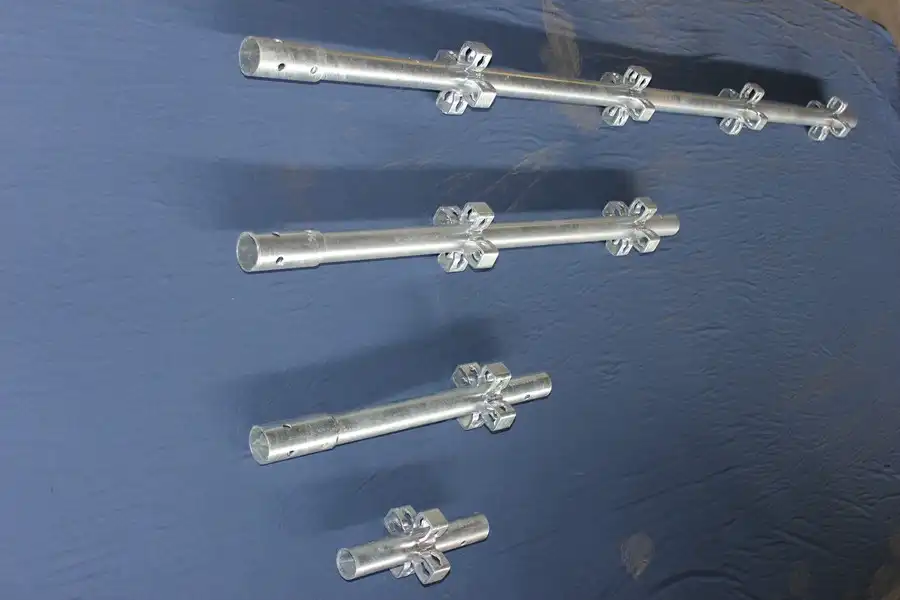
Understanding Crab Type Scaffolding Systems
Before spending money on a temporary works solution, buying teams need to know what makes a modular shoring tower different from a regular tube-and-clamp setup and why that difference is important for a heavy-load project.
What Defines This System
The name of the crab-style scaffolding system comes from the unique claw-shaped nodes on each standard. These nodes grip the horizontal ledger from different angles, making a strong connection that doesn't depend on the consistency of the worker's torque. This makes a self-aligning joint that gets tighter as the vertical load goes up.
Core Components
Each tower assembly has Q235 carbon steel uprights with an outer diameter of 60.3 mm, eight-hole chrysanthemum disks welded every 1.5 m, movable base jacks, U-head jacks, and interlocked ledgers. Every part is hot-dip galvanized to give it a zinc covering of 60–80 microns that will keep it from rusting over time.
Where It Differs from Cuplock and Ringlock
Cuplock methods use a top-cup-and-bottom-cup locking process that needs to be done by hand. For facade work, Ringlock gives you a lot of geometric freedom. On the other hand, the crab type scaffolding crab-joint system focuses on axial load capacity and rigidity at height. This makes it the best heavy-duty formwork support solution when spans are longer than normal or clearance heights are higher than 15 meters.
How Crab Type Scaffolding Improves Construction Site Efficiency
How efficient a building site is is shown by how many hours it saves, how much work it avoids, and how many crashes it stops. When it comes to three specific performance areas, modular tower shoring works better than older ways.
Faster Assembly and Disassembly
Because the joining places have already been thought out, you don't have to cut, fit, and clamp each tube separately. Field data from bridge deck projects shows that putting it together takes about 40% less time than with traditional bowl-buckle scaffolding. Crews can prepare tower parts on the ground and then use a crane to move them into place. This greatly reduces the risk of working at heights.
Improved Worker Safety and Output
The self-locking node gets rid of the most common mistake in assembly: fittings that are too loose. Instead of using a wrench, the joint tightens itself under load, so site supervisors can cut down on inspection time without raising the risk. The OSHA Scaffolding Standard (29 CFR 1926 Subpart Q) says that scaffolds must be able to hold four times the planned load. The crab system's safety factor of ≥3:1 under allowed load and its load range of 40 kN–75 kN meet these requirements.
Reduced Project Cost
The cost per cycle is cheaper for both contractors and renting companies when parts can be used more than once and have a service life of more than 15 years. Hot-dip galvanization stops the surface cracking that makes painted options wear out faster, which is especially important for coastal bridge projects where salt speeds up the rusting of steel. Less damage to parts means fewer repair orders and fewer problems with deliveries.
These improvements in performance directly lead to tighter project schedules and more stable procurement budgets — crab type scaffolding helps make both possible — which are two outcomes that technical directors and procurement managers always aim for.
Comparing Crab Type Scaffolding with Other Scaffolding Solutions
When buying heavy shoring, it's important to compare the load capacity, speed, and total lifecycle cost. In the table below, you can see how different popular methods stack up against the most important factors for big infrastructure projects.
Here are the main points of comparison that buying teams usually look at:
- Traditional tube and clamp: High flexibility in geometry but slow to assemble, prone to human error at joints, and limited to approximately 30 kN axial load per standard under typical field conditions.
- Bowl-buckle (cuplock) systems: Faster than tube and clamp, but the top-cup seating sequence requires careful supervision; axial capacity tops out around 40 kN per standard in most configurations.
- Ringlock scaffolding: Excellent for complex façade or multi-direction geometry; however, its rosette connection is optimized for access scaffolding rather than heavy vertical shoring at heights above 20 meters.
- Crab-joint modular towers: Self-locking nodes, 40–75 kN per standard capacity, 60.3 mm diameter uprights that outperform 48 mm alternatives by 35% in axial load tests, and 15+ year galvanized service life.
Each method can be used in the right way. When it comes to bridge viaduct shoring, building large industrial plants, and ultrahigh formwork, the crab system's axial load advantage and faster assembly speed give a better long-term return on investment. When rental companies add these towers to their fleet, they can charge more per day than normal frame scaffolds because the system can handle more weight and be used in more situations.
Selecting and Implementing Crab Type Scaffolding: A Practical Guide
To pick the correct modular shoring system, you need to go through a structured evaluation process that is directly linked to the project requirements.
Evaluate Load and Height Requirements
Start with the loads that the structural engineer figured out for each propping point. A single standard that can hold 75 kN needs a certain size base plate and the ability to support weight on the ground. Crab type scaffolding must meet the same requirement, so make sure the seller can give you load calculation papers and third-party test results; the owner and inspector must agree to these in order to approve high-clearance formwork projects.
Verify Supplier Credentials
Manufacturers of heavy-duty scaffolding with a good reputation have ISO 9001 certification for quality management, ISO 14001 certification for environmental management, and ISO 45001 certification for work safety. Getting a CE certificate means that the building meets European safety standards. Before bulk orders are placed, suppliers should also offer sample parts with records of their dimensions being checked.
Plan for Installation, Maintenance, and Custom Components
For non-standard spans and column grids, you may need custom-length ledgers or base plates that have been changed. Check with the supplier to make sure they can make these parts with ±1 mm drawing tolerances. Every year that they are used, locking pins and disk welds should be checked regularly. Because it is modular, worn-out parts can be replaced without having to throw away whole tower sections.
Future Trends in Heavy-Duty Modular Shoring
The modular shoring market is going toward better material use and digital integration. With BIM coordination, project engineers can now model full tower layouts before the steel arrives on site. This cuts down on clashes and improves the order of the tower's construction. IoT-enabled load sensors that are attached to each standard provide real-time data during concrete pours, which lets engineers know right away if the loads start to move around in ways they didn't expect.
When it comes to materials, companies are testing higher-yield steel grades to make walls thinner without lowering their axial strength. This would lower the shipping weight per ton of load capacity. Hot-dip galvanization is still the best way to treat the surface of something that will be used in harsh settings for 15 years or more, and there isn't a good replacement coating method that works as well in the field and costs as little.
Conclusion
Crab-joint modular shoring cuts down on the time it takes to put together, improves load control, and makes parts last much longer than with standard tube-and-clamp systems. It's easy to see why procurement managers should look for crab type scaffolding for heavy-duty formwork support in ultrahigh formwork applications, bridge shoring, or building industrial plants.
The system is made up of Q235 steel uprights, eight-hole disk connections that lock into place automatically, and hot-dip galvanized surfaces. It works reliably throughout the entire project lifecycle. When buying in bulk, choosing a manufacturer with certified production processes and the ability to make things to order takes away the risk.
FAQ
What load can a single standard carry?
Load capacity ranges from 40 kN to 75 kN per standard depending on upright diameter, ledger spacing, and height configuration. The 60.3 mm outer-diameter uprights used in Xingrui's system outperform 48 mm alternatives by approximately 35% in axial load testing.
How long do these components last?
With hot-dip galvanization at 60–80 microns zinc coating thickness and annual inspection of locking pins and welds, service life exceeds 15 years even in coastal or chemically aggressive environments.
Can non-standard components be manufactured to drawing?
Yes. Manufacturers such as Shandong Xingrui Building Materials Co., Ltd. accept custom fabrication orders based on customer-supplied drawings, with tolerances held to ±1 mm for critical connection geometry.
What certifications should I request from a supplier?
Request ISO 9001, ISO 14001, ISO 45001, and CE certification documentation. For US projects, verify compliance with ANSI/SSFI SC100-5/05 and confirm that structural load calculation books are available for inspector review.
Is this system compatible with standard accessories?
Yes. U-head jacks, base jacks, and steel deck planks that comply with ISO outer-diameter standards are compatible, provided the upright diameter matches the accessory specification.
Get Your Heavy-Load Shoring Quote from GREEN FORMWORK
You can directly contact Shandong Xingrui Building Materials Co., Ltd. through GREEN FORMWORK. They are a confirmed producer of crab-type scaffolding with 12 welding robots, over 40,000 m² of production space, and ISO 9001, 14001, and 45001 certifications. As a standard, our system can handle 40–75 kN. It comes with full documentation for load calculations and sample parts before bulk orders. To get details and prices right away, email our engineering team at sdxingruiqp@126.com or go to sdxingrui.com.
References
1. American National Standards Institute / Scaffold and Access Industry Association. ANSI/SSFI SC100-5/05: Scaffolding—Safety Requirements. ANSI, 2005.
2. European Committee for Standardization. EN 12810-1: Façade Scaffolds Made of Prefabricated Components—Part 1: Product Specifications. CEN, 2003.
3. Occupational Safety and Health Administration. OSHA Standard 29 CFR 1926 Subpart Q: Scaffolding. U.S. Department of Labor, 2013.
4. Chandrangsu, T., and Rasmussen, K. J. R. "Investigation of Geometric Imperfections and Joint Stiffness of Support Scaffold Systems." Journal of Constructional Steel Research, 2011.
5. Zhang, H., Chandrangsu, T., and Rasmussen, K. J. R. "Probabilistic Study of the Strength of Steel Scaffold Systems." Structural Safety, 2010.
6. Peng, J. L., Pan, A. D., and Chen, W. F. "Approximate Analysis Method for Modular Tubular Falsework." Journal of Structural Engineering, ASCE, 1998.
Learn about our latest products and discounts through SMS or email