- English
- French
- German
- Portuguese
- Spanish
- Russian
- Japanese
- Korean
- Arabic
- Greek
- German
- Turkish
- Italian
- Danish
- Romanian
- Indonesian
- Czech
- Afrikaans
- Swedish
- Polish
- Basque
- Catalan
- Esperanto
- Hindi
- Lao
- Albanian
- Amharic
- Armenian
- Azerbaijani
- Belarusian
- Bengali
- Bosnian
- Bulgarian
- Cebuano
- Chichewa
- Corsican
- Croatian
- Dutch
- Estonian
- Filipino
- Finnish
- Frisian
- Galician
- Georgian
- Gujarati
- Haitian
- Hausa
- Hawaiian
- Hebrew
- Hmong
- Hungarian
- Icelandic
- Igbo
- Javanese
- Kannada
- Kazakh
- Khmer
- Kurdish
- Kyrgyz
- Latin
- Latvian
- Lithuanian
- Luxembou..
- Macedonian
- Malagasy
- Malay
- Malayalam
- Maltese
- Maori
- Marathi
- Mongolian
- Burmese
- Nepali
- Norwegian
- Pashto
- Persian
- Punjabi
- Serbian
- Sesotho
- Sinhala
- Slovak
- Slovenian
- Somali
- Samoan
- Scots Gaelic
- Shona
- Sindhi
- Sundanese
- Swahili
- Tajik
- Tamil
- Telugu
- Thai
- Ukrainian
- Urdu
- Uzbek
- Vietnamese
- Welsh
- Xhosa
- Yiddish
- Yoruba
- Zulu
How to Choose Fast Cuplock Scaffolding for Your Construction Needs
Choosing the right scaffolding system can make or break a project timeline. Fast cuplock scaffolding is a modular support system built around a fixed bottom cup and a sliding top cup that locks up to four horizontal ledgers to one vertical standard in a single action. This self locking design eliminates the need for unsecured bolts or wedges, reduces construction time by up to 40% over typical bowl buckling frames and decreases labour expenses substantially. Whether you are dealing with bridge building or industrial maintenance, or high-rise formwork, this book will take you through all the factors that matter before you sign a purchase order.
Understanding Fast Cuplock Scaffolding: Features and Benefits
Before you compare price models or suppliers, it's helpful to know what makes this system different from past ones at the component level.
Core Components and How the Node Works
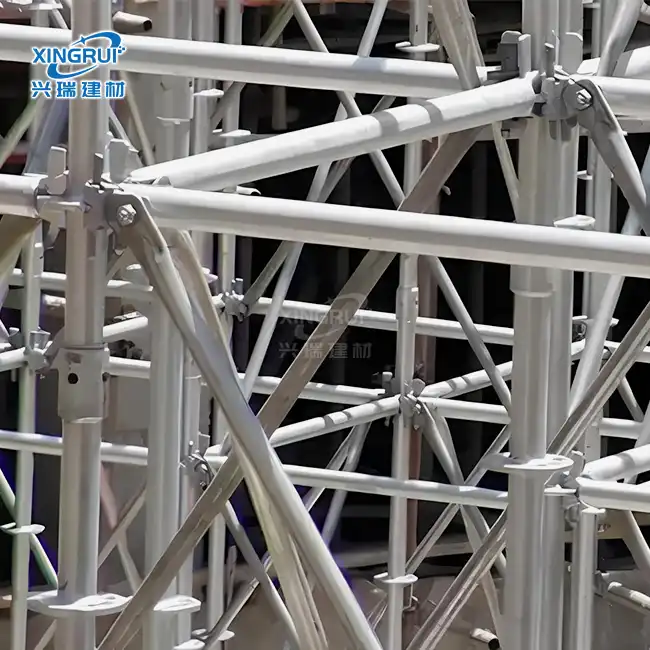
The system consists of the diagonal braces, vertical standards, horizontal ledgers and the signature cup node. Every 0.5 m a bottom cup is welded to the standard. If you are using a system from Shandong Xingrui Building Materials Co., Ltd., the top cup will glide down and over the ledger blades. In the top cup there is a spring that mechanically connects all four connections simultaneously so no hammer is necessary.
Material and Surface Treatment
Cup lock parts manufactured by Xingrui are constructed of Q235 high strength carbon steel. The tubes are 48.3 mm in diameter and 3.2–3.5 mm thick-walled. 65-85 micron hot-dip galvanisation (HDG) fulfils ASTM A123 criteria and provides each item with a field service life of well over 15 years, even in marine or industrial environments.
Key Performance Advantages
The spring-loaded auto-locking mechanism gives real-world benefits. Here are the main ways this system improves performance:
- Speed: Erection efficiency is 40% higher than traditional bowl buckle frames, and 3–5 times faster than tube-and-clamp methods, according to published field comparisons.
- Load capacity: Each standard supports up to 60 kN (varies by configuration), satisfying BS EN 12811-1 and ANSI/SSFI SC100-5/05 requirements for heavy-duty shoring.
- Zero loose parts: The self-locking cup eliminates bolts and wedges, reducing component loss and the safety risks tied to improperly tightened fittings.
More productivity means less work for less money—up to 35% less than with tube-and-clamp—and faster project schedules, which are very important when penalties for missing milestones are possible.
Key Criteria for Choosing Fast Cuplock Scaffolding
With the fundamentals clear, procurement teams need a structured checklist to evaluate competing offers objectively.
Safety Standards and Certification
Always confirm that the fast cuplock scaffolding supplier can provide third-party documentation. Look for conformity with BS EN 12811-1 for access and working scaffolds, ANSI/SSFI SC100-5/05 for the North American market and ISO 9001 quality management certification. Xingrui is also accredited to ISO 14001(Environmental) and ISO 45001(Occupational Health & Safety) standards, which many EPC customers now need as part of the contract. The minimum requirement for Q235 steel is the batch-level Mill Test Certificates (MTC), which is not optional.
Cost Structure and Lifecycle Value
The Upfront unit price is only one data point. A galvanised cup-lock system with a service life of 15 years costs a lot less per project cycle than a painted system that has to be re-finished every two to three years. Also consider the reusability of Xingrui’s made-to-order system and its design for repeated cycles, as well as the expenses of storage, shipping and maintenance before you make a final financial comparison versus ringlock or kwikstage alternatives.
Customization and Sample Availability
Large EPC contracts often need non-standard bay lengths or special base configurations. Confirm the supplier accepts custom orders based on client drawings and can deliver samples within 7–14 days. Xingrui's 79,800 m² facility, equipped with 12 welding robots and 6 automatic welding lines, supports exactly this kind of responsive, specification-driven production. Technical support is available on call to resolve drawing queries before production starts.
Fast Cuplock Scaffolding vs. Other Popular Scaffolding Systems
Cup-Lock vs. Ringlock Scaffolding
Ringlock systems use a rosette plate and wedge pin, allowing connections at eight angles. This gives more geometric flexibility on curved structures. Fast cuplock scaffolding, by contrast, connects at 90-degree intervals, which suits orthogonal layouts—typical of building cores, bridge falsework, and industrial shoring bays—and assembles faster because the spring mechanism requires no separate wedge drive.
Cup-Lock vs. Kwikstage Scaffolding
Kwikstage systems are common in Australia and the UK for access scaffolding on facades. Their pressed-steel spigots are quick to assemble but carry lower axial loads than a Q235 cup-lock standard. For heavy formwork shoring where vertical loads exceed 30 kN per standard, cup-lock is the stronger technical choice and meets the higher end of international load tables.
Selecting Based on Project Type
Bridge decking, tunnel lining, and industrial plant turnarounds consistently favor fast cup-lock scaffolding because the system adapts to irregular terrain through adjustable base jacks, scales to 50+ meter tower heights with proper engineering, and completes assembly cycles faster than any wedge-based alternative. For simple facade access at moderate heights, a kwikstage or ringlock system may be more cost-efficient.
Procurement Tips: Where and How to Acquire Fast Cuplock Scaffolding?
Sourcing the right modular shoring system involves more than finding a low unit price.
Verifying Supplier Credentials
Request ISO certificates, CE declarations of performance, and recent third-party inspection reports. Suppliers exporting to 100+ countries, as Xingrui does, typically maintain documentation packages that satisfy both European and North American project audits. If your client requires a factory audit, confirm the supplier's willingness to host third-party inspections before issuing a purchase order.
Understanding Trade Terms and Lead Times
Standard lead times from a production-ready facility run 15–30 days for stock specifications. Custom orders may add 7–14 days for sample approval. Xingrui ships from Rizhao Port in Shandong Province, a seaport with direct container routes to major global hubs, which reduces inland transit exposure. Typical payment terms follow a 30%–50% TT deposit structure, with the balance released against shipping documents.
After-Sales Support and Warranty
Confirm the fast cuplock scaffolding supplier provides written warranty terms and a clear process for handling batch defects discovered after delivery. Technical support on call, spare component availability, and responsive documentation handling all reduce project risk, particularly when your site is far from the manufacturer's location.
Installation, Safety, and Best Practices
Proper setup determines whether the system delivers its rated performance in the field.
Step-by-Step Erection Sequence
Begin with a level base plate and adjustable screw jack on compacted ground. Insert vertical standards, connect base ledgers into the bottom cups, then slide top cups down to lock horizontal members at each node. Install diagonal braces per the engineer's layout drawing. No special tools are needed beyond a rubber mallet for minor alignment corrections—the spring mechanism handles final engagement.
Compliance and On-Site Safety Protocols
OSHA 29 CFR 1926 Subpart Q governs scaffolding in the United States and requires competent-person inspection before each work shift. Node-point shear tests and vertical compression tests at the design load should be completed before any structure exceeds two lifts. Check top cups for deformation, inspect weld integrity around bottom cups, and retire any standard showing visible cracks or corrosion pitting.
Routine Maintenance to Extend Asset Life
After each project, clean mud and concrete residue from cup nodes, inspect galvanization for bare spots, and store components off the ground. A well-maintained HDG cup-lock set can cycle through dozens of projects before showing measurable wear, directly improving the return on your capital asset investment.
Conclusion
Three things are important when choosing the right fast cuplock scaffolding system: the approved load performance, the supplier's dependability, and the total cost over the life of the system. All three of these things are always met by fast cup-lock scaffolds in bridge, tunnel, and industrial propping situations. Before making a commitment, check the certifications, ask for samples, and make sure they can handle custom orders. Shandong Xingrui is a good choice for procurement teams that need to meet tight delivery dates because it has a production infrastructure, a history of exporting to other countries, and on-call technical support.
FAQ
Q1: How does the spring-locking mechanism differ from a traditional hammer-driven cup?
A: In traditional bowl-buckle setups, the top cup has to be hit with a hammer to make it stay in place. The spring-loaded design of Xingrui automatically engages when the top cup falls over the ledger blades. This gets rid of the need for a hammer step and cuts the time it takes to put together nodes by about 40%.
Q2: Can the system be customized for non-standard bay dimensions?
A: Yes, Xingrui takes orders based on drawings provided by the customer and sends models within 7–14 days. The automated welding lines at the facility can handle precise size tolerances for custom lengths, base plates, and special connection parts.
Q3: What certifications should I request before placing a bulk order?
A: Ask for at least ISO 9001, CE paperwork or a Declaration of Performance, and batch-level MTC for the steel grade. For US projects, make sure they follow ANSI/SSFI SC100-5/05. It is also certified by ISO 14001 and ISO 45001, which are other standards.
Q4: What are typical shipping timelines for large orders?
A: Stock-specification orders usually ship 15 to 30 days after the deposit is confirmed. It takes about 25 to 35 days for sea freight to get from Rizhao Port to major US East Coast ports. It takes an extra 7–14 days for custom orders to be made after the samples are approved.
Q5: Is the system reusable across multiple projects?
A: Yes, cycling can be done over and over again on Q235 steel with an HDG coating. If you clean and store parts properly after each project, they will stay within their serviceable range for 15 years or more in normal conditions.
Request a Quote from GREEN FORMWORK — Your Fast Cuplock Scaffolding Supplier
With help from Shandong Xingrui Building Materials Co., Ltd., GREEN FORMWORK sells fast cuplock scaffolding that is certified by ISO 9001, ISO 14001, and ISO 45001 to builders in more than 100 countries. Our Q235 steel parts, spring-auto-locking nodes, and ability to make to order make us a reliable source for big projects. You can email our team at sdxingruiqp@126.com to get samples, look over technical specs, or start your inquiry right away.
References
1. British Standards Institution. BS EN 12811-1: Temporary Works Equipment — Scaffolds — Performance Requirements and General Design. BSI, 2003.
2. Scaffold & Access Industry Association. ANSI/SSFI SC100-5/05: Scaffolding — Safety Requirements. SAIA, 2005.
3. American Society for Testing and Materials. ASTM A123/A123M: Standard Specification for Zinc (Hot-Dip Galvanized) Coatings on Iron and Steel Products. ASTM International, 2017.
4. Occupational Safety and Health Administration. OSHA 29 CFR 1926 Subpart Q: Scaffolds. U.S. Department of Labor, 2020.
5. International Organization for Standardization. ISO 9001:2015 — Quality Management Systems: Requirements. ISO, 2015.
6. Peurifoy, R. L., Schexnayder, C. J., & Shapira, A. Construction Planning, Equipment, and Methods. McGraw-Hill Education, 2010.
Learn about our latest products and discounts through SMS or email