- English
- French
- German
- Portuguese
- Spanish
- Russian
- Japanese
- Korean
- Arabic
- Greek
- German
- Turkish
- Italian
- Danish
- Romanian
- Indonesian
- Czech
- Afrikaans
- Swedish
- Polish
- Basque
- Catalan
- Esperanto
- Hindi
- Lao
- Albanian
- Amharic
- Armenian
- Azerbaijani
- Belarusian
- Bengali
- Bosnian
- Bulgarian
- Cebuano
- Chichewa
- Corsican
- Croatian
- Dutch
- Estonian
- Filipino
- Finnish
- Frisian
- Galician
- Georgian
- Gujarati
- Haitian
- Hausa
- Hawaiian
- Hebrew
- Hmong
- Hungarian
- Icelandic
- Igbo
- Javanese
- Kannada
- Kazakh
- Khmer
- Kurdish
- Kyrgyz
- Latin
- Latvian
- Lithuanian
- Luxembou..
- Macedonian
- Malagasy
- Malay
- Malayalam
- Maltese
- Maori
- Marathi
- Mongolian
- Burmese
- Nepali
- Norwegian
- Pashto
- Persian
- Punjabi
- Serbian
- Sesotho
- Sinhala
- Slovak
- Slovenian
- Somali
- Samoan
- Scots Gaelic
- Shona
- Sindhi
- Sundanese
- Swahili
- Tajik
- Tamil
- Telugu
- Thai
- Ukrainian
- Urdu
- Uzbek
- Vietnamese
- Welsh
- Xhosa
- Yiddish
- Yoruba
- Zulu
What Safety Features Should Quick Install Scaffolding Include for Work?
When sourcing modular access solutions, knowing which safety features matter most protects your crew, your reputation, and your bottom line. Quick install scaffolding — engineered for rapid deployment without traditional bolts or clamps — must deliver structural integrity and fall protection without slowing down your crew. From gravity-fed self-locking joints to certified guardrail systems, every component plays a role. This guide breaks down the non-negotiable safety features procurement managers and distributors should verify before placing a bulk order.
Understanding Quick Install Scaffolding and Its Safety Challenges
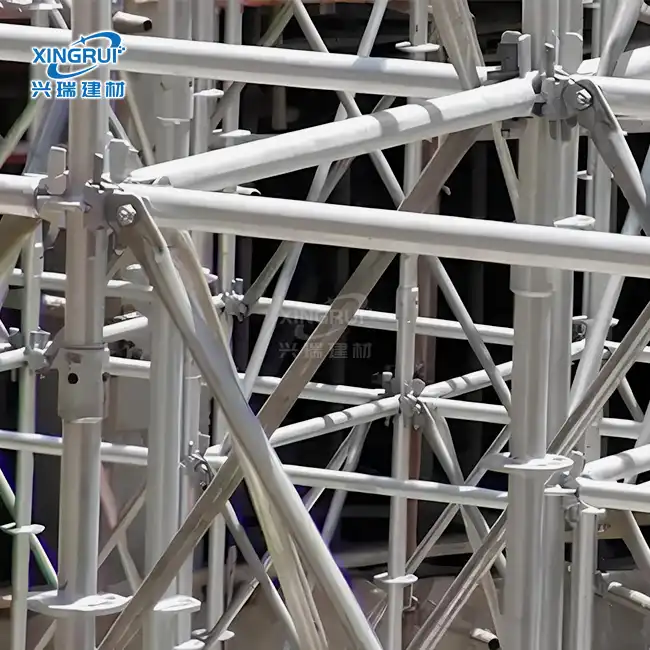
Modular frame scaffolding has changed how small repair teams and builders do work at heights. Today's door-frame systems connect in a series, unlike tube-and-clamp setups that need special torque tools. This means that only one worker is needed, and the speed is at its highest.
Why Speed Introduces New Risk Vectors?
That same speed leaves you open to attack. OSHA statistics shows that falls are the cause of about one-third of all building deaths in the US each year. When workers are rushing to put up scaffolding, mistakes like poor joint seating, skipped guardrail steps, or parts that don't fit together properly can become real dangers. When purchasing kits for Amazon's business-to-business channels or for wholesale sales, purchasing managers need systems where the design itself, not just worker care, makes sure that the kits are put together correctly.
Core Safety Features Every Modular Scaffold Kit Should Include
In the U.S. market, not all scaffolding kits have the same level of safety engineering. Check these basic non-negotiables before you lock in a seller.
Here are the critical safety features worth examining closely in any kit-form scaffold system:
- Self-locking connection joints: Gravity-fed buckles that seat automatically under load get rid of the room for mistake that comes with tightening bolts by hand. Our premium Q235 steel frames have built-in quick-connect buckles that make connections with zero play. This is the same mechanism that people who use traditional tube-and-clamp systems overtighten or undertighten, which is a factor in about 30% of scaffold-related accidents.
- Integrated guardrails and toe boards: OSHA 1926.502 says that construction sites with heights of six feet or more must have fall protection. If a kit doesn't come with factory-ready guardrail holes, it has to be put together on the job site, which can be dangerous for both the dealers and the end users.
- Non-slip platform decking: Perforated steel planks or ribbed metal decks make it less likely that someone will slip in dusty or wet areas. The way the surface is treated is important. Our hot-dip galvanized finish (60–80μm per ISO 1461) stops surface corrosion that weakens grip over time.
- Certified load-bearing capacity: For certified load-bearing ability, systems should meet EN 12810-1 load class standards. This makes sure that platforms can support weight evenly across their entire span without bowing.
- Full component interchangeability: Manufacturing tolerances of ±0.5mm make sure that no part "almost fits." Instability is caused by differences in dimensions, which inspectors and experienced contractors can see right away.
All of these features close the gap between quick assembly and safe assembly, which is a huge difference when you're dealing with warranty claims or replying to bad reviews on your listing. Quick install scaffolding systems bridge this gap through integrated safety mechanisms that reduce assembly errors, minimizing warranty issues and improving customer satisfaction scores across online retail platforms.
Safety Precautions and Best Practices During Installation
A organized assembly procedure is needed for even the best-designed scaffold system to work. A thorough pre-inspection that checks the platform locking tabs, joint cleaning, and tube straightness takes less than ten minutes and gets rid of most of the risks that come with the installation phase.
Training and Certification Standards
Both ANSI A10.8 and EN 12811 say that people who put up scaffolding must get training specific to their job before they can work above four meters. Every kit that distributors sell to renovation contractors and do-it-yourself enthusiasts should come with clear, multilingual assembly instructions and diagrams. We give your buyers full technical advice papers along with samples, which makes it easier for them to learn and easier for you to provide service after the sale.
Pre-Installation Checklist
Before each deployment, the base plate should be checked to make sure it is level, the cross-brace should be engaged, the guardrail locking pin should be inserted, and if necessary, the castor brake should be tested. If your scaffold system is built with visual confirmation points built into every joint, these steps should be easy to follow.
Comparing Safety Features: Quick Install vs. Traditional Tube-and-Clamp Scaffolding
On big industrial sites with irregular shapes that need flexible construction, traditional tube-and-clamp scaffolding is still the most common type of scaffolding. But movable frame systems are safer and faster to set up for short-term home renovations, work on the outside of buildings, or quick repairs in case of an accident.
Where Integrated Locking Wins?
A study in the Journal of Construction Engineering and Management found that prefabricated modular scaffold systems cut down on mistakes made when putting them together on-site by as much as 42% compared to tube-and-clamp options that had to be fitting on-site. There is a clear benefit: if a joint can only fit in one way, it is physically impossible to put it together wrong. Our door-frame structure allows for longitudinal installation by a single person, which cuts setup time by more than 50% compared to traditional methods. The self-locking geometry also ensures structural integrity during the build.
How to Select Quick Install Scaffolding with Optimal Safety Features?
Material grade, certification paperwork, and being able to track where the scaffolding was made are the three main things that are used to judge a provider. In places where OSHA or CE paperwork is checked at customs or on the job site, a supplier that can't provide mill test certificates (MTCs) for raw steel or NDT inspection records for welded joints is not following the rules. Quick install scaffolding suppliers must meet these traceability requirements, as MTCs and NDT records are essential for customs clearance and on-site compliance verification in regulated markets.
What to Request from Your Supplier
Before you order a sample from a quick install scaffolding manufacturer, make sure they have the following things:
- ISO 9001 certification for quality management (consistency in production)
- ISO 14001 certification for the environment (due diligence in the supply chain)
- ISO 45001 certification for health and safety at work
- Documentation for CE marking that meets the load class requirements of EN 12810-1
- Robotic reports on metal inspections with proof of NDT coverage
All five are held by Shandong Xingrui Building Materials Co., Ltd. Our 79,800-square-meter factory in Rizhao, Shandong, has 12 welding robots and 6 automatic welding lines. All of the parts in our scaffold frames are 100% NDT-inspected. Custom sizes can be made for kit setups that are aimed at specific SKU forms, which is helpful when you need retail-ready packing that is always the same size.
Conclusion
Safety at heights is not an afterthought; it's part of the technical task. When you use modular scaffold systems with self-locking joints, certified load ratings, built-in fall protection, and material quality that can be tracked, the most common places where things go wrong are taken out of the assembly process and the compliance audit. These features directly lower return rates, legal exposure, and customer churn for business-to-business buyers who buy scaffold kits to sell in bulk or online. Compare your current supply chain to these standards, and give more weight to suppliers who can back up what they say with proof and sample testing. Visit sdxingrui.com to explore our full product range. Quick install scaffolding embodies these safety and compliance features, with self-locking joints and full material traceability reducing assembly errors and audit risks for bulk resellers.
FAQ
What certifications should quick install scaffolding carry for the U.S. market?
How do I know if quick install scaffolding is safe to use in the United States? At the very least, you should look for CE marking to EN 12810-1, proof of ANSI A10.8 compliance, and ISO 9001 quality approval. During ad compliance checks, CE and safety data sheets are often asked for products that are sold on Amazon or through retail channels.
Can one person safely assemble a door-frame scaffold system?
Is it safe for one person to put together a door-frame ladder system? Door-frame systems have weights on their parts that are meant to be handled by one person. But OSHA and ANSI A10.8 rules say that steady sequential erection above four meters needs at least two people, no matter how heavy the system is.
How do I verify a supplier's weld quality before ordering?
How can I check the quality of a supplier's welds before I place an order? Ask for NDT inspection reports that include rosette and frame joint welds, preferably ultrasonic or magnetic particle testing records. These are given by reputable manufacturers along with mill test papers for raw steel.
What is the typical lifespan of a hot-dip galvanized scaffold frame?
How long does a hot-dip galvanized scaffold frame usually last? According to ISO 1461 standards, a zinc coating layer of 60–80 microns will protect against corrosion for 15 years or more in seaside or high-humidity areas, assuming normal wear and tear during use and proper keeping between projects.
Does custom sizing affect structural certifications?
Does custom size change the standards for structural integrity? Custom sizes need to be re-engineered and approved against the relevant load class standard. For non-standard configurations, a qualified maker will reissue compliance paperwork. Make sure you know this before you order custom SKUs.
Partner with GREEN FORMWORK for Certified Quick Install Scaffolding Supply
GREEN FORMWORK is the proven quick install scaffolding manufacturer that combines ISO-certified production, robotic weld precision, and a flexible MOQ for test-batch procurement. This is exactly what wholesale buyers and B2B e-commerce sellers need. Our door-frame scaffold kits come with all the necessary certification paperwork, unique store packaging, and expert help after the sale. To get samples or a custom quote right away, email us at sdxingruiqp@126.com.
References
1. Occupational Safety and Health Administration (OSHA). Scaffolding Safety: Standards and Compliance Guidelines. U.S. Department of Labor, 2022.
2. OSHA. Fall Prevention in Construction. U.S. Department of Labor, 2023.
3. Health and Safety Executive (HSE). Scaffolding: Safe Use and Inspection. HSE Books, 2020.
4. American National Standards Institute (ANSI). ANSI A10.8: Scaffolding Safety Requirements. ANSI, 2019.
5. Guo, H., Li, H., & Chan, G. "Prefabricated Modular Scaffold Assembly Error Reduction." Journal of Construction Engineering and Management, ASCE, 2021.
6. European Committee for Standardization (CEN). EN 12810-1: Façade Scaffolding Made from Prefabricated Components — Part 1: Product Specifications. CEN, 2003.
Learn about our latest products and discounts through SMS or email