- English
- French
- German
- Portuguese
- Spanish
- Russian
- Japanese
- Korean
- Arabic
- Greek
- German
- Turkish
- Italian
- Danish
- Romanian
- Indonesian
- Czech
- Afrikaans
- Swedish
- Polish
- Basque
- Catalan
- Esperanto
- Hindi
- Lao
- Albanian
- Amharic
- Armenian
- Azerbaijani
- Belarusian
- Bengali
- Bosnian
- Bulgarian
- Cebuano
- Chichewa
- Corsican
- Croatian
- Dutch
- Estonian
- Filipino
- Finnish
- Frisian
- Galician
- Georgian
- Gujarati
- Haitian
- Hausa
- Hawaiian
- Hebrew
- Hmong
- Hungarian
- Icelandic
- Igbo
- Javanese
- Kannada
- Kazakh
- Khmer
- Kurdish
- Kyrgyz
- Latin
- Latvian
- Lithuanian
- Luxembou..
- Macedonian
- Malagasy
- Malay
- Malayalam
- Maltese
- Maori
- Marathi
- Mongolian
- Burmese
- Nepali
- Norwegian
- Pashto
- Persian
- Punjabi
- Serbian
- Sesotho
- Sinhala
- Slovak
- Slovenian
- Somali
- Samoan
- Scots Gaelic
- Shona
- Sindhi
- Sundanese
- Swahili
- Tajik
- Tamil
- Telugu
- Thai
- Ukrainian
- Urdu
- Uzbek
- Vietnamese
- Welsh
- Xhosa
- Yiddish
- Yoruba
- Zulu
Rosette Ringlock Scaffolding Uses in High-Rise Construction Projects
When a project rises above 20 stories, the scaffolding system you choose stops being a background decision and becomes a structural one. Rosette ringlock scaffolding has become the preferred modular access system for high-rise construction across Europe and North America precisely because it handles vertical scale without sacrificing speed or safety. Its eight-hole daisy-type rosette joint allows connections at multiple angles without bolts or loose hardware, making it a dependable choice where height, load, and crew safety all demand the highest standard.
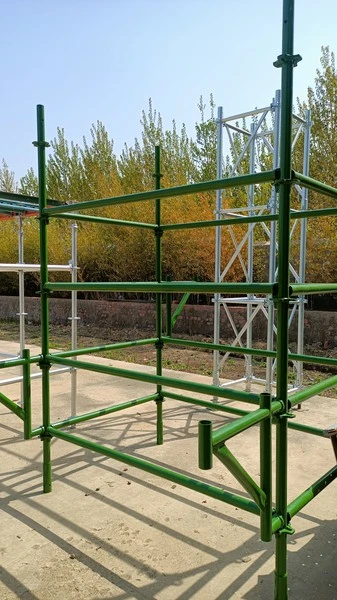
Understanding Rosette Ringlock Scaffolding and Its Components
The Rosette Connector: The Heart of the System
This method is different from past ones because of the circular rosette disk that is welded every 0.5 meters along each vertical standard. There are eight connection points on each disk: four smaller holes for ledgers at 90-degree angles and four larger holes for diagonal braces at angles that can be changed. This shape makes a stable structural node that spreads weight in all directions without needing a single bolt on-site.
Core Components You Need to Know
Vertical standards (uprights), horizontal ledgers, diagonal braces, base jacks, and top jacks make up the key parts of the system. Every part in our line is made from either Q235B or Q355B steel, and the pipe sizes are 48.3mm or 60mm, and the wall thicknesses are 3.0mm to 3.25mm. With one hammer blow, the wedge-locking head on each ledger engages the rosette and locks it in place. You don't need a torque wrench, and the nuts won't fall off because they're too high up.
Why Component Precision Matters for Rental Fleets
Dimensional tolerance is important for procurement managers who are in charge of a rental asset pool because it determines whether new stock can be mixed with old stock on a real job site. This is especially critical for rosette ringlock scaffolding, where components from different batches must connect reliably on site. Our parts are made following a strict quality tracking system that includes go/no-go gage tests at every stage of production. This makes sure that every piece that leaves our 79,800-square-meter factory in Rizhao, Shandong, has the same dimensions as the last order.
Key Advantages of Ringlock Scaffolding in High-Rise Projects
Working at heights quickly shows up any weaknesses in a scaffolding system. Wind loads go up with height, crews are always rotating, and any delays in putting up or taking down the structure add to the costs of the project. Because it works better in tall buildings, this method stands out in the following ways:
- No loose hardware at height. The wedge-locking mechanism is gravity-assisted and self-retaining. Once struck into the rosette, it will not dislodge under vibration or wind, which directly reduces the risk of dropped-object incidents — a leading cause of fatalities on high-rise sites.
- Hot-dip galvanization at 65–80 microns. This zinc coating covers internal pipe surfaces and weld seams, not just external faces. In coastal or high-humidity environments, it delivers a documented service life exceeding 15 years, keeping asset depreciation low and insurance costs predictable.
- 360-degree connection flexibility. The eight-hole rosette accepts connections at any of its angular positions, so the same components that build a straight facade scaffold can reconfigure into curved or angled geometry around irregular façades or architectural protrusions without cutting or bending.
These benefits directly lead to lower labor costs per square meter of access, longer asset life between repairs, and fewer safety issues. All of these things are important to a supply chain manager who is figuring out the total cost of ownership for a rental fleet.
Comparison: Ringlock vs. Other Scaffolding Systems
Ringlock vs. Cuplock
A top cup and a bottom cup are used in cuplock systems to lock more than one ledger at a single node. They work well for simple rectangular buildings, but not so well for projects with bent faces, tapered towers, or floor plates that aren't square. Rosette ringlock scaffolding can work with those shapes without any extra adapters. Ringlock systems also have higher nodal shear resistance in third-party load tests when the steel weights are the same.
Ringlock vs. Kwikstage and Frame Scaffolding
People like Kwikstage for home and light business projects where speed and low cost per bay are important. In North America, frame scaffolding is often used for low-rise work. Ringlock has the highest vertical load capacity per standard of any system. This is important when holding high-level access platforms or shoring up formwork for high-level concrete pours. To get the most out of its fleet, a rental company can use ringlock to make it more useful for both normal building work and difficult infrastructure projects.
Cost-Benefit Perspective for Procurement
Ringlock parts are more expensive than standard frame or kwikstage systems when you buy them all at once. But the per-use cost is much lower over the asset's life when you consider its 15-year or longer service life, lower labor costs per erection cycle, and the fact that the same inventory can be used on a wider range of projects. In the European market, rental companies have constantly said that ringlock assets get more use and make more money per renting day than cuplock assets of the same type.
Practical Guide: Installation, Usage, and Maintenance in High-Rise Projects
Site Assessment and Sequential Assembly
As soon as the first standard is poured, the correct base plate and sole board plan must be checked against the load transfer line of the building. The plumb standards are set to within 0.2% of the true line, the base jacks are changed, and the ledgers are locked in place from the bottom bay up. This order keeps the structure stable at all times, instead of relying on a rigid frame that is already built.
Applications Beyond the Facade
The ringlock parts that are used for external access scaffolding can be changed into internal shoring towers for slab formwork, loading platforms, stair towers, and cantilever fan decks on a high-rise building site. This is the real practical value of the system: one inventory pool can serve multiple apps at the same time for a single job, which means a contractor doesn't have to hire as many assets.
Maintenance Protocol That Protects Your Asset Value
The standards should be checked for bent wedge heads, deformed rosette disks, and standards that aren't straight after each project cycle. Wedges that have obvious curves should be changed because they are cheap parts. If standards are found to be not straight enough by 0.2%, they should be taken out of service. It only takes a few minutes per piece to use magnetic induction to check the zinc covering on returned rosette ringlock scaffolding parts. This will show you any places where the galvanization has worn down below 50 microns, so you can treat those parts again before the next hire cycle.
How to Choose and Source Rosette Ringlock Scaffolding for Your Project
Certifications and Standard Compliance
You should make sure that any supplier you look at has test reports that show they meet EN 12810 and EN 12811 standards for the European market or ANSI/SSFI SC100 standards for the US market. In addition to ISO 9001, Shandong Xingrui Building Materials Co., Ltd. also has ISO 14001 for environmental management and ISO 45001 for health and safety at work. All of the goods have got CE Certification. You can look over these papers before you decide to buy something.
Sampling and Technical Validation Before Bulk Orders
Before a buyer commits to a bulk order, we give them physical samples that come with full technical support, such as dimensional reports, zinc coating thickness test data, and load test certificates. We always do this during the sales process because we know that a rental company's buying process needs approval from more than one client, such as safety engineers, warehouse managers, and finance. Our facility in Rizhao has direct access to Rizhao Port, which cuts down on wait times compared to producers in the interior.
Supplier Selection Criteria That Reduce Long-Term Risk
A trustworthy ringlock scaffolding provider should be able to show that their raw materials can be tracked back to mill certificates, that their measurements are always accurate across batches, that they will supply extra parts for a long time, and that their factory is ready for an audit.
We make things in more than a dozen specialized workshops that are equipped with 12 welding robots and 6 automatic welding lines. We send our goods to over 100 countries and have good relationships with many of them so they keep ordering from us. We can do OEM work based on samples and plans provided by the customer.
Conclusion
Every scaffolding system in high-rise building is put to the test by wind loads, long raising cycles, and the need for parts that work the same way after hundreds of reuse cycles. The hot-dip galvanized finish, wedge-locking rosette ringlock scaffolding joint, and ability to work with EN 12810/12811 standards make the ringlock system a smart choice for rental companies and builders who need equipment that will last and do its job. Shandong Xingrui Building Materials Co., Ltd. builds these systems to customers' specifications, helps buyers with samples and technical validation, and keeps enough production capacity to safely meet big orders with multiple containers.
FAQ
What is the maximum height for ringlock scaffolding on a high-rise project?
There is no fixed upper limit set by the system itself. Heights above 50 meters are achievable but require a site-specific engineering calculation covering wind load, foundation bearing capacity, and tie spacing. Diagonal bracing frequency increases with height. Always engage a structural engineer for any scaffold exceeding the height thresholds in your local regulation.
Can new ringlock components mix with existing inventory from another brand?
Mixing is technically possible only when wedge-head geometry and rosette disk thickness are verified as identical through dimensional testing. We strongly discourage assuming compatibility without testing, as even a 1mm variance in rosette hole diameter can create play in joints that compounds under dynamic loads at height.
Is hot-dip galvanization worth the cost premium over pre-galvanized?
Yes. Hot-dip galvanization coats internal surfaces and weld zones where pre-galvanized sheet cannot reach. Independent testing shows HDG at 65 microns provides roughly ten times the corrosion resistance of pre-galvanized finishes in salt-spray testing, which directly affects asset life in coastal or humid climates.
What maintenance does the system require between hire cycles?
Inspect wedge heads for bending, check rosette disks for deformation, verify standard straightness within 0.2% tolerance, and test zinc coating thickness magnetically. Replace bent wedges immediately — they are inexpensive and their failure at height is not.
Does Shandong Xingrui accept custom specifications?
Yes. We process custom orders based on customer drawings and samples, covering non-standard pipe lengths, special base plate configurations, and OEM branding requirements.
Partner with GREEN FORMWORK for Your Next High-Rise Project
Shandong Xingrui Building Materials Co., Ltd. backs GREEN FORMWORK, which helps rental companies and builders in more than 100 countries make industrial-grade rosette ringlock scaffolds. Our high-quality Q235 steel parts, 65+ micron HDG coating, and ISO 9001/14001/45001-certified production give procurement pros the quality assets and paperwork they need. You can visit sdxingrui.com or email us at sdxingruiqp@126.com to get samples, technical data sheets, or a volume-tiered quote.
References
1. European Committee for Standardization. EN 12810-1: Facade Scaffolds Made of Prefabricated Components — Part 1: Products Specifications. CEN, 2003.
2. European Committee for Standardization. EN 12811-1: Temporary Works Equipment — Part 1: Scaffolds — Performance Requirements and General Design. CEN, 2003.
3. Chandrangsu, T., and Rasmussen, K.J.R. "Investigation of Geometric Imperfections and Joint Stiffness of Support Scaffold Systems." Journal of Constructional Steel Research, 2011.
4. Standards Australia. AS/NZS 1576.3: Scaffolding — Prefabricated and Tube-and-Coupler Scaffolding. Standards Australia, 2020.
5. Scaffold & Access Industry Association. ANSI/SSFI SC100-5/10: Standards for Steel Scaffolding. SAIA, 2014.
6. Peng, J.L., Pan, A.D., and Chen, W.F. "Approximate Analysis Method for Modular Tubular Falsework." Journal of Structural Engineering, ASCE, Vol. 127, No. 3, 2001.
Learn about our latest products and discounts through SMS or email