- English
- French
- German
- Portuguese
- Spanish
- Russian
- Japanese
- Korean
- Arabic
- Greek
- German
- Turkish
- Italian
- Danish
- Romanian
- Indonesian
- Czech
- Afrikaans
- Swedish
- Polish
- Basque
- Catalan
- Esperanto
- Hindi
- Lao
- Albanian
- Amharic
- Armenian
- Azerbaijani
- Belarusian
- Bengali
- Bosnian
- Bulgarian
- Cebuano
- Chichewa
- Corsican
- Croatian
- Dutch
- Estonian
- Filipino
- Finnish
- Frisian
- Galician
- Georgian
- Gujarati
- Haitian
- Hausa
- Hawaiian
- Hebrew
- Hmong
- Hungarian
- Icelandic
- Igbo
- Javanese
- Kannada
- Kazakh
- Khmer
- Kurdish
- Kyrgyz
- Latin
- Latvian
- Lithuanian
- Luxembou..
- Macedonian
- Malagasy
- Malay
- Malayalam
- Maltese
- Maori
- Marathi
- Mongolian
- Burmese
- Nepali
- Norwegian
- Pashto
- Persian
- Punjabi
- Serbian
- Sesotho
- Sinhala
- Slovak
- Slovenian
- Somali
- Samoan
- Scots Gaelic
- Shona
- Sindhi
- Sundanese
- Swahili
- Tajik
- Tamil
- Telugu
- Thai
- Ukrainian
- Urdu
- Uzbek
- Vietnamese
- Welsh
- Xhosa
- Yiddish
- Yoruba
- Zulu
What Features Should You Compare in an American Type Scaffold Frame?
When sourcing an american type scaffold frame for North American job sites, the features you compare directly determine site safety, labor efficiency, and your total landed cost. The right door-type frame must meet OSHA and ANSI A10.8 dimensional standards, carry verified load ratings, resist corrosion through outdoor storage cycles, and assemble without specialized tools. Get these comparisons wrong, and you face rejected shipments, job-site accidents, or frames that simply don't fit your crew's workflow.
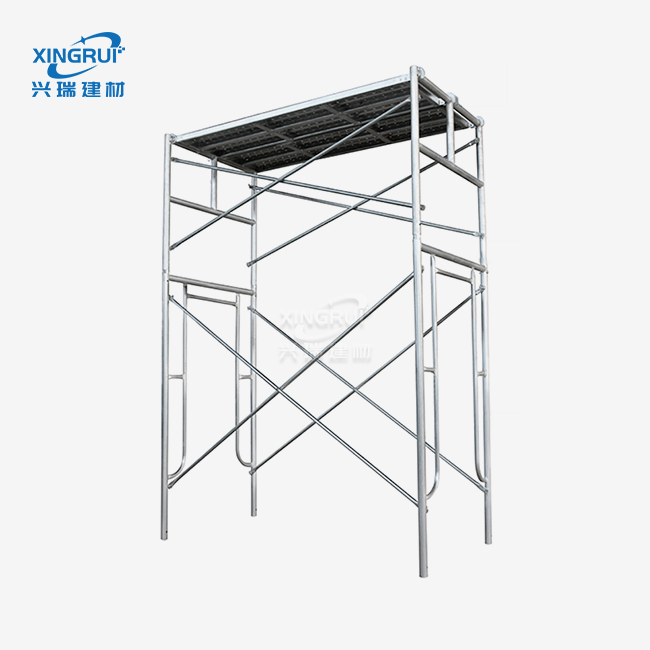
Understanding the Basics of American Type Scaffold Frames
What They Are and Where They're Used
American-style door frames, which are also known as mason frames or walk-thru frames, are made of pre-fabricated steel panels that are joined together with cross braces and coupling pins. They are used for heavy-duty masonry work where both the frame and the load above it must hold up regularly, as well as for repointing bricks in homes and businesses. Because of their standard shape, they are the first choice for most residential and light commercial sites in North America.
Key Dimensions and Load Parameters
The most common size in North America is 5 feet by 5 feet, which is about 1700 mm by 1219 mm. The outside width of the tube is 1.69 inches (42.4 mm), and the wall thickness is between 0.090 and 0.120 inches. It is common for steel towers built to this standard to have ultimate load ratings above 50,000 pounds, which are the numbers used in ANSI A10.8-2019 compliance testing for multi-story mason frame stacks.
Safety Features and OSHA Compliance
A10.8 and OSHA 1926.451 must be met by every frame sold in the U.S. Positive-lock pin connections, straight ladder rungs with consistent spacing, and a strong weld at the header-to-leg junction are all important safety features. Before every shift, a "competent person," as OSHA describes the job, must check each frame for broken welds, bent rungs, and surface pitting.
How They Compare to Other Scaffold Types
Ring lock, cuplock, and Kwikstage methods can be used to build vertically faster on big building projects, but they cost more per unit and need more training. For most home and mid-rise business jobs, the american type scaffold frame is the best choice because it covers the most ground for the least amount of money, parts are easy to find, and crews in the U.S. and Canada are familiar with it.
Core Features to Compare When Evaluating American Type Scaffold Frames
If you pick the wrong frame, you may have to do more work, wait longer, and even get an OSHA ticket. Before you place a large order, go through these four groups of features in a planned way.
These are the main things that every buying manager should look at:
- Steel grade and tube specification: Q235 steel (yield strength ≥235 MPa) with a 42.4 × 2.0 mm tube delivers the wall thickness needed for heavy masonry loads. Thinner walls reduce shipping weight but compromise load margins. Ask for mill certificates and cross-check them against ASTM A500 equivalency before approving a sample.
- Load capacity and weld quality: CO₂-shielded welds at every header-to-leg joint resist fatigue under repeated loading cycles far better than basic MIG passes. Request a destructive "break test" report or ultrasonic weld test data from your supplier. Frames from Shandong Xingrui achieve pin alignment tolerances of ±0.5 mm, which keeps multi-story stacks plumb without shimming.
- Surface treatment: Hot-dip galvanization (HDG) at ≥65 microns zinc coating provides internal tube protection and a degree of self-repair at scratches—critical for frames stored outdoors between rental cycles. Heavy-duty powder coating costs less upfront but protects only the exterior surface.
- Lock-pin compatibility and modular fit: American-style flip locks, drop locks, and C-locks are not interchangeable across all brands. Confirm that the supplier's lock spacing matches your existing inventory (typically 27.75 in) and that the tube OD matches before mixing batches on site.
A stable long-term supply partner is different from a one-time price win that costs more in the long run. For example, consistent dimensional limits cut down on mistakes made during production that could weaken the structure.
Comparing American Type Scaffold Frames with Other Scaffolding Systems
American vs. European Frames
European frames use metric tube sizes (usually 48.3 mm OD) and different ways to connect the braces. They don't work with lock parts made in North America, which is why choosing the right american type scaffold frame matters. Finding European-spec frames can be hard for wholesalers who work with builders in the U.S. and Canada because it can lead to parts misunderstanding and possible OSHA violations.
American Frames vs. Ring Lock and Cuplock Systems
Ring lock and cuplock systems work great for big infrastructure or petrochemical projects where links that can go in more than one way speed up complicated shapes. Door frames, on the other hand, cost about 20–35% less per bay and don't need any special rosette connectors for standard residential facades or commercial building repairs. The simpler inventory also makes it easier for rental fleets to manage their storage.
When to Choose System Scaffolding Instead
If your builders work on a lot of high-rise curtain-wall jobs over 125 feet with odd floor plans, system scaffolding is better for those shapes. For most residential repair, masonry, and mid-rise commercial projects in North America—which is where most importers in this segment do most of their business—door frames are still the most cost-effective and OSHA-compliant choice.
Procurement Considerations for Bulk Buyers and OEM Clients
Vendor Qualification: Certifications and Factory Audits
Check that you have the ISO 9001 quality management, ISO 14001 environmental management, and ISO 45001 occupational health certifications before you ship your first container. All three of these certifications show that a factory does more than just end-of-line inspection. They also show that they have documented process control. Shandong Xingrui Building Materials Co., Ltd. owns all three and runs a 79,800-square-meter factory with 12 welding robots and 6 automatic welding lines in Rizhao, Shandong. This is a city with direct port access that cuts down on travel times to U.S. West Coast ports.
Container Loading, Landed Cost, and Lead Times
The cost per frame changes significantly when you nestle 1700 × 1219 mm frames optimally into a 40 HQ container. Before you agree on a FOB price with a provider, make sure they give you an approved loading plan with a piece count. Take into account the most recent Section 301 tariff classifications and ask for written proof of the HS number. For orders during the construction season, make sure the production lead time fits with when your site will begin. Shandong Xingrui takes custom orders and offers sample frames and full technical documentation to help you decide to buy.
Customization, Reusability, and After-Sales Support
Frames made to order—with unique sizes, surface finishes, or brand-name paint colors—extend the life of the product and help rental fleets stand out. If you keep up with maintenance, good american type scaffold frame can be used for dozens of projects, which lowers your cost per use over time. Make sure that your supplier offers mill certificates in English, help with bill of lading, and a technical contact who can be reached quickly. Shandong Xingrui helps with technical questions and offers samples for all OEM and bulk orders.
Practical Tips for Using and Maintaining American Type Scaffold Frames
Safe Assembly Practices
Always begin on a flat, mud-sill base. Make sure that the cross braces lock securely—a loose brace is the main reason why horizontal collapse happens during assembly—and fully insert the coupling pins before adding the next tier. Someone who knows what they're doing should walk the building after each level is added.
Inspection Checklists and Maintenance Schedules
Check each frame before each shift. Check for horizontal rungs that are bent (reject if bending is more than ¼ inch), cracked welds where legs meet, and damage to the zinc covering that shows bare steel. To stop seizures, clean mud and concrete splatter out of pin holes after each job. With regular maintenance, HDG frames that still have their zinc coating should last 10 to 20 years in rental fleets.
Adapting to Different Construction Environments
HDG frames are the best choice for coastal or industrial areas where rusting is likely to happen. Powder-coated frames can lower the cost of each unit in domestic projects in the inland areas where frames move around a lot, as long as the coating is checked for damage during shipping and fixed as needed. Steel is more likely to break when it's cold, so check welds more often during the winter.
Conclusion
There are four things that can be checked to make sure you choose the right american type scaffold frame: the steel grade, the quality of the welds, the surface treatment, and how well the frame fits with OSHA-standard gear. If you compare these features in an unbiased way, using mill certificates, weld test data, and factory audits as proof, you can keep your business safe from quality problems and unexpected costs. If an importer or distributor wants to serve the North American market, the most reliable way to get stable product quality and high profit margins is to work directly with a recognized maker.
FAQ
What is the standard size of an American type scaffold frame?
Most in North America are 5 feet by 5 feet (1700 mm by 1219 mm). A walk-thru frame is usually 5 feet 4 inches wide and 6 feet 4 inches tall so that people can walk through at the floor level.
What lock types are used with American door frames?
Flip locks, drop locks, and C-locks are the three main types of locks. C-locks have a moving collar that is better in areas with a lot of shaking, while flip locks use a gravity toggle for quick bracing. You must get tubes that are all the same OD (1.69 in / 42.4 mm).
How often should frames be inspected on site?
OSHA says that the scaffold must be checked by a qualified person before each work shift. Key checks look for things like pin socket corrosion, broken welds, and bent rungs.
What is the maximum safe height for a door-frame tower?
Without ties, OSHA says that the height-to-base ratio should be 4:1. When built correctly, towers can safely be taller than 125 feet with the right outriggers and wall ties.
How do I verify zinc coating thickness on HDG frames?
Use a magnetic thickness gage like the Elcometer. According to ANSI A123, structural steel needs to be ≥45 microns thick. Shandong Xingrui specifies ≥65 microns, which gives more protection against rust.
Request a Sample or Quote — GREEN FORMWORK American Type Scaffold Frame Supplier
GREEN FORMWORK gets its American-style scaffold frames directly from Shandong Xingrui Building Materials Co., Ltd., a company that is ISO 9001/14001/45001 certified and builds them to meet ANSI A10.8 and OSHA standards. As standard, the pins are made of Q235 premium steel and have an HDG finish that is ≥65 microns thick. You can get custom sizes, OEM labels, and ideas for filling containers. To get a sample and detailed information right away, email us at sdxingruiqp@126.com or go to sdxingrui.com.
References
1. American National Standards Institute. ANSI A10.8: Safety Requirements for Scaffolding. ANSI, 2019.
2. Occupational Safety and Health Administration. OSHA Standard 1926.451: Scaffolds—General Requirements. U.S. Department of Labor, 2020.
3. American Galvanizers Association. Hot-Dip Galvanizing for Corrosion Protection: A Specifier's Guide. AGA, 2018.
4. Peng, J. L., Pan, A. D. E., & Chen, W. F. "Approximate Analysis Method for Modular Tubular Falsework." Journal of Structural Engineering, ASCE, 2001.
5. ASTM International. ASTM A500: Standard Specification for Cold-Formed Welded and Seamless Carbon Steel Structural Tubing in Rounds and Shapes. ASTM, 2021.
6. Construction Industry Institute. Scaffolding Safety and Productivity: Industry Best Practices Report. CII, University of Texas at Austin, 2017.
Learn about our latest products and discounts through SMS or email