- English
- French
- German
- Portuguese
- Spanish
- Russian
- Japanese
- Korean
- Arabic
- Greek
- German
- Turkish
- Italian
- Danish
- Romanian
- Indonesian
- Czech
- Afrikaans
- Swedish
- Polish
- Basque
- Catalan
- Esperanto
- Hindi
- Lao
- Albanian
- Amharic
- Armenian
- Azerbaijani
- Belarusian
- Bengali
- Bosnian
- Bulgarian
- Cebuano
- Chichewa
- Corsican
- Croatian
- Dutch
- Estonian
- Filipino
- Finnish
- Frisian
- Galician
- Georgian
- Gujarati
- Haitian
- Hausa
- Hawaiian
- Hebrew
- Hmong
- Hungarian
- Icelandic
- Igbo
- Javanese
- Kannada
- Kazakh
- Khmer
- Kurdish
- Kyrgyz
- Latin
- Latvian
- Lithuanian
- Luxembou..
- Macedonian
- Malagasy
- Malay
- Malayalam
- Maltese
- Maori
- Marathi
- Mongolian
- Burmese
- Nepali
- Norwegian
- Pashto
- Persian
- Punjabi
- Serbian
- Sesotho
- Sinhala
- Slovak
- Slovenian
- Somali
- Samoan
- Scots Gaelic
- Shona
- Sindhi
- Sundanese
- Swahili
- Tajik
- Tamil
- Telugu
- Thai
- Ukrainian
- Urdu
- Uzbek
- Vietnamese
- Welsh
- Xhosa
- Yiddish
- Yoruba
- Zulu
Traditional Steel Tube Scaffolding vs Modular Systems: Key Differences
The key difference between traditional steel tube scaffolding and modular systems is the connection. Traditional steel tube scaffolding joins loose tubes with couplers, so crews can set any angle, height, or spacing on site. Modular systems use fixed nodes, which speed up repeat layouts but limit changes. If your jobs involve odd shapes, mixed inventory, or tight budgets, tube and coupler often fits better. If your jobs repeat the same bay size, modular saves labor. Below, I compare the two on cost, safety, and buying details.
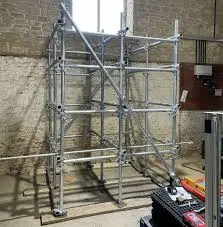
What Is Traditional Steel Tube Scaffolding?
Core Parts of a Tube-and-Coupler System
Steel tubes, couplers, base plates, adjustable jacks, bracing, and platforms make up traditional steel tube scaffolding on site. Standards, vertical tubes, send the load down. Horizontal ledgers and transoms connect the standards, while diagonal braces stabilise them. Couplers clamp tubes at desired angles. The right angle coupler unites two tubes at 90 degrees, whereas the swivel coupler does anything other. Each connection clamps, so workers can construct around pipelines, stair towers, and uneven terrain. Traditional civil engineering projects use the established, dependable, and low-cost technology.
How Crews Assemble and Inspect the Structure
Good work begins before the first tube rises. The team inspects drawings, ground conditions, tie-in sites, and access. Base plates, jacks, standards, ledgers, transoms, braces, ties, and guardrails are placed next. Each elevator must be level. OSHA's scaffold regulation, 29 CFR 1926 Subpart L, requires a competent person to oversee installation, relocation, and dismantling and examine the scaffold before each shift. Top rails must be 38–45 inches tall. Teams disassemble from the top down and sort tubes and couplers by size and condition at the end. Rental yards benefit from sorting since clean returns speed up turnover.
Q235 Tube Specifications at a Glance
Our traditional steel tube scaffolding uses premium Q235 carbon steel in national standard Φ48×3.0 mm welded pipe, paired with malleable cast iron fasteners. We check every component to a ±0.5 mm dimensional tolerance and check zinc adherence. The table lists the main parameters.
| Parameter | Specification |
|---|---|
| Material grade | Q235 premium carbon steel |
| Outer diameter | Φ48.3 mm (±0.5 mm) |
| Wall thickness | 3.0–4.0 mm |
| Tensile strength | Up to 510 MPa |
| Yield strength | 235–345 MPa minimum |
| Finish | Hot-dip galvanized |
| Zinc coating | Over 40 microns (300 g/m²) |
| Standard length | 1.0–6.0 m, customizable |
| Safe working load | 2.0–3.0 kN/m², by configuration |
| Service life | 10+ years outdoors |
| Standards | BS 1139, EN 39, EN 74 |
The 48.3 mm outer diameter is about 1.9 inches, a common tube size in North America, so confirm that your couplers match before you order. A 3.0 kN/m² rating equals roughly 63 pounds per square foot, and your engineer should confirm the duty rating for each layout.
Traditional Steel Tube Scaffolding vs Modular Systems in Practice
Connection Method and Flexibility
Main difference is part connection. Couplers latch onto circular tubes anywhere along their length, letting you set height, angle, and spacing. A rosette or cup is placed along each vertical standard in ringlock and cuplock systems. Ledgers latch onto nodes at intervals and angles. That arrangement accelerates construction and makes pieces easy to count, but it restricts what you can build without adapters. Fixed nodes suit rectangular facades. Couplers provide for flexibility around a boiler, curving tank, or stair tower with variable floor heights. Contractors often employ a modular main construction with tube and coupler at odd corners.
Erection Speed, Labor, and Crew Skill
Crews make fewer choices on recurring bays, so modular systems go up quicker. Instead of measuring and tightening couplers, a worker locks a ledger onto a node. Tube-and-coupler work requires additional expertise since every coupler must be tight and every tube square. Trained personnel assemble it rapidly, and the approach is proven on project sites. Rental yards value labour in two ways. Your employees must count, sort and fix parts at the yard, and clients pay for erection time. Tubes and couplers are straightforward to check since bent or fractured tubes are obvious.
Load Capacity and Stability
Neither system has universal load ratings. Designed stability relies on ties, bracing, foundation, platform loads, wind exposure, and installation quality for traditional steel tube scaffolding. Scaffolds and components must sustain their own weight and four times the maximum load per OSHA. When engineered properly, tube-and-coupler and modular constructions can handle large loads. Thus, the greater question is not which system is stronger. Ask which one your teams can build successfully with matching components and purchase documentation.
Comparison With Frame and Aluminum Options
Since workers snap pre-welded frames together with cross bracing, frame scaffolding fits straight façade construction with uniform widths and modest heights. It's fast, but the frame size determines bay width and lift height. Aluminium systems are lighter and easier to handle, while steel systems are stronger and more industrial. Flexible, low-cost tube and coupler is between these possibilities. Many yards store tubes and couplers near modular fleets to address gaps fixed parts cannot reach.
Cost, Safety, and Choosing the Right System
Looking at the Full Cost
System cost is not determined by tube pricing. Check steel weight, couplers, platforms, jacks, surface treatment, freight, labour, disassembly, storage, repairs, and reuse. Modular systems may cost more since quicker assembly reduces labour on recurrent tasks. On uneven projects or when you have appropriate tubes and couplers, traditional steel tube scaffolding is cheaper. Losses include bent tubes, missing couplers and rejected non-standard pipe eat into rental yard profits. Inspecting and renting a tube with a wall thickness and mill certificate is easy. Request an itemised quote with freight terms from each supplier, then compare tube and rental cycle costs.
Safety Requirements for Tube-and-Coupler Builds
Safety requires engineering, matching parts, and inspection. OSHA estimates that 65% of construction workers use scaffolds and that its guidelines save 4,500 injuries and 50 fatalities annually. A competent person inspects the scaffold before each shift under 29 CFR 1926 Subpart L, and workers require fall protection on platforms above 10 feet above ground. Check for bent tubes, corrosion, loose couplers, missing bracing, soft ground beneath base plates and broken platforms. Maintain inspection and repair journals. Couples need special care. Blowhole castings and stripped couplers are dangerous, therefore reject them at the yard before shipping.
Decision Matrix: Which System Fits Your Jobs?
This table shows when each system tends to fit better.
| Factor | Traditional tube and coupler | Modular (ringlock, cuplock) |
|---|---|---|
| Connection | Clamp couplers at any point | Fixed nodes at set intervals |
| Best layouts | Irregular, industrial, retrofit | Repeating façades, large projects |
| Erection speed | Slower, skill dependent | Faster on repeat bays |
| Adaptability | High | Limited without adapters |
| Inventory | Mixes with existing tubes | Needs matching system parts |
| Tracking | By tube length and coupler type | By standardized components |
If most rows in the middle column match your jobs, tube and coupler — namely traditional steel tube scaffolding — deserves a place in your fleet. Many yards choose a hybrid, which pairs a modular main structure with tubes at irregular points.
Buying Traditional Steel Tube Scaffolding: What to Check Before You Order
Procurement Checklist
Clear specifications avoid delivery rejection. Include tube diameter, wall thickness, length, steel grade, finish, coupler type, rated capacity, and standards. Request batch-specific material certifications, test results, and traceability from the supplier. A heat-numbered mill test certificate confirms which steel went into the pipe. Measure wall thickness upon delivery, since tubes below the given figure risk site rejection. Check lead time, minimum order quantity, packing, and quality before shipping. Vague load claims, missing wall-thickness data, inadequate bids, combined incompatible parts, and no after-sales service are red flags.
Who Makes Our Scaffolding
Shandong Xingrui Building Materials Co., Ltd., a subsidiary of Xingrui Group, manufactures building formwork and scaffolding since 2007. Our 79,800-square-meter facility in Rizhao, Shandong, employs 920 people, including 180 technicians. We operate 12 welding robots, 6 automated welding lines, 4 cold roll forming sets, and 5 semi-automatic forging lines. Export shipping is supported by Rizhao's harbour, airport, and high-speed rail hub. Our management systems are ISO 9001, ISO 14001, and ISO 45001 certified, and our goods are CE certified. We trace raw materials and goods throughout manufacture and supply to over 100 countries and regions.
Samples, Custom Orders, and Technical Backup
Test your purchase before making a big order. You may compare wall thickness, galvanising, and coupler fit to your stock using our samples and technical support. Specified typical steel tube scaffolding. We make tubes to your lengths and specifications from drawings or samples. Our malleable cast iron fasteners and right angle couplers are suitable for civil engineering and reusable. Lost couplers and bent tubes reduce your margin, thus reuse important.
Conclusion
Modular scaffolding and traditional steel tube scaffolding vary mostly in connection. Couplers allow crews to select any angle and spacing for uneven constructions, industrial activity, and mixed merchandise, while fixed nodes speed modular design. Neither system has a universal load rating, therefore engineering, ties, bracing, foundation, and inspection determine stability. OSHA requires a qualified person and a fourfold safety factor. Cost should include labour, freight, losses, and reuse, not just tube price. Specific wall thickness, sound couplers, and traceable papers prevent Q235 tube rejections and rental complaints. Many projects benefit from a hybrid system.
FAQ
Is tube-and-coupler scaffolding stronger than modular scaffolding?
Neither system has a universal load rating. Strength depends on the full design, including bracing, ties, foundation, platform loading, and component quality. Both types can handle heavy-duty work when a qualified engineer designs the structure and a competent person checks the build.
Can I mix tubes and couplers with ringlock or cuplock parts?
Yes. Right angle and swivel couplers can tie into modular scaffolding or bridge gaps around obstructions. Mixed fleets are common in rental yards because tubes fill spaces that fixed parts cannot. Have an engineer approve each mixed connection for load and stability.
What load can your Q235 tubes carry?
Our safe working load ranges from 2.0 to 3.0 kN/m², depending on spacing and configuration. The top figure equals roughly 63 pounds per square foot. Your engineer should confirm the duty rating for each layout.
Do you provide samples and custom lengths?
Yes. We provide samples with technical backup, and we produce tubes to your drawings. Standard lengths run from 1.0 to 6.0 meters, and we can customize them for your project.
Request Samples and a Quote for Traditional Steel Tube Scaffolding
Send your drawings, quantities, and wall-thickness requirements to GREEN FORMWORK at sdxingruiqp@126.com, and we will help you match the right system. As a traditional steel tube scaffolding manufacturer, we offer Q235 tubes, malleable cast iron fasteners, samples with technical backup, and ISO 9001, ISO 14001, and ISO 45001 certification. Visit sdxingrui.com for details, and ask for a project-specific quotation today.
References
1. OSHA, 29 CFR 1926 Subpart L: Scaffolds, 1996
2. British Standards Institution, BS 1139-1.1: Metal Scaffolding, Specification for Tubes for Tubular Scaffolding, 1990
3. European Committee for Standardization, EN 39: Loose Steel Tubes for Tube and Coupler Scaffolds, 2001
4. European Committee for Standardization, EN 74-1: Couplers, Loose Spigots and Baseplates for Use in Working Scaffolds and Falsework, 2005
5. European Committee for Standardization, EN 12811-1: Temporary Works Equipment, Scaffolds, Performance Requirements and General Design, 2003
6. American Society of Safety Professionals, ANSI/ASSP A10.8: Scaffolding Safety Requirements, 2019
Learn about our latest products and discounts through SMS or email