- English
- French
- German
- Portuguese
- Spanish
- Russian
- Japanese
- Korean
- Arabic
- Greek
- German
- Turkish
- Italian
- Danish
- Romanian
- Indonesian
- Czech
- Afrikaans
- Swedish
- Polish
- Basque
- Catalan
- Esperanto
- Hindi
- Lao
- Albanian
- Amharic
- Armenian
- Azerbaijani
- Belarusian
- Bengali
- Bosnian
- Bulgarian
- Cebuano
- Chichewa
- Corsican
- Croatian
- Dutch
- Estonian
- Filipino
- Finnish
- Frisian
- Galician
- Georgian
- Gujarati
- Haitian
- Hausa
- Hawaiian
- Hebrew
- Hmong
- Hungarian
- Icelandic
- Igbo
- Javanese
- Kannada
- Kazakh
- Khmer
- Kurdish
- Kyrgyz
- Latin
- Latvian
- Lithuanian
- Luxembou..
- Macedonian
- Malagasy
- Malay
- Malayalam
- Maltese
- Maori
- Marathi
- Mongolian
- Burmese
- Nepali
- Norwegian
- Pashto
- Persian
- Punjabi
- Serbian
- Sesotho
- Sinhala
- Slovak
- Slovenian
- Somali
- Samoan
- Scots Gaelic
- Shona
- Sindhi
- Sundanese
- Swahili
- Tajik
- Tamil
- Telugu
- Thai
- Ukrainian
- Urdu
- Uzbek
- Vietnamese
- Welsh
- Xhosa
- Yiddish
- Yoruba
- Zulu
When performing overhead work on scaffolding what protective measures
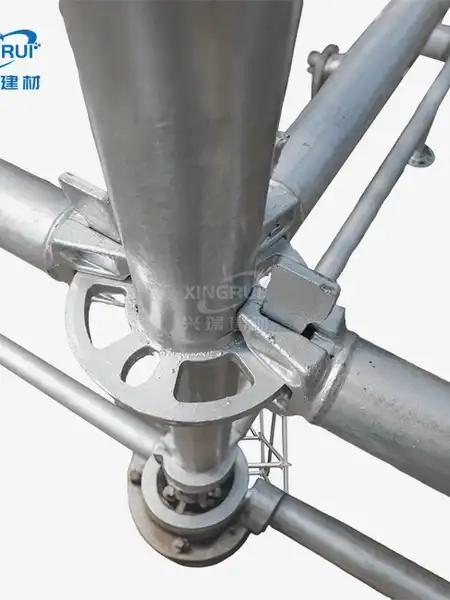
When performing overhead work on scaffolding, protective measures must address fall prevention, falling object control, and structural stability. Workers need properly fitted PPE—hard hats, full-body harnesses, safety glasses, and gloves—combined with guardrails, toe boards, and debris nets. The scaffold structure itself must meet load and geometry requirements for the task. This is where 8-hole disc scaffolding becomes a practical choice: its wedge-lock rosette design delivers secure multi-directional connections and a vertical load capacity exceeding 40kN per standard, reducing structural risk during elevated operations.
Understanding the Risks of Overhead Work on Scaffolding
Working from above on a ladder is very dangerous. The U.S. Bureau of Labor Statistics says that about one-third of all building deaths each year are caused by falls from heights. Knowing the different types of risks helps site managers and buying teams choose the right tools and plan for safety better.
Falling Objects and Dropped Tools
When tools, fasteners, and other things fall from high places, they can kill workers below. 29 CFR 1926.502 of OSHA says that workers must have toeboards, screens, or canopy structures when they are under busy overhead activities. It is necessary to have a safe scaffold platform with toe boards that can hold loose materials.
Falls from Height
Falls happen directly because of things like improper scaffolding setup, missing guardrails, or platforms that are too heavy. According to OSHA, about 4,500 people are hurt and 60 people die every year in the United States because of accidents involving scaffolding. Above 10 feet, platforms must have full planks, guardrails must be put up on all open sides, and personal fall arrest systems must be used.
Scaffold Instability and Environmental Loads
A system that wasn't designed well can become unstable because of wind, uneven ground, and side forces from work being done above it. There is a side lean that gets worse with height called "parallelogram deformation" that can happen on a scaffold that doesn't have the right diagonal support. Systems that don't have enough triangulation fail when vertical and horizontal loads are put on them at the same time, especially on buildings bigger than 20 meters.
Protective Measures for Overhead Work on Scaffolding
Personal protective equipment, structure safety measures, and worker training all work together to keep workers safe during overhead activities. 8-Hole disc scaffolding is one such structural safety measure. There is no one measure that works by itself. This is how a layered approach really works.
The first line of defense is the right PPE. On or below an active scaffold, every worker must wear a Class E hard hat, ANSI Z87.1-rated eye protection, cut-resistant gloves, and a full-body harness that is connected to a separate anchor point, not the scaffold frame itself.
For overhead work, the following structure safety measures must be in place:
- Guardrails: Top rail at 38–45 inches, mid-rail at roughly half that height, rated to withstand 200 lbs of force in any direction per OSHA 1926.451(g).
- Toeboards: Minimum 3.5 inches high along all open platform edges to prevent tool rolloff.
- Safety netting and debris screens: Installed beneath the working platform when workers or pedestrians occupy the area below.
- Correct load management: Platform planks must be rated for the combined weight of workers, tools, and materials. Overloading is a primary cause of platform failure.
Training is much more important than tools. A "competent person" must check the scaffolding before every work shift, according to OSHA. Workers should get formal training on how to put things together, how much weight they can carry, and what to do in case of an emergency descent. Third-party audits regularly show that sites that keep records of training have lower incident rates.
The above-mentioned hazards can be dealt with by a combination of PPE, structural controls, and training. Picking the right scaffold system makes it easier to do all of these things properly.
Why 8-Hole Disc Scaffolding Is Ideal for Overhead Work
How safe work can be done from above is directly related to the shape of a scaffold. In comparison to cuplock or tube-and-coupler alternatives, the 8-Hole disc scaffolding system, also known as ringlock scaffolding, better addresses the structural needs of elevated work.
Secure Multi-Directional Connections
Each vertical standard has a rosette connector with eight slots. Four of the slots are narrow, for perpendicular ledgers, and the other four are wider, for diagonal braces. This set-up allows true 45-degree triangulation at every node, which keeps structures longer than 20 meters from warping to the side. The gravity-fed wedge-lock mechanism makes a bolt-free connection that locks itself, so there are no more loose coupler failures that can cause the scaffold to fall.
High Load-Bearing Capacity
When set up correctly, each standard in the system can hold more than 40kN of vertical load. The Q235 quality carbon steel pipe has a width of 48mm or 60mm and a wall thickness of 3.2mm with a tolerance of ±0.1mm. It stays structurally sound from -20°C to +200°C. For work that needs to be done above in petroleum or industrial settings, this temperature stability is a big plus.
Adaptability to Complex Frame Configurations
Standard frame scaffolding has trouble with curved walls, odd floor plans, and support needs that go in more than one direction. The eight-slot rosette lets you put it together at different angles without having to cut or make it to order. This makes it perfect for supporting bridges, getting to tanks for repair, and doing exterior work on tall buildings. Along each vertical standard, there is a 500mm rosette interval that also makes the bay geometry consistent and predictable across large installations.
These benefits to the structure directly lead to better conditions for working above. Shape-wise stable scaffolding with correctly connected parts means that guardrails stay in place, platforms stay level, and workers can concentrate on their work rather than the structure beneath their feet.
Procurement Considerations for 8-Hole Disc Scaffolding
There's more to finding 8-Hole disc scaffolding than just comparing unit prices. When purchasing teams only look at cost per kilogram, they often find quality problems that lead to claims, delays, and guarantee issues after delivery.
The following factors should be taken into account when choosing an 8-Hole disc scaffolding maker or supplier:
- Material certification: Verify steel grade through mill test certificates. Q235 carbon steel should be confirmed via spectrochemical analysis, not just product labeling.
- Weld integrity: Rosette-to-pipe welds are the system's most stressed connection point. Ultrasonic testing records for each production batch confirm that welds meet EN 12810-1 or AS/NZS 1576 requirements.
- Hot-dip galvanization (HDG): Zinc coating thickness should exceed 80 microns per ISO 1461. This level of protection delivers 15–25 years of corrosion resistance in coastal and industrial environments, reducing lifecycle cost significantly.
- Dimensional tolerance: Outer diameter and wall thickness must stay within ±0.1mm to guarantee component interchangeability across large mixed-lot orders.
- Certifications: ISO 9001 (quality management), ISO 14001 (environmental management), and CE certification confirm the manufacturer operates under audited production controls.
- Mixed-container capability: Distributors servicing multiple project types benefit from suppliers who can consolidate standards, ledgers, diagonal braces, and accessories into a single container shipment.
From a 79,800 m2 facility in Rizhao, Shandong, Shandong Xingrui Building Materials Co., Ltd. makes 8-Hole disc scaffolding for sale in more than 100 countries. The company has 180 technical staff, 12 welding robots, and six automatic welding lines. Before committing to an order, they offer product samples with full technical paperwork. This is a useful step for importers who want to check the quality of the goods before sending out a trial package.
Conclusion
When working on an overhead scaffold, safety needs to be planned out in a structured way. Fall protection, controlling falling objects, wearing the right PPE, and making sure the scaffolding is stable all need to be looked at at the same time. Through its rosette connection design, high load capacity, and ability to react to complicated site geometry, the 8-Hole disc scaffolding system meets the structural aspect of that requirement.
When purchasing teams bring in scaffolding systems to sell or use themselves on a project, they should check the steel grade, weld quality, galvanization depth, and certification compliance of each supplier before making a decision. This helps protect both the margin and the supplier's reputation. It's not just a matter of how much a scaffold system costs; it's also a matter of safety.
FAQ
What is the maximum load capacity of 8-hole disc scaffolding?
In its normal state, each vertical standard can hold more than 40kN of weight. The actual capacity relies on the depth of the bays, the distance between the ledgers, and where the diagonal braces are placed.
How often should the scaffold be inspected during a project?
According to OSHA 1926.451(f)(3), a qualified person must check the structure before every work shift, after any event that could affect its stability, and after being exposed to weather events like heavy rain or high winds.
Can components from different manufacturers be mixed?
There are standards for many ringlock systems, but the rosette thickness and wedge angles change by 0.5mm to 1mm from one company to the next. Professional advice says that before mixing brands on the same structure, you should do a compatibility test and a load check.
Does hot-dip galvanization affect dimensional tolerances?
Over 80 grains of zinc are added during the HDG process. When they machine their parts, reputable companies take this into account so that the fit of the parts stays within the ±0.1mm range after they are galvanized.
Are samples available before placing a bulk order?
Yes, GREEN FORMWORK gives out samples of their products along with technical information before they confirm an order. Email sdxingruiqp@126.com to ask for examples to check the grade.
Get a Quote from GREEN FORMWORK Today
With ISO 9001, ISO 14001, and CE documentation, GREEN FORMWORK offers Certified 8-Hole disc scaffolding made from Premium Q235 Steel. Our mixed-container shipping makes it easy for distributors who serve the construction market in the Middle East, Southeast Asia, and other places to buy everything they need in one place. We are a direct 8-Hole disc scaffolding maker, so we can offer low prices, open payment terms, and sample checks before shipping. To get a quote, email our team at sdxingruiqp@126.com or go to sdxingrui.com.
References
1. U.S. Bureau of Labor Statistics. Census of Fatal Occupational Injuries Summary. 2022.
2. Occupational Safety and Health Administration (OSHA). Scaffolding Safety: OSHA 3150. U.S. Department of Labor, 2023.
3. British Standards Institution. EN 12810-1: Façade Scaffolding Made of Prefabricated Components. BSI, 2003.
4. Standards Australia. AS/NZS 1576.1: Scaffolding – General Requirements. Standards Australia, 2019.
5. International Organization for Standardization. ISO 1461: Hot Dip Galvanized Coatings on Fabricated Iron and Steel Articles. ISO, 2022.
6. Health and Safety Executive (HSE). The Work at Height Regulations 2005: A Brief Guide. HSE Books, 2014.
Learn about our latest products and discounts through SMS or email