- English
- French
- German
- Portuguese
- Spanish
- Russian
- Japanese
- Korean
- Arabic
- Greek
- German
- Turkish
- Italian
- Danish
- Romanian
- Indonesian
- Czech
- Afrikaans
- Swedish
- Polish
- Basque
- Catalan
- Esperanto
- Hindi
- Lao
- Albanian
- Amharic
- Armenian
- Azerbaijani
- Belarusian
- Bengali
- Bosnian
- Bulgarian
- Cebuano
- Chichewa
- Corsican
- Croatian
- Dutch
- Estonian
- Filipino
- Finnish
- Frisian
- Galician
- Georgian
- Gujarati
- Haitian
- Hausa
- Hawaiian
- Hebrew
- Hmong
- Hungarian
- Icelandic
- Igbo
- Javanese
- Kannada
- Kazakh
- Khmer
- Kurdish
- Kyrgyz
- Latin
- Latvian
- Lithuanian
- Luxembou..
- Macedonian
- Malagasy
- Malay
- Malayalam
- Maltese
- Maori
- Marathi
- Mongolian
- Burmese
- Nepali
- Norwegian
- Pashto
- Persian
- Punjabi
- Serbian
- Sesotho
- Sinhala
- Slovak
- Slovenian
- Somali
- Samoan
- Scots Gaelic
- Shona
- Sindhi
- Sundanese
- Swahili
- Tajik
- Tamil
- Telugu
- Thai
- Ukrainian
- Urdu
- Uzbek
- Vietnamese
- Welsh
- Xhosa
- Yiddish
- Yoruba
- Zulu
What Is a Crab Type Support Tower? A Buyer’s Guide for OEMs Today
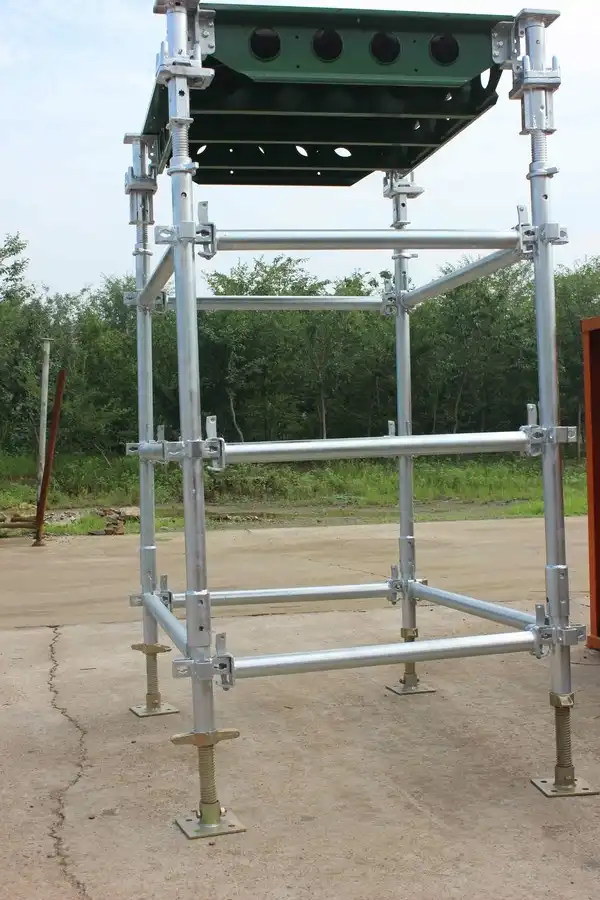
A crab type support tower is a heavy-duty modular shoring system built from high-strength steel, designed to carry concentrated vertical loads across large-span structures such as bridges, elevated floor slabs, and industrial platforms. Its distinctive crab-style frame — reinforced with horizontal and diagonal bracing — distributes mechanical loads evenly across the entire tower footprint. For OEM buyers and procurement teams sourcing temporary shoring equipment, understanding how this system works, where it performs best, and what to verify before purchasing can directly affect project safety, schedule, and cost.
Understanding Crab Type Support Towers: Definition and Core Principles
What the Structure Actually Looks Like?
The casual name for the modular support tower comes from the way its frame is set up: wide and with many legs. Vertical poles, which are usually 48 or 60 mm in diameter and have walls that are 3.0 mm to 3.5 mm thick, are locked into square or rectangular grid designs. The frame is held together by horizontal ledgers and diagonal cross-braces. This gives it 360-degree stiffness that tube-and-clamp systems can't match at the same load levels.
How Load Distribution Works
The crab-style arrangement spreads compressive forces across all four vertical members at the same time, while traditional prop systems transfer loads along a single central axis. This shape lowers the chance of eccentric loads, which is a main reason why shoring falls apart when concrete is poured. As of now, a single tower unit made to these standards can hold up to 500kN, which means it can be used for casting bridge cap beams and thick industrial floor slabs.
Applicable International Standards
People who want to buy a heavy-load shoring tower should make sure that it meets EN 12812 for temporary works performance and ISO 1461 if it is hot-dip galvanized. The crab type support tower made by GREEN FORMWORK are made using the ISO 9001 quality management, ISO 14001 environmental management, and ISO 45001 occupational health and safety management systems. This gives structural engineers the proof they need for site compliance submissions.
Comparing Crab Type Support Towers with Alternatives: Making the Right Choice
Modular Shoring Towers vs. Tube-and-Clamp Scaffolding
Tube-and-clamp systems are flexible in odd shapes, but each link depends on the right amount of force being applied by hand to each fitting. Loose couplers are always found to be the main cause of temporary works failures in field studies. The modular tower gets rid of this variable completely—components click or pin into fixed node positions, making load paths that are predictable even if different workers use different methods to put them together.
Modular Shoring Towers vs. Ringlock and Cuplock Systems
Ringlock and cuplock supports work well for access platforms and carrying light to moderate loads up and down. But when shoring loads go over about 100kN per leg, the bracing density of standard ringlock frames stops working. Because the crab-style frame has more bracing points and is designed to work best with vertical shoring paths, civil engineers choose it for bridge falsework instead of general scaffolds.
Material and Coating Choices
Q235 premium carbon steel is what GREEN FORMWORK uses by default. Hot-dip galvanization makes things last much longer than 15 years, especially for projects that are near water or have a lot of humidity, like hydropower pipes or marine infrastructure. The zinc coating also keeps the clean, professional look that project managers and inspection officials expect from building sites that have to follow rules.
Procurement and Transaction Insights for OEMs
What to Verify Before Placing an Order
Four things that procurement teams should look at before deciding on a crab type support tower supplier are third-party load test certificates with clear safety factors, dimensional tolerances on vertical pole straightness and node concentricity, current ISO certifications (not old copies), and how the manufacturer's stated lead time fits in with the concrete-pour schedule for the project. Deliveries of shoring that are late are some of the most annoying and expensive problems that can happen during bridge and building work.
Here are the most important things that every OEM buyer should confirm before making a purchase:
- Certified load test data: Request destructive and non-destructive compression test reports showing ultimate capacity against theoretical design loads, not just manufacturer-stated figures.
- Custom fabrication capability: Confirm the supplier can produce non-standard heights and configurations from customer-supplied drawings, with sample or first-piece approval before full-batch production.
- Delivery commitment in writing: For schedule-driven projects, a written delivery guarantee with penalty provisions protects the buyer if production delays occur.
When you buy specialized temporary work tools from overseas makers, these steps directly lower the procurement risk that comes with it.
Buy vs. Rent: A Practical Framework
If an OEM buyer is in charge of more than one project a year, buying a modular shoring system outright usually pays for itself in two to three deployments, compared to renting one for each project. GREEN FORMWORK's towers are designed to be used on more than one project. The modular parts can be put together over and over again without losing their shape as long as the upkeep steps are followed after the project is finished. Rental from a regional wholesaler may still be the most cost-effective option for a single big project, but buyers should look at the total cost of the asset over three years before making a decision.
Maintenance, Safety, and Long-Term Performance Optimization
Post-Project Inspection Protocol
A structured checklist should be used by support teams to go through after each crab type support tower release. Look at all of the vertical members to see if they are bowing or deforming. Check the joint points, especially where the nodes meet, for wear cracks or spatter buildup that could hide cracks that are starting to form. Base jacks and U-head jacks should have their screw threads cleaned before the next job so that they can still be adjusted.
Recognizing Wear Patterns Early
The base plate welds, the diagonal brace pin holes, and the U-head screw mechanism are the parts of a shoring tower that get worn down the most over time. It is very dangerous for corrosion to happen inside pin holes because it causes stress concentrations when the machine is loaded. Teams that work in humid or ocean areas should check these things after every project, not just when they're supposed to.
Optimizing ROI Across the Asset Lifecycle
A movable shoring tower that is well taken care of can be used for 50 or more project rounds. Structural engineers can make better choices about reuse if they keep an accurate maintenance log that lists each deployment site, the load that was applied, and the condition of the parts when they were taken apart. This paperwork also meets the needs of insurance companies and government agencies in most markets.
Conclusion
Picking the correct heavy-load shoring system can impact the safety of the project, its timeliness, and the long-term value of the assets. With its engineered load distribution, flexible assembly, and ability to be used on more than one project, a crab type support tower meets the main needs of bridge falsework, industrial floor slab building, and temporary works underground. The best results will come from OEM buyers who check certifications, make sure the equipment can be customized, and plan upkeep from the start. Buying from a company that has documented quality systems and shown they can export greatly lowers the risk of buying something.
FAQ
What factors most affect load capacity?
Tower height-to-width ratio is the primary variable. As height increases relative to base width, effective capacity drops due to buckling risk. Outriggers and wall ties can extend free-standing height beyond 40 meters when a structural engineer verifies the design. Steel grade, wall thickness, and node connection geometry also directly influence rated capacity.
How does this system compare to ringlock scaffolding for bridge shoring?
Ringlock scaffolding is designed for access and lighter distributed loads. The crab-style modular tower provides higher bracing density along vertical load paths, making it the appropriate choice when single-point shoring loads exceed standard scaffolding capacity limits.
Which certifications should I require from a supplier?
At minimum, require ISO 9001 for quality management and test reports referencing EN 12812 for shoring performance. ISO 14001 and ISO 45001 indicate that the manufacturer's operating environment meets international environmental and safety standards, which matters for multinational project compliance documentation.
Can the system be custom-fabricated to project drawings?
Yes. GREEN FORMWORK accepts orders based on customer-supplied drawings and samples, producing towers to non-standard heights, base dimensions, and load specifications. Sample supply and technical assistance are available before full-batch production begins.
Request a Quote from GREEN FORMWORK — Trusted Crab Type Support Tower Manufacturer
The export name of Shandong Xingrui Building Materials Co., Ltd. is GREEN FORMWORK. They make and sell heavy-duty modular shoring systems that are certified by ISO 9001, ISO 14001, and ISO 45001 standards. We have the production space to meet tight project deadlines at our 79,800-square-meter factory in Rizhao, China. It has 12 welding robots and 6 automatic welding lines. To get a detailed data sheet or a unique quote, email our team at sdxingruiqp@126.com.
References
1. British Standards Institution. BS EN 12812: Falsework — Performance Requirements and General Design. BSI, 2008.
2. International Organization for Standardization. ISO 9001: Quality Management Systems — Requirements. ISO, 2015.
3. International Organization for Standardization. ISO 45001: Occupational Health and Safety Management Systems. ISO, 2018.
4. Peng, J. L., et al. "Stability Analysis of Modular Falsework Systems Under Eccentric Loading." Journal of Constructional Steel Research, Elsevier, 2009.
5. Chandrangsu, T., and Rasmussen, K. J. R. "Investigation of Geometric Imperfections and Joint Stiffness of Support Scaffold Systems." Journal of Constructional Steel Research, Elsevier, 2011.
6. Health and Safety Executive (HSE). Falsework: A Step-by-Step Guide to Safe Practice. HSE Books, 2017.
Learn about our latest products and discounts through SMS or email