- English
- French
- German
- Portuguese
- Spanish
- Russian
- Japanese
- Korean
- Arabic
- Greek
- German
- Turkish
- Italian
- Danish
- Romanian
- Indonesian
- Czech
- Afrikaans
- Swedish
- Polish
- Basque
- Catalan
- Esperanto
- Hindi
- Lao
- Albanian
- Amharic
- Armenian
- Azerbaijani
- Belarusian
- Bengali
- Bosnian
- Bulgarian
- Cebuano
- Chichewa
- Corsican
- Croatian
- Dutch
- Estonian
- Filipino
- Finnish
- Frisian
- Galician
- Georgian
- Gujarati
- Haitian
- Hausa
- Hawaiian
- Hebrew
- Hmong
- Hungarian
- Icelandic
- Igbo
- Javanese
- Kannada
- Kazakh
- Khmer
- Kurdish
- Kyrgyz
- Latin
- Latvian
- Lithuanian
- Luxembou..
- Macedonian
- Malagasy
- Malay
- Malayalam
- Maltese
- Maori
- Marathi
- Mongolian
- Burmese
- Nepali
- Norwegian
- Pashto
- Persian
- Punjabi
- Serbian
- Sesotho
- Sinhala
- Slovak
- Slovenian
- Somali
- Samoan
- Scots Gaelic
- Shona
- Sindhi
- Sundanese
- Swahili
- Tajik
- Tamil
- Telugu
- Thai
- Ukrainian
- Urdu
- Uzbek
- Vietnamese
- Welsh
- Xhosa
- Yiddish
- Yoruba
- Zulu
What Load Capacity Should 8-Hole Disc Scaffolding Support for Safety?
When buyers ask about load capacity for 8-hole disc scaffolding, the answer matters for safety, compliance, and protecting their investment. A properly engineered system built from Q235 premium steel should support a vertical load-bearing capacity of at least 40kN per standard under typical configuration. This figure aligns with EN 12810-1 and AS/NZS 1576 requirements and reflects real-world demands on construction sites handling workers, materials, and environmental stress simultaneously. Knowing this number helps procurement professionals compare suppliers honestly and avoid costly structural failures on active job sites.
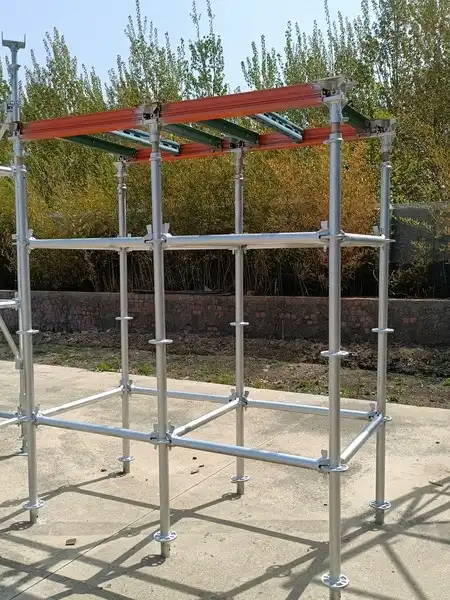
Understanding Load Capacity in 8-Hole Disc Scaffolding
Before you place an order, it's helpful to know what "load capacity" really means in everyday language. It's not just one number; it tells you how a system deals with different kinds of power at the same time.
Dead Loads, Live Loads, and Environmental Stress
When you talk about "dead loads," you're talking about the weight of the scaffolding itself. Live loads are things like people working, tools, and things that are saved on the site. Wind pressure, heat expansion, and, in some places, snow buildup are all caused by environmental loads. OSHA 29 CFR 1926.451 says that scaffolding must be able to hold at least four times its own weight. According to safety factor estimates, a system that is rated at 40kN must be checked to see how well it can handle forces that are close to 160kN.
Why International Standards Define the Baseline?
In Europe, EN 12811-1 is the standard that says how well access and working scaffolds must work. It lists load classes from 1 (0.75 kN/m²) to 6 (6.0 kN/m²). ISO guidelines also govern how materials are tested and how well galvanization works. Before goods leave the country or get to a job site in the Middle East or Southeast Asia, project owners often ask importers to show compliance paperwork like material certificates and test reports.
What Happens When Load Ratings Are Ignored?
Failures of scaffolding almost never happen without any signs. The main reasons why structures fall apart are overloaded platforms, missing diagonal braces, and steel types that haven't been checked. The UK Health and Safety Executive said that about 25% of construction-related deaths happen on or near scaffolding every year. Buying things based only on price, without checking the load certification, directly raises the risk for contractors further down the line.
Structural Design Features Affecting Load Capacity
The shape of a rosette-style system is not random; it is designed to move forces through the structure in a predictable way.
The Rosette Node and Multi-Directional Load Transfer
8-hole disc scaffolding load movement takes place at the disk nodes that are welded every 500 mm along each vertical standard. Eight evenly spaced connection slots—four narrow slots for perpendicular ledgers and four wider slots for diagonal bracing—make it possible for forces to spread out across the frame instead of concentrating in one spot. This shape makes 45-degree triangulation possible, which is needed for buildings higher than 20 meters to be stable on the sides.
Material Grade and Corrosion Protection
The consistent tensile strength of Q235 premium carbon steel makes it a good choice for heavy industrial uses. With a wall thickness of 3.2mm to 3.25mm and a range of ±0.1mm, parts from different production runs can fit together without any gaps that could let them slip when they're loaded. Hot-dip galvanization with a zinc coating of at least 80 microns protects the steel surface for 15 to 25 years in coastal or high-humidity areas, keeping the structure strong for the whole asset's useful life.
How This Compares to Cuplock and Frame Systems
Cuplock systems use a single rotating cup joint, which limits the types of angles that can be used for bracing and can become loose after many building rounds. Standard frame scaffolding has a fixed shape that can't be changed to fit different floor plans. The eight-slot rosette design is better at supporting structures in more than one way, putting together complicated frames, and working with odd shapes than the other two systems combined. This flexibility directly supports higher effective load capacity in site designs that aren't typical.
Comparative Analysis: 8-Hole Disc Scaffolding vs Other Systems on Load Capacity and Safety
Buyers can make better choices about where to get things when they know how different methods work together.
8-Hole vs 6-Hole Disc Systems
A 6-hole rosette has fewer angular connection points, which makes it harder to brace and makes it harder for the system to triangulate forces in complicated shapes. In an 8-hole layout, the two wider holes on the sides are meant for diagonal bracing and provide significantly better lateral load protection. For projects longer than 20 meters or with unusual plan forms, the 6-hole system needs extra bracing, which costs more and takes longer to put together.
8-Hole Disc vs Ringlock and Wedge Systems
Ringlock scaffolding and wedge systems can both be used as platforms for normal building heights. The 8-hole disk system, on the other hand, has a gravity-fed wedge-lock mechanism that gets rid of loose bolts and couplers. This makes it less likely that the connection will break during load transfer. When compared to tube-and-coupler options, assembly labor costs drop by up to 50%. This also cuts down on human mistake during installation, which is one of the main reasons why load capacity fails in the field.
Long-Term Cost Efficiency
Components that can be used again and again are made to be compatible across multiple project cycles; their dimensions must be within ±0.1mm. Hot-dip zinc finishes don't need to be painted over after each use. A well-made disk scaffold system has a much lower per-use cost over its 15–25-year service life than systems whose parts need to be replaced often because they are rusted or twisted.
Best Practices in Installation and Maintenance to Ensure Safe Load Capacity
Even the best-designed system won't work if it's put together wrong or never checked.
Professional Installation Procedures
Certified construction workers must follow a set order: base plates and bottom boards go in first, then vertical standards, horizontal ledgers, and diagonal braces, which are put on top of each other in different layers. Skipping the bracing step is a common way to save time on construction sites, but it lowers the frame's ability to resist side loads with 8-hole disc scaffolding. Before the next tier is put together, each wedge-lock connection has to be fully driven home.
When installing something, these are the main checks that make sure the load capacity doesn't fail on site:
- Base plate alignment: All base plates must sit level on compacted ground or sole boards, with a maximum tilt tolerance of 1:500 to prevent eccentric loading on the standard.
- Diagonal brace placement: Braces must be installed at every third bay minimum, using the wide slots of the rosette to achieve the correct 45-degree angle.
- Connection seating confirmation: Each wedge-lock must be visually and physically verified as fully seated before platform boards are loaded.
These checks don't take long—less than 10 minutes per bay—but they stop most of the load-related accidents that happen on active construction sites.
Maintenance and Inspection Intervals
Before each project launch, check all of its parts. Check for rosettes that aren't round, welds that are cracked where the pipe meets the disk, and damage to the zinc coating that shows bare steel. For high-load situations, ultrasonic weld testing should be done at the rosette connection point every five project cycles. This is because it is the most likely place for a disk scaffold system to fail.
Detecting Wear Before It Becomes Dangerous
Standards that are bent should be taken out of service right away. If you can see that a standard has a bow of more than 3 mm per meter, it loses a certain amount of its rated axial capacity. If you can, organize your inspection records by the serial number of each part, and change your stock so that older parts are checked first.
Procurement Considerations for Safe and Efficient 8-Hole Disc Scaffolding
Over time, it costs more to buy something based only on price. Before they place a container order, these are the things that experienced importers look for.
Supplier Certification and Quality Documentation
Ask for proof of the materials (mill test results that show the real steel grade), records of the weld inspections, and copies of the ISO 9001 and CE approvals. Quality controls are built into the production process, not put on afterward, if the seller has ISO 9001 (Quality), ISO 14001 (Environmental), and ISO 45001 (Occupational Health & Safety) certifications. Check to see if samples are available before committing to a full container. Samples with technical support are standard practice for reputable manufacturers.
Mixed-Container Loading and MOQ Flexibility
For wholesale importers who handle many product lines, being able to put disk standards, ledgers, diagonal braces, and accessories into a single container lowers the cost of freight per unit and makes clearing customs easier. Make sure that your seller can handle different configurations without needing separate MOQs for each type of part.
Lead Times, Payment Terms, and After-Sales Support
For traders who supply busy job sites, stable booking cycles are just as important as unit price. Write down the production wait times and make sure the seller can get to your port. Shandong Xingrui Building Materials Co., Ltd. is based in Rizhao, which is a port city with direct sea freight links that helps them keep to their export plans. You can choose from different T/T payment options, and you can also ask for OEM production based on customer drawings.
Conclusion
A disk scaffold system's safe load capacity relies on the grade of steel, the shape of the nodes, the quality of the galvanization, how well they are installed, and their approval, not just how much they cost. A common 8-hole disc scaffolding system rated at 40kN, made from Q235 steel, and in line with EN 12810-1 gives purchasing managers a way to compare sources in an honest way. Importers and wholesalers who work with freelancers in Southeast Asia and the Middle East should choose a provider that offers full paperwork, samples, and the ability to handle both single and multiple containers. This will protect their margins and image over many restocking rounds.
FAQ
What is the minimum safe load capacity for disc scaffold standards?
A disc scaffold standard should support a vertical load of at least 40kN under normal configuration. Safety regulations, including OSHA 29 CFR 1926.451, require the system to hold four times its rated working load, so a 40kN standard must be tested to approximately 160kN before being cleared for site use.
Can 8-hole systems handle irregular or curved structures?
Yes. The eight-slot rosette allows connections at multiple angles, making the system well-suited to curved facades, tank wrapping, and non-rectangular floor plans where fixed-geometry systems cannot adapt without expensive custom fabrication.
How do I verify steel grade before shipment?
Request a mill test report (spectrochemical analysis) confirming the actual chemical composition of the steel used. Reputable suppliers provide this alongside weld inspection records as part of their standard pre-shipment quality documentation.
What zinc coating thickness is acceptable for coastal environments?
A minimum of 80 microns of hot-dip galvanization is the accepted threshold for corrosion resistance in coastal or high-humidity environments, in line with ISO 1461 requirements. Coatings below this threshold may show surface rust within two to three years.
Is certified training required to assemble this system?
Yes. While the wedge-lock mechanism is straightforward, a certified Scaffolding Competent Person must supervise or conduct assembly to ensure correct bracing sequences and connection seating, both of which directly affect the system's rated load capacity.
Get a Quote on 8-Hole Disc Scaffolding from GREEN FORMWORK
Shandong Xingrui Building Materials Co., Ltd., a subsidiary of GREEN FORMWORK, sells 8-hole disc scaffolding directly to buyers in over 100 nations. When you place your first order, we'll send you samples of our Q235 steel systems along with full documentation for ISO 9001, ISO 14001, and ISO 45001 certifications. You can also choose to load them in a mix of containers. You can email us at sdxingruiqp@126.com to find out how much your next container will cost and if it is available.
References
1. European Committee for Standardization. EN 12811-1: Temporary Works Equipment — Scaffolds — Performance Requirements and General Design. CEN, 2003.
2. Occupational Safety and Health Administration. OSHA Standard 29 CFR 1926.451: Scaffolding — General Requirements. U.S. Department of Labor, 2001.
3. Standards Australia / Standards New Zealand. AS/NZS 1576: Scaffolding — General Requirements. SAI Global, 2010.
4. International Organization for Standardization. ISO 1461: Hot Dip Galvanized Coatings on Fabricated Iron and Steel Articles — Specifications and Test Methods. ISO, 2009.
5. Health and Safety Executive. Health and Safety in Construction Statistics, Great Britain. HSE Books, 2022.
6. European Committee for Standardization. EN 12810-1: Façade Scaffolds Made of Prefabricated Components — Part 1: Product Specifications. CEN, 2003.
Learn about our latest products and discounts through SMS or email