- English
- French
- German
- Portuguese
- Spanish
- Russian
- Japanese
- Korean
- Arabic
- Greek
- German
- Turkish
- Italian
- Danish
- Romanian
- Indonesian
- Czech
- Afrikaans
- Swedish
- Polish
- Basque
- Catalan
- Esperanto
- Hindi
- Lao
- Albanian
- Amharic
- Armenian
- Azerbaijani
- Belarusian
- Bengali
- Bosnian
- Bulgarian
- Cebuano
- Chichewa
- Corsican
- Croatian
- Dutch
- Estonian
- Filipino
- Finnish
- Frisian
- Galician
- Georgian
- Gujarati
- Haitian
- Hausa
- Hawaiian
- Hebrew
- Hmong
- Hungarian
- Icelandic
- Igbo
- Javanese
- Kannada
- Kazakh
- Khmer
- Kurdish
- Kyrgyz
- Latin
- Latvian
- Lithuanian
- Luxembou..
- Macedonian
- Malagasy
- Malay
- Malayalam
- Maltese
- Maori
- Marathi
- Mongolian
- Burmese
- Nepali
- Norwegian
- Pashto
- Persian
- Punjabi
- Serbian
- Sesotho
- Sinhala
- Slovak
- Slovenian
- Somali
- Samoan
- Scots Gaelic
- Shona
- Sindhi
- Sundanese
- Swahili
- Tajik
- Tamil
- Telugu
- Thai
- Ukrainian
- Urdu
- Uzbek
- Vietnamese
- Welsh
- Xhosa
- Yiddish
- Yoruba
- Zulu
Why a Modular Scaffolding System Improves Jobsite Safety and Speed
A modular scaffolding system makes the job site safer and faster by replacing haphazard assembly with fixed connection points, standard parts, and layouts that can be used again and again. It takes less time for crews to measure and fit, so they can put up and take down structures faster. Built-in guardrails, platforms, and stairs make it less likely that someone will fall, and knowing where the loads will go makes engineering checks easier. When a crew has to make do, safety and speed are the only things that can't go together. I talk about how the system works, where it fits, and how to check its capacity in this article. I also talk about what you should ask a seller before you buy something.
What Is a Modular Scaffolding System and How Does It Work?
Standardized Parts and Fixed Connection Nodes
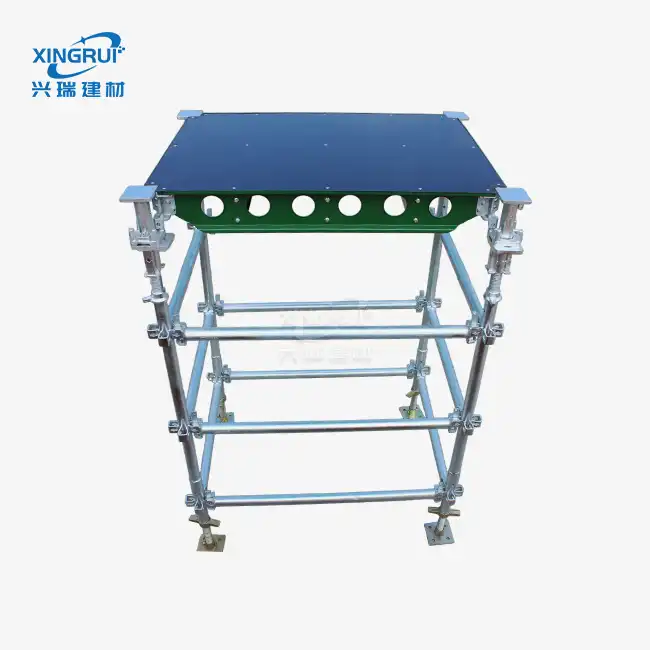
There are vertical standards, ledgers, diagonal braces, transoms, platforms, and adjustable bases that make up a modular scaffolding system, which is also sometimes called system scaffolding. These pieces lock together with rosettes, cups, pins, or wedges acting as fixed points. For this reason, the crew doesn't have to measure every joint like they do with tube and clamp. An eight-hole disk node is used in our GREEN FORMWORK system. Many ledgers and braces meet at the same level because bars can join at any angle between 0° and 360° around a single point. The structure is more stable and has fewer spacing and leveling mistakes as a result.
Common System Types
It refers to a number of different locking systems. This type of lock uses a rosette disk, a cup and blade, and a wedge to go through a bracket. Heavy-duty, frame, aluminum, and mobile shoring systems all use parts that are the same. Instead of being outside of modular, ringlock and cuplock belong in it. Ringlock, cuplock, banana-type, HK, and frame scaffolding are all in our series. We also sell foot planks, baffles, fasteners, and tools. The disk thickness and hole tolerance of parts made by different companies can be different. I tell buyers to only keep one system per structure unless the supplier confirms in writing that the systems will work together.
What Modular Design Does Not Replace
Consistency is improved by modular design, but it does not replace engineering. Load calculations, a strong base, the right ties, and a trained crew are still needed for a scaffold. The total set-up, such as the bay size, lift height, bracing, platform type, and ground conditions, determines the capacity. The structure of a modular scaffolding system must be inspected by a qualified person, and all of its parts must work together. The system is a good place to start for me. Even though it reduces variation, the scaffold's safety is still determined by a site-specific design and a written inspection routine.
How a Modular Scaffolding System Improves Jobsite Safety
Built-In Edge Protection and Predictable Load Paths
First, safety gets better because the parts come ready to put together. Guardrails, mid-rails, toe boards, platforms, and stair towers all connect to the main structure at the same nodes, which means that workers don't have to use as many makeshift barriers. Load moves in a straight line through the standards, ledgers, and braces.
Adjustable base jacks let the crew level the scaffold even if the ground isn't level, as long as the sole boards and soil can hold the weight. OSHA says that about 2.3 million construction workers, or about 65% of the industry, use scaffolding on a regular basis. This means that consistent design reaches a lot of people.
Standards, Inspection, and Training
It all starts with OSHA's scaffold rule, 29 CFR 1926 Subpart L, in the United States. For each scaffold to be legal, it must be able to hold at least four times its own weight. People who are more than 10 feet above a lower level need to be safe in case they fall.
The scaffolding needs to be checked by a qualified person before every work shift and after anything that could damage it. When a project is in another country, the owners will often also ask for compliance with EN 12801 and 128111. Because inspectors know where each pin, wedge, and brace goes, these checks can be done faster with fixed node positions.
Load Capacity, Height Limits, and Engineering Verification
The information we have on file shows that Q235 carbon steel has a yield strength of at least 235 MPa, a capacity of more than 40 kN, and a height capacity of more than 50 meters. Because of this, I never quote these numbers without adding that note.
Different checks need to be done on light-duty access platforms, medium-duty work platforms, heavy-duty scaffolds, and shoring towers. As a result of the bay size, vertical spacing, bracing, tie pattern, foundation, wind exposure, and off-center loading, the outcome is different. The wind is most of a problem for external scaffolding that is covered with sheets, nets, or banners. You should ask for load tables, material certificates, datasheets, and assembly instructions. You should also ask for help from an engineer with your layout.
How a Modular Scaffolding System Increases Erection and Project Speed
Repeatable Connections Cut Fitting Work
Making fewer choices leads to speed. A worker uses a tube and clamp to measure, place, and tighten each coupler. The worker puts the ledger end on the rosette and drives the locking pin with a disc-lock node. Bay sizes repeat, so the tenth bay goes up the same way the first one did. Less rework and lower labor costs come from having fewer fittings. I won't promise a specific percentage of productivity because the results depend on the difficulty of the design, the skill of the crew, the ease of access, and the logistics. You can get a number based on your own site from a short study on a mock-up bay.
Kitting, Labeling, and Container Planning
The speed starts before the scaffolding gets to the job site. From a bill of quantities, teams can count standard parts, put them into kits, label them by zone, and set them up near each work area. Then, instead of looking through loose stock, crews pull what they need one item at a time.
The packing plan is just as important as the parts list for projects that will be sent abroad. If you want to ship something, make sure the BOQ matches the container loading list. If there is a missing item, the crew could get stuck. Keep extra pins, ledgers, and braces somewhere easy to find. We can handle large orders because our plant has 12 welding robots and 6 automatic welding lines.
Reconfiguration, Dismantling, and Reuse
You can move, shorten, and extend modular parts without having to do a full redesign. The crew adds or takes away ledgers and braces at the nodes when a building has setbacks, pipes, openings, or different heights. When parts are taken apart in a controlled way, they can be moved to the next zone or project. Our listed specification calls for more than 100 cycles of assembly. Hot-dip galvanizing or powder coating can be used for the surface. Galvanized parts have a 60–80 micron zinc layer. Crews must check each piece, set aside any broken or bent parts, and store stock that is dry and in order for reuse to work.
Modular Scaffolding System vs. Other Options, and Where It Fits
Compared With Tube-and-Clamp and Frame Scaffolding
When you have a lot of flat facades, frame scaffolding works well because the frames can be stacked quickly. It isn't as adaptable around curves, pipes, or changing heights. Every joint in tube and clamp depends on the worker's size and torque, so it takes longer to put together and the quality isn't always the same. There is also a modular scaffolding system in the middle. It can fit into odd shapes while keeping the spacing the same. Steel can hold more weight and last longer, but aluminum is easier to work with and lighter. Pick based on loads, height, geometry, worker skills, and transport limits instead of the product label.
Complex Buildings and Irregular Structures
With multidirectional connections, the same parts can be used to build around curves, walls at an angle, and other obstacles. Which is why our system works well with complicated buildings and strange shapes. Standardized parts that fit across specifications make arc-shaped and long-span structures useful. The same node points are used for platforms, stairs, and guardrails. The stock stays simple, and crews don't have to make new kits for each tricky corner. This saves time on-site when they need to make special fixes.
Applications Across Industrial and Civil Projects
In oil and gas refineries, workers need to be able to get around spherical tanks and a lot of pipes. Because the node is flexible, maintenance teams can get to those areas even when the network is down. Heavy-duty shoring towers carry the loads of the concrete forms used in bridge and viaduct work. Commercial landmarks need to be easy to put together and look the same. For large crowds, grandstands, stage towers, and lighting rigs need to be easy to set up and have strong safety features. For each use, a project-specific design is still needed, which includes rules for wind, ties, access, and dangerous areas.
How to Choose, Buy, and Verify a Modular Scaffolding System Supplier
Match the System to Project Conditions and Total Cost
Start by choosing the type of building, the working height, the size of the platform, the load class, the length of the project, the ground, the weather, and the maximum weight that can be moved. Then check connection type, compatibility, bracing, tie options, corrosion protection, handling weight, documents, and spare-parts access. You should look at more than just the price per ton or square meter when you compare prices. The final number changes because of things like labor, freight, accessories, storage, reuse, and maintenance. It may cost more to use a cheaper set that isn't well-made or has thin coatings or missing parts than a better-made one for a number of projects.
Buy, Rent, or Customize
When contractors have ongoing projects and need storage space, buying is the best option. It's best to rent for short-term or specific jobs. Send drawings, measurements, working height, load needs, accessories, standards, delivery port, and schedule to get a correct quote. Set up early the loading of containers, labeling, Incoterms, customs papers, inspection, packing, lead time, and lead time for export orders. We make things to order based on your drawings and samples, and we give your team samples and technical help to make sure they fit before placing a full order. Our export logistics are helped by the fact that Rizhao has its own airport, seaport, and high-speed rail hub.
Avoid Common Mistakes and Verify the Supplier
Some mistakes that can cost a lot of money are picking the cheapest option, mixing parts from different systems, copying a standard layout without site engineering, inspecting only once, and not paying attention to spare parts. Ask about where the materials come from, how the welding is controlled, how the dimensions are checked, how the surface is treated, how the product is tested, and how each batch can be tracked. Check to see if each certificate covers the whole product, just a part of it, or just the management system.
Shandong Xingrui Building Materials Co., Ltd., which has been around since 2007, backs GREEN FORMWORK. Our 79,800-square-meter plant has 920 workers, 180 of whom are technicians. ISO 9001, ISO 14001, and ISO 45001 are all management system standards that our system meets. Our products have also been certified by CE.
Conclusion
A modular scaffolding system makes things safer and faster by having fixed nodes, standard parts, built-in edge protection, and layouts that can be used again and again. Inspectors know where each part goes, crews don't have to measure and fit as much, and teams can rearrange and use the same stock. Still, these benefits depend on the whole solution: a tested design, parts that work together, proper assembly, regular checks, and careful upkeep. Modular systems are better for irregular structures and industrial access work than frame and tube-and-clamp options. It is better to choose a system based on its total cost, documentation, and supplier verification than just its purchase price. This is better for both workers and schedules.
FAQ
What is a modular scaffolding system?
It is a set of standards, ledgers, braces, and platforms that are already made and can be locked together at fixed points, like ringlock rosettes or cuplock cups.
Is it safer than tube and clamp?
It cuts down on improvised joints and adds guardrails and access, but design, training, and inspection are still needed to make sure it is safe.
How do I confirm capacity and height limits?
Capacity is based on how everything is set up. For your layout, ask for load tables and engineering help.
Which documents should I request?
To make sure the standards for your project are met, ask for load tables, material certificates, assembly instructions, quality records, and conformity documents.
Discuss Your Modular Scaffolding System Requirements with GREEN FORMWORK
Green Formwork needs your drawings, working height, loads, standards, port, and schedule. You can send them to sdxingruiqp@126.com. As a Rizhao company that makes modular scaffolding systems, we make Q235 steel products to order, give you samples, and help you with technical issues. Our team will make the layout work with your site and the way you pack. For more information, ask for a quote right away.
References
1. Occupational Safety and Health Administration, Safety and Health Regulations for Construction: Scaffolds, 29 CFR 1926 Subpart L, 1996.
2. Occupational Safety and Health Administration, A Guide to Scaffold Use in the Construction Industry (OSHA 3150), 2002.
3. European Committee for Standardization, EN 12811-1 Temporary Works Equipment: Scaffolds, Performance Requirements and General Design, 2003.
4. European Committee for Standardization, EN 12810-1 Façade Scaffolds Made of Prefabricated Components: Product Specifications, 2003.
5. American Society of Safety Professionals, ANSI/ASSP A10.8 Scaffolding Safety Requirements, 2019.
6. International Organization for Standardization, ISO 9001 Quality Management Systems: Requirements, 2015.
Learn about our latest products and discounts through SMS or email