- English
- French
- German
- Portuguese
- Spanish
- Russian
- Japanese
- Korean
- Arabic
- Greek
- German
- Turkish
- Italian
- Danish
- Romanian
- Indonesian
- Czech
- Afrikaans
- Swedish
- Polish
- Basque
- Catalan
- Esperanto
- Hindi
- Lao
- Albanian
- Amharic
- Armenian
- Azerbaijani
- Belarusian
- Bengali
- Bosnian
- Bulgarian
- Cebuano
- Chichewa
- Corsican
- Croatian
- Dutch
- Estonian
- Filipino
- Finnish
- Frisian
- Galician
- Georgian
- Gujarati
- Haitian
- Hausa
- Hawaiian
- Hebrew
- Hmong
- Hungarian
- Icelandic
- Igbo
- Javanese
- Kannada
- Kazakh
- Khmer
- Kurdish
- Kyrgyz
- Latin
- Latvian
- Lithuanian
- Luxembou..
- Macedonian
- Malagasy
- Malay
- Malayalam
- Maltese
- Maori
- Marathi
- Mongolian
- Burmese
- Nepali
- Norwegian
- Pashto
- Persian
- Punjabi
- Serbian
- Sesotho
- Sinhala
- Slovak
- Slovenian
- Somali
- Samoan
- Scots Gaelic
- Shona
- Sindhi
- Sundanese
- Swahili
- Tajik
- Tamil
- Telugu
- Thai
- Ukrainian
- Urdu
- Uzbek
- Vietnamese
- Welsh
- Xhosa
- Yiddish
- Yoruba
- Zulu
Why Choose a British Standard Frame for Secure Site Systems?
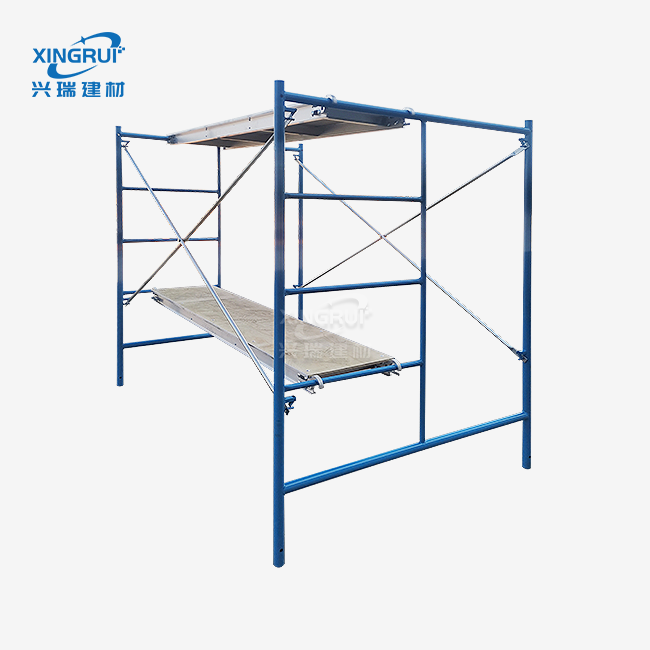
A British standard frame is the best option because it provides a safe working environment and a standardized door-type scaffolding system with known sizes, load requirements, and accessories. We use Q235 steel pipes with walls that are 2.0 mm thick, which is what BS says is right, and our frames meet the load requirements of BS EN 12810 and 12811. They're easier for inspectors to check, crews can put them up faster, and yards can use them for more than one project. These frames are made by GREEN FORMWORK for projects in Europe, Southeast Asia, and the Commonwealth. How do they stack up against other choices? How do I pick one? What should I ask a supplier?
What Are the Main Benefits of a British Standard Frame?
Standard Dimensions Cut Site Errors
A door-style scaffolding unit built to BS standards is known as a British Standard Frame. Ours is set up in a standard 1930 × 914 mm way, so crews can work from the same set of measurements in every bay. The erection sequence repeats when each frame is the same as the last, so supervisors don't have to spend as much time measuring and fixing. Our welding lines have a ±0.5 mm tolerance on dimensions, which means that the connection points for the braces stay in the same place from one piece to the next. That consistency cuts down on the time needed for inspections and makes it easier to train new crew members. The parts will still line up on site when you put together frames from different delivery batches for the same project.
Q235 Steel Supports Load and Reuse
One type of steel in China is called Q235, and its number means that it has a minimum yield strength of 235 MPa according to GB/T 700. It is used to make scaffolding because it welds well and can stand up to a lot of use on the job site. The frames we make have walls that are 2.0 mm thick, and they meet the load requirements of BS EN 12810 and 12811. These standards tell scaffolds made of prefabricated parts how to work and how to be designed. Since the frames can be used again and again, the cost of buying them can be spread out over several projects. Still, you need to check each unit after each use, take out any bent parts, and keep the coating in good shape.
Compatibility with BS Accessories
The accessories only work well with a frame if they fit. Cross braces, diagonal braces, and connecting rods that meet BS standards go with our British standard frame. This is important for rental yards and contractors who mix stock from different sources because connection points that don't match up cause delays and force crews to make do with what they have. You can add parts later without having to redo the bay layout if you use standard mounting centers. When you order frames from us, we include accessories that go with them, so when it arrives, it's a system that works instead of a bunch of separate parts. Your drawings and samples can help us figure out how to connect things if they need special details.
British Standard Frame vs. Other Frame Scaffolding Options
BS Frames Compared with Other Frame Standards
Frame scaffolds are made to different standards depending on where they are used, and their sizes, terms, and connection details don't always match. A British standard frame complies with BS standards, whereas frames made in accordance with Chinese GB regulations or other regional systems may have different section sizes and fittings. If you mix them in one bay, it could lead to a bad fit and a slow erection. Make sure you know which standard your engineer, client, or local government uses in the scaffold design before you place your order. Send us a sample or drawing if you need to match stock that we already have. Before production starts, we compare the sizes so that you can see if there is a problem on paper instead of on the job site.
Frame Systems vs. Ringlock and Cuplock
Types of door frames, ringlocks, and cuplocks are all good for different tasks. Frame scaffolding is easy to set up on straight walls and bays that are repeated because workers just put standard units in place and lock them together with braces. Ringlock and cuplock both use node connections that let you make more angles. This is helpful for buildings with heavy shoring, curved walls, and layouts that aren't straight. When it comes to building faces and access work, I usually recommend frames. For more complicated shapes, I suggest node systems. Since we make frame, ringlock, and cuplock scaffolding, we can tell you which one will work best with your plans instead of pushing a single product.
Why the Standard Name Alone Is Not Enough?
Just because something is labeled "British Standard" doesn't mean it works well. You should ask for the standard that was used, the frame drawing, the material grade, the coating specifications, and records of the batch inspections. How the frames, braces, base jacks, platforms, and how the crews put them together affect the total load capacity of the scaffold. It's not possible for one frame to carry the rating for the whole building. In the US, OSHA's 29 CFR 1926 Subpart L scaffold rule also has rules about how they should be built and used. People in the US who want to buy a system should check with their engineer to see what rules apply to the project.
How to Choose the Right British Standard Frame for a Secure Site?
Define Load, Height, and Site Conditions
Do not start with the catalog, but with the job. Record the working height, the number of levels, the weight that will be on the platform, the wind exposure, and the length of time that the scaffold will be up. These are the things your scaffold engineer needs to compare the design to BS EN 12811 or the standard your client gives them. Write down any ground limits, like stair towers or ladder positions, because soft ground and slopes change how the base is built. You need to plan where the guardrails and toe boards will go before you order the frames for a safe site. If you give us this information early on, our technicians can make sure that the frame and list of accessories match your design.
Confirm Specifications and Fit
Our British standard frame has the following main characteristics.
| Parameter | Specification |
|---|---|
| Standard compliance | British BS Standard |
| Frame dimensions | 1930 mm × 914 mm |
| Pipe wall thickness | 2.0 mm |
| Material grade | Q235 steel |
| Surface treatment | G30–G90 galvanization / powder coating |
| Dimensional tolerance | ±0.5 mm |
| Compatible accessories | BS cross braces, diagonal braces, connecting rods |
| Load capacity | Meets BS EN 12810/12811 requirements |
Compare these numbers to what you drew. You can send us drawings and samples to make a custom order if your design needs a different size.
Match the Surface Treatment to the Environment
It depends on the coating that you choose how long a frame will last. We can galvanize from G30 to G90 and powder coat. When it comes to galvanizing grades, a higher number means a thicker zinc layer that protects better against salt and water. A heavier coating is needed for coastal projects, places that are humid, and rentals that last a long time. Powder coating can be useful for jobs where looks or color coding are important, but dry inland sites that don't get used often might not need it. Let us know the weather, how long the project will take, and how many times you plan to use the finish, and we'll help you find a price that fits your needs.
Certification, Quality Control, and Supplier Support
ISO Systems and CE Certification
We use ISO 9001 for quality management, ISO 14001 for environmental management, and ISO 45001 for health and safety at work management in our production of british standard frame. Also, our goods have been approved by CE. Procurement teams and project engineers need these certificates to show a client that they are following the rules. Remember that a management system certificate only shows how a factory works. The performance of a product depends on the design of the frame, the standard it meets, and the scaffold that is built from it. So, ask any supplier for the drawings, the certificates, and the reports on the batch inspections all at the same time. That paperwork comes with your order so that your file stays complete.
Production Controls Behind Frame Accuracy
There is a factory where accuracy starts. The area of our site in Rizhao, Shandong, is 79,800 square meters, and more than 40,000 of those are standard workshops. 920 people work for us, and 180 of them are technicians. We have 4 cold roll forming sets, 12 welding robots, and 6 automatic welding lines. With robotic welding, the ±0.5 mm tolerance is kept because the same weld path is used on every frame. At each stage of production, we keep track of the raw materials and finished goods that come in, so quality records can be traced back to the batch. We've sent packages to more than 100 countries and regions since 2007.
Samples, Custom Orders, and Procurement Checklist
We offer samples and make frames to order. You can call or email our technical team with questions. Before you ask for a quote, make a short list of the standard that you want in your design, the frame size, the number of frames, the surface treatment, the accessories, the delivery port, and the documents that your client needs. Next, don't just look at the unit price when you compare suppliers; look at the lead time, payment terms, and shipping terms like FOB or CIF as well. Because we are in Rizhao, which has its own seaport, we can ship goods to other countries. We can make sure the fit is right before we start production if you send us a drawing or sample with your question.
Conclusion
A British Standard frame provides secure site systems with a standard door-type scaffolding unit with consistent dimensions, clear load requirements, and BS accessories that are compatible with it. Q235 steel with walls of 2.0 mm can be used more than once, and the surface treatment should be right for the climate and length of the project. When you look at frames next to other regional standards and ringlock or cuplock systems, you can see that the best choice depends on how the site is laid out and the standard that is named in the design. Performance can't be proven by the label alone; buyers also need drawings, information about the materials, information about the coating, and records of inspections. Quality that can be proven is supported by ISO management systems, CE certification, controlled welding, and batch tracking. Clear specifications, approval of samples, and careful comparison of suppliers all help cut down on mistakes before production.
FAQ
Is a british standard frame safe for any site by itself?
No, safety depends on how well the scaffold is designed, put together, and checked on a regular basis. The frame must also meet the standards set by your engineer.
Can I order a custom size?
Yes. We can do custom work based on your samples and drawings. The standard size for our setup is 1930 × 914 mm.
Can I get a sample before placing a large order?
Yes. Our technical team is here to answer your questions while you look over the samples we give you.
Are the frames reusable?
Yes. If you check the frames for damage after each use and replace any that are broken, you can use them for more than one project.
Request a British Standard Frame Quote from GREEN FORMWORK
Trying to find a British standard frame manufacturer who can work from your plans? You can email GREEN FORMWORK at sdxingruiqp@126.com with your frame size, quantity, surface treatment, and delivery port. We give you samples, answer your technical questions, and make you a quote for Q235 door-type scaffolding that is made in line with ISO 9001, ISO 14001, and ISO 45001 standards.
References
1. British Standards Institution, BS EN 12811-1: Temporary Works Equipment, Scaffolds, Performance Requirements and General Design, 2003
2. British Standards Institution, BS EN 12810-1: Façade Scaffolds Made of Prefabricated Components, Product Specifications, 2003
3. Standardization Administration of China, GB/T 700: Carbon Structural Steels, 2006
4. Occupational Safety and Health Administration, Scaffolds Used in the Construction Industry (29 CFR 1926 Subpart L), 1996
5. International Organization for Standardization, ISO 9001: Quality Management Systems, Requirements, 2015
6. International Organization for Standardization, ISO 45001: Occupational Health and Safety Management Systems, Requirements, 2018
Learn about our latest products and discounts through SMS or email