- English
- French
- German
- Portuguese
- Spanish
- Russian
- Japanese
- Korean
- Arabic
- Greek
- German
- Turkish
- Italian
- Danish
- Romanian
- Indonesian
- Czech
- Afrikaans
- Swedish
- Polish
- Basque
- Catalan
- Esperanto
- Hindi
- Lao
- Albanian
- Amharic
- Armenian
- Azerbaijani
- Belarusian
- Bengali
- Bosnian
- Bulgarian
- Cebuano
- Chichewa
- Corsican
- Croatian
- Dutch
- Estonian
- Filipino
- Finnish
- Frisian
- Galician
- Georgian
- Gujarati
- Haitian
- Hausa
- Hawaiian
- Hebrew
- Hmong
- Hungarian
- Icelandic
- Igbo
- Javanese
- Kannada
- Kazakh
- Khmer
- Kurdish
- Kyrgyz
- Latin
- Latvian
- Lithuanian
- Luxembou..
- Macedonian
- Malagasy
- Malay
- Malayalam
- Maltese
- Maori
- Marathi
- Mongolian
- Burmese
- Nepali
- Norwegian
- Pashto
- Persian
- Punjabi
- Serbian
- Sesotho
- Sinhala
- Slovak
- Slovenian
- Somali
- Samoan
- Scots Gaelic
- Shona
- Sindhi
- Sundanese
- Swahili
- Tajik
- Tamil
- Telugu
- Thai
- Ukrainian
- Urdu
- Uzbek
- Vietnamese
- Welsh
- Xhosa
- Yiddish
- Yoruba
- Zulu
Why Choose Crab Type Scaffolding for Heavy-Duty Construction?
When a project involves bridge shoring, large-span factory structures, or basement heavy-load support, the scaffolding system you select directly affects safety, schedule, and cost. Crab type scaffolding answers those demands with a self-locking node design, Q235 premium steel construction, and per-standard load ratings between 40 kN and 75 kN. Its crab-claw-shaped connection automatically tightens under vertical pressure, giving engineering teams a structurally consistent joint every time—without relying on manual torque checks or individual worker skill.
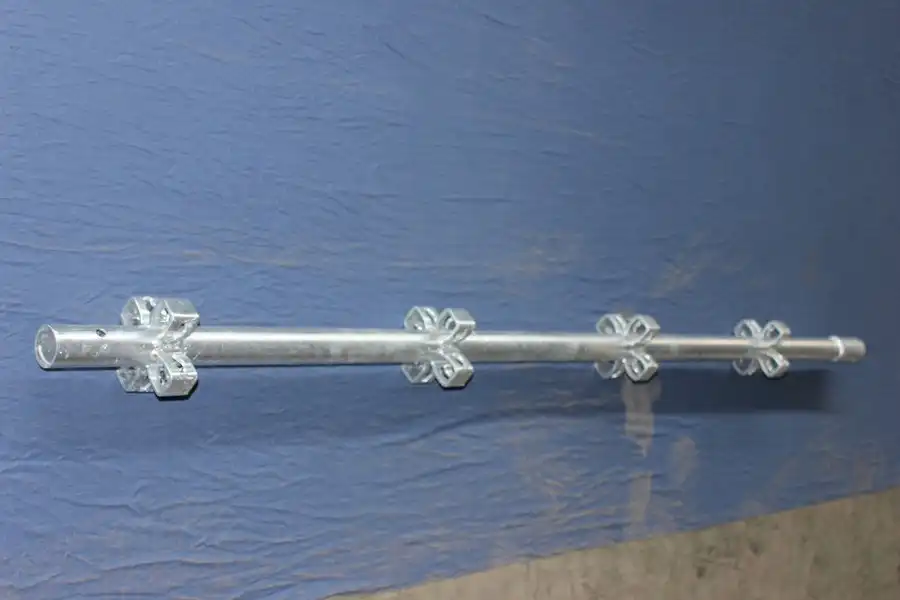
Understanding Crab Type Scaffolding: Features and Components
Tech leads need to know exactly what they're getting before they pick a defense system. The three parts that follow break down the physical parts of this system that make it work.
The Chrysanthemum Disc Node
It's different because it has an eight-hole chrysanthemum disk. Each hole can take a ledger from a different compass direction. This means that teams don't have to cut members to line up the grid to fit decks with uneven column spacing, curves, or existing mechanical runs. Frames with cup-lock or bowl-buckle don't let you move that way.
Q235 Carbon Steel Uprights
The uprights are 60.3 mm wide on the outside, and the walls are 3.0 mm to 3.5 mm thick. Q235 carbon steel has a yield strength of about 235 MPa, and each standard can hold between 40 kN and 75 kN of vertical load, depending on the height and how the bracing is set up. The diameters in the 60-series work about 35% better than the 48 mm options in axial load tests.
Hot-Dip Galvanized Surface Treatment
Over 60–80 microns of zinc are put on every part through hot-dip galvanization. This layer won't rust for more than 15 years if it is checked often and kept away from salt water, chemical plants, and damp basements. This makes it good for both owners and rental teams because the asset's value stays high even after being used a lot.
Why Crab Type Scaffolding Excels in Heavy-Duty Construction?
Each part of a traditional tube-and-clamp device has to be torqued to the right amount by a different worker. An important issue with scaffolding on high-clearance projects is that it is not always tightened. This has been shown in studies in the field. That's not taken into account in the design of the modular shoring tower.
This system is better than others because it does the following things better:
- Nodes that lock themselves: That is, the crab-joint gets tighter as the load goes up. In other words, the shear strength goes up at each node in the same way that the force does. There is no need for a second tightening pass after the first one.
- 40% faster assembly: Pre-engineered connection points cut set-up time by 40% compared to tube-and-clamp systems. Project teams can cut down on the time it takes to set up the forms and pour the concrete faster.
- Multidirectional force transfer: The eight-hole disk shares axial and horizontal loads in all directions. This keeps stress from building up, which is what happens in single-axis systems that fail too soon.
- Wind-load resistance: The rigid locking geometry and high-density Q235 steel make vibrations less common than with lighter aluminum options. We need to do this on bridge decks and open industrial sites where wind loads are almost too high to safely handle.
These perks of crab type scaffolding take care of the two things that technical leads worry about the most: making sure the structure is safe and sticking to the plan. This process goes faster if you can show a managing engineer or owner agent a load-test data sheet that shows a safety factor of at least 3:1.
Comparing Crab Type Scaffolding with Other Heavy-Duty Solutions
Every procurement team does a technical comparison before they spend money. The table below gives a concise side-by-side view.
| System | Typical Load per Standard | Assembly Speed | Best Application |
|---|---|---|---|
| Crab / Tower Shoring | 40 kN–75 kN | Fast (pre-engineered nodes) | Bridge shoring, ultra-high formwork |
| Ring-lock Modular | 30 kN–60 kN | Moderate | General access, multi-level façades |
| Cup-lock / Bowl-buckle | 20 kN–40 kN | Moderate | Low-to-medium height slabs |
| Tube & Clamp | Variable | Slow (manual fitting) | Complex custom geometry |
Purchase vs. Rental Decisions
People who rent out things love the crab tower system because its hot-dip galvanized finish and replaceable parts make it useful for many projects. One set of standard units, base jacks, U-head jacks, and steel planks can be used to build a factory, support a bridge, or hold up a basement. There is no need for project-specific stock.
Compatibility with Standard Accessories
The method can be used with steel boards, U-head jacks, and ISO-standard base jacks as long as the outside sizes are the same. This makes it less likely that a team of buyers will have to only buy things from one source.
Customization for Non-Standard Spans
A lot of bridge and trestle projects need spans that aren't normally set up. If a client gives GREEN FORMWORK drawings and samples, they can make custom work for them. So, buying teams don't have to change the structure to fit catalog sizes; they can give exact bay lengths, step heights, or load ratings.
Selecting the Right Crab Type Scaffolding Supplier: Key Considerations
It's not enough to just look at the price per ton when choosing a crab type scaffolding maker. There are three things that make suppliers you can trust stand out:
Certifications and Third-Party Test Reports
For quality control, look for ISO 9001, ISO 14001, and ISO 45001 certifications. For health and safety at work, look for ISO 45001 certificates. Also, check that the item has a CE mark and meets the requirements of EN 12810-1 and ANSI/SSFI SC100-5/05. These are the certifications that Shandong Xingrui Building Materials Co., Ltd. has. If you ask, they can give you structural calculation packages and third-party test reports. Before they agree to a high-clearance shoring plan, owners and engineers in charge need these kinds of papers.
Manufacturing Scale and Delivery Reliability
For big bridge projects, hundreds of tons of materials need to be brought in at set times so that each pour can happen on time. Xingrui's 79,800 m² Rizhao facility has over 40,000 m² of standard workshops, 12 welding robots, and 6 automatic welding lines. Large orders with more than one delivery date can fit in that much space. Rizhao's airport, seaport, and high-speed train make it easy for the company to send items to the US and other places.
Samples and Technical Support Before Commitment
A good company that sells crab type scaffolding will give you examples and a full technical package before you place a bulk order. This package should include load estimates, assembly drawings, and material certifications. Xingrui does just that; it lets buying teams check out test bays before the whole project starts.
Maximizing the Value of Crab Type Scaffolding in Your Construction Projects
You need to do more than just choose the right high-load shoring system to get the most out of it. To make the parts last longer, teach the team how to use the self-locking node sequence, check the locking pins and disk welds often, and keep the parts on level racks so they don't bend. Digital inspection records, which are photos of node conditions linked to component ID numbers, are being used more and more by rental companies and big contractors to keep track of the condition of assets across projects. This type of method that can be used more than once also helps the environment because it cuts down on the amount of one-time use materials that end up in landfills.
Conclusion
Lots of heavy-duty building projects need shoring systems that work perfectly, like bridges, viaducts, large industrial buildings, and very tall formwork structures. The load ratings on the crab type scaffolding tower system have been checked. It has 15-year service life, self-locking nodes, and force transfer in more than one direction. ISO 9001, ISO 14001, ISO 45001, and CE have all approved it. Technical performance, delivery reliability, and long-term asset value are all things that procurement teams should look at. This system makes a strong case, and test data backs it up.
FAQ
Q1: How does this system differ from ring-lock scaffolding?
A: Both use disc-based nodes, but the crab joint locks more tightly as the load increases. In pure vertical propping, this gives it a structural edge. Most of the time, ring-lock is better for building access scaffolding with diagonal members in a lot of different planes.
Q2: What load capacity can I expect per standard?
A: Single standard can hold between 40 kN and 75 kN, depending on the height of the uprights, the design of the braces, and the distance between the ledgers. For every setup, there is a structural modeling package.
Q3: Can non-standard components be fabricated to our drawings?
A: As long as the customer gives Xingrui drawings and samples, they can make the orders. Lead times for non-standard parts depend on how hard they are to make, but they are known for sure when the quote is given.
Q4: What is the realistic service life?
A: If you cover the system with 60–80 microns of hot-dip galvanized zinc and check the nodes and pins often, it will last longer than 15 years, even in seaside or chemically harsh places.
Q5: How are large bulk orders coordinated for delivery?
A: Xingrui is in Rizhao, which makes it easy to get to the seaport. Because of the way the site is set up, staged delivery plans can be made during the contract phase that are tied to the order of project pours.
Contact GREEN FORMWORK for a Crab Type Scaffolding Quote
Shandong Xingrui Building Materials Co., Ltd. runs GREEN FORMWORK and sells approved crab type scaffolding to builders and rental companies all over the world. Our team gives you load estimate packages, real samples, and help planning how to deliver large orders in stages. To get a quote that works for your project, email our tech team at sdxingruiqp@126.com.
References
1. British Standards Institution. EN 12810-1: Façade Scaffolding Made of Prefabricated Components — Part 1: Product Specifications. BSI, 2003.
2. Peng, J. L., & Chan, S. L. "Scaffold Engineering: Material, Design, Construction and Performance." Journal of Constructional Steel Research, 2007.
3. Scaffold & Access Industry Association (SAIA). Scaffolding Use in the United States: Safety and Standards Overview. SAIA, 2019.
4. Occupational Safety and Health Administration (OSHA). Scaffolding Standards: 29 CFR 1926 Subpart Q. U.S. Department of Labor, 2020.
5. Huang, Y. L., et al. "Load-Carrying Capacity of Modular Steel Scaffolding Systems." Engineering Structures, 2017.
6. Scaffold Industry Association. ANSI/SSFI SC100-5/05: Scaffolding — Safety Requirements. Scaffold Industry Association, 2005.
Learn about our latest products and discounts through SMS or email