- English
- French
- German
- Portuguese
- Spanish
- Russian
- Japanese
- Korean
- Arabic
- Greek
- German
- Turkish
- Italian
- Danish
- Romanian
- Indonesian
- Czech
- Afrikaans
- Swedish
- Polish
- Basque
- Catalan
- Esperanto
- Hindi
- Lao
- Albanian
- Amharic
- Armenian
- Azerbaijani
- Belarusian
- Bengali
- Bosnian
- Bulgarian
- Cebuano
- Chichewa
- Corsican
- Croatian
- Dutch
- Estonian
- Filipino
- Finnish
- Frisian
- Galician
- Georgian
- Gujarati
- Haitian
- Hausa
- Hawaiian
- Hebrew
- Hmong
- Hungarian
- Icelandic
- Igbo
- Javanese
- Kannada
- Kazakh
- Khmer
- Kurdish
- Kyrgyz
- Latin
- Latvian
- Lithuanian
- Luxembou..
- Macedonian
- Malagasy
- Malay
- Malayalam
- Maltese
- Maori
- Marathi
- Mongolian
- Burmese
- Nepali
- Norwegian
- Pashto
- Persian
- Punjabi
- Serbian
- Sesotho
- Sinhala
- Slovak
- Slovenian
- Somali
- Samoan
- Scots Gaelic
- Shona
- Sindhi
- Sundanese
- Swahili
- Tajik
- Tamil
- Telugu
- Thai
- Ukrainian
- Urdu
- Uzbek
- Vietnamese
- Welsh
- Xhosa
- Yiddish
- Yoruba
- Zulu
60 Series Heavy-Duty Ringlock Support vs Shoring Props: Which Wins?
Long spans and large loads favour 60 series heavy-duty ringlock support, while 60 series medium-duty ringlock support suits relatively lighter requirements. The 60.3 × 3.2 mm Q235 uprights, 8-way rosettes, and braced bays sustain concrete weight over a grid, ideal for bridge falsework, large floor slabs, and tunnel support. Shoring props set up quickly with minimal pieces, making them ideal for repairs and minor slab pours. Engineered calculations and verified test results should decide as neither system has a predetermined rating. To help you get the proper price, I evaluate both choices on structure, load, safety, cost, and procurement.
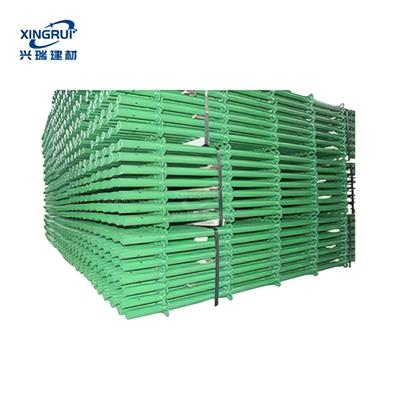
What Is a 60 Series Heavy-Duty Ringlock Support System?
How the System Is Built
Imagine linked pieces rather than a post. Vertical standards push the load down. Base jacks and U-heads establish height and support beams above ledgers and diagonal braces in rosettes welded along each standard. One node in our eight-hole disc rosette permits multiple connections in various directions. A gentle hammer tap seats wedge pins that fall into the disc and lock by gravity. A braced tower or multi-bay grid distributes weight and prevents sideways movement, unlike a single prop.
Why Q235 Steel and a 60.3 × 3.2 mm Tube Matter
A 3.2 mm wall and 60.3 mm outside diameter make up the upright's "60". Structure steel Q235 has a minimum yield strength of 235 MPa. Buckling resistance increases with inertia, therefore tube size counts. I estimate that a 60.3 × 3.2 mm tube has double the moment of inertia of a 48.3 × 3.2 mm tube. Real improvements are lower, and our research shows 50–70% greater vertical capacity than 48 mm. Wall thickness influences capacity, therefore measure it upon delivery using a gauge.
Core Specifications at a Glance
Here are the core specifications of our 60 series heavy-duty ringlock support.
| Parameter | Specification |
|---|---|
| Upright | 60.3 × 3.2 mm welded pipe |
| Steel | Q235 |
| Node | Eight-hole disc |
| Single upright load | 120 kN |
| Maximum step distance | 1.5 m |
| Finish | Hot-dip galvanized, 65–80 microns |
| Welding | Full-penetration automatic |
The 120 kN rating equals about 27,000 pounds-force. Your engineer should still check it against your own bay spacing, height, and bracing before ordering. We also operate under ISO 9001, ISO 14001, and ISO 45001 management systems.
Key Differences and Load Capacity Comparison
Structure and Load Path
Telescoping steel columns are shoring props. Set the height using an outer tube, inner tube, pin, and threaded collar, and the load goes straight down that column. 60 series heavy-duty ringlock support forms reliable Ringlock grids. Ledgers and braces connect standards as U-heads load them. Ringlock bays withstand sway as a unit due to that tie, whereas props utilise formwork or bracing to keep plumb. Props work with light, short supports, whereas ringlock works with tall, hefty, large-area layouts.
What Controls Capacity in Each System
Neither system is rated universally. Bay spacing, standard height, jacking extension, thickness of wall, steel grade, support, base ground, and load eccentricity determine ringlock capacity. Extension is the key driver for props: a longer column collapses at a lower force, lowering stated ratings. Bad alignment, bent tubes, and worn pins reduce capacity. OSHA's 29 CFR 1926.703 mandates formwork and shoring to sustain all reasonable loads, while ASCE/SEI 37 addresses construction-stage loads. For bridges, use the AASHTO temporary works handbook. Request design tables for project-specific computations, not headline numbers.
Side-by-Side Comparison
The table below sums up the main differences.
| Factor | 60 series ringlock | Shoring props |
|---|---|---|
| Structure | Braced grid | Single column |
| Best height | Tall towers, deep bays | Low to moderate |
| Load spread | Across many nodes | Point by point |
| Setup | More parts, more planning | Fast, few parts |
| Typical use | Bridges, thick slabs, tunnels | Repairs, small slabs |
Use it as a starting point, then let your engineer confirm the details.
Installation, Safety, and Application Fit
Setting Up Ringlock Support Safely
Because settlement pushes loads onto neighbouring standards, start on solid, level ground with sole plates under each base jack. Jack extensions should be short, standards plumb, and ledgers and bracing installed during construction. Center each U-head beneath its beam and ensure all wedge pins are seated. Preload or load check huge pours if your design requires it. OSHA scaffold guidelines require a competent person to check components for apparent faults before each work shift and after any incident that might impact structural integrity. This works for falsework too.
Using Shoring Props Safely
Props applaud discipline. For 60 series heavy-duty ringlock support and individual props alike, keep the extension within the specified range and set each prop plumb with full contact at the base and head. Completely insert the pin and screw the collar to the desired height. Taller supports or heavy slabs need horizontal or diagonal bracing to counteract sideways force. Reject bent tubes, thread damage, and mixed-maker parts. Plan the stripping sequence, check slab strength before removing supports, and examine after impact or bad weather.
Which Project Fits Which System
Ringlock supports box girder formwork, long-span bridges, large transfer slabs, industrial roofs and tunnel/subway station support. The 60 series is ideal for ultrahigh and long-span formwork, huge loads, and repetitive layouts. Hot-dip galvanising aids humid subterranean operations. Pick props for remodelling, tiny slabs, localised repairs, and narrow access when staff transport a few pieces by hand. Many crews use ringlock for the heavy grid and props for edges, small bays, and late alterations. Standard 60 series components keep rental fleet inventory constant across projects.
Cost, Logistics, and Procurement Considerations
Look at Total Delivered Cost
Tonnage price might deceive. Low per-ton quotes may mask a weaker tube since thinner walls weigh less. Compare per-piece pricing to confirmed wall thickness, steel quality, and zinc coating. Your engineer may minimise erection hours by using fewer uprights and joints with the wider 60 series tube when designing bays. Modular parts may be reused, and hot-dip galvanising with 65–80 microns of zinc protects steel in damp yards and outdoor storage. Ask about quotation validity dates and staged delivery since steel prices fluctuate.
Documents to Request Before You Sign
Request mill certificates with heat figures, wall-thickness tolerances, galvanising thickness files, weld inspection data, and node or tower load test results from all suppliers. These documents help your inspector track batches and resolve acceptance problems. We operate under the standards ISO 9001, ISO 14 and ISO 45001 and monitor materials and goods at each step for complete traceability. We provide samples and technical support so your engineer may test and measure before a significant purchase. Send acceptance criteria early to ensure manufacturing and inspection meet project requirements.
Export Logistics from Rizhao
Our facility is located in Rizhao, Shandong, a hub with access to seaport, airport, and high-speed trains. The campus has 920 employees, 180 of whom are technicians, and encompasses 79,800 square meters, including almost 40,000 square meters of standardised workshops. Large orders for 60 series heavy-duty ringlock support are supported by 4 cold roll shaping sets, 12 welding robots, and 6 automated welding lines. We export to over 100 nations & regions. Set container loading, bundling labels, packing lists, clauses, and arrange batch shipment early in order planning. Share your timetable so we can match production to site demands.
How to Choose the Best Heavy-Duty Ringlock Support
Define Your Project Data First
Note support height, area, concrete thickness, framework weight, live loads, ground bearing, time frame, and weather. These statistics help your engineer size bays and evaluate buckling length. Access constraints like crane reach or hand-carry only influence component size and weight. Include local standards like OSHA, project specifications, and AASHTO temporary works guidance for bridges. A full data sheet lets the supplier match components to actual loads instead of guessing, speeding up quotes and reducing rework.
Verify the Supplier and the Product
Compare tube diameter, thickness of wall, steel grade, foot lengths, jacks range, node design, load, and finish to designs. Then consider the maker's workshop capacity, welding and shaping equipment, quality control, certifications, and drawing-based order expertise. Our 60 series pieces are reusable and may be custom processed from client designs and samples. Get a sample, measure it, and compare it to your specs. A failed batch costs more than a sample test.
Final Verdict: Ringlock, Props, or Both
When height, load, or area increase or task arrangement repeats, use 60 series heavy-duty ringlock support. Props for brief, light, localised work that requires speedy setup. Choose both for projects with strong main bays and modest edge zones. Always base decisions on calculations, site circumstances, and confirmed manufacturer data, and retain inspection records from the start. Your workforce, schedule, and inventory investment are protected.
Conclusion
The comparison indicates that 60 series heavy-duty ringlock support and shoring props tackle various issues. Ringlock supports bridges, large slabs, and tunnels by creating a braced grid using 60.3 × 3.2 mm Q235 uprights with eight-hole rosettes, distributing high loads and resisting sway. Shoring props, which are single telescoping columns, are ideal for fast, light, localised projects with few parts.
Both systems' capacity varies on height, spacing, consequently, bracing, wall thickness, steel quality, and ground, hence no rating applies to every arrangement. Safe usage needs proper installation and frequent inspection, and a realistic cost comparison considers delivered price, re-use, finish, and paperwork, not just price. The practical result: match system to load and geometry and verify using engineering data.
FAQ
Can I compare one prop rating with a ringlock rating directly?
No. A ringlock rating applies to an upright inside a braced layout, while a prop rating applies to a single column at a given extension. Compare complete designs instead.
Is 60 series ringlock support better for tall structures?
Usually yes, because the larger tube and braced bays resist buckling better, and the system suits ultra-high formwork. Your engineer must still verify the design.
Does wall thickness matter that much?
Yes. Buckling resistance depends on the moment of inertia, so a thinner wall lowers capacity. Measure samples and request mill certificates.
Is galvanizing worth it?
Hot-dip galvanizing with 65–80 microns of zinc protects against humidity and outdoor storage, and it suits tunnel and coastal work better than paint alone.
Can GREEN FORMWORK customize sizes?
Yes. We accept custom processing based on your drawings and samples, and we can send samples and technical guidance before you place an order.
Request a 60 Series Ringlock Support Quote from GREEN FORMWORK
Planning a bridge, heavy slab, or tunnel project? GREEN FORMWORK, backed by Shandong Xingrui Building Materials Co., Ltd., is a 60 series heavy-duty ringlock support manufacturer offering Q235 uprights, hot-dip galvanizing, custom sizing, samples, and technical guidance. Request a technical review and factory-direct quote by sending your support height, bay dimensions, design loads, quantities, and delivery date to sdxingruiqp@126.com. You can find more details at sdxingrui.com.
References
1. ACI Committee 347, Guide to Formwork for Concrete (ACI 347R-14), American Concrete Institute, 2014
2. American Concrete Institute, Formwork for Concrete (ACI SP-4), 8th Edition, 2014
3. ASCE/SEI 37-14, Design Loads on Structures During Construction, American Society of Civil Engineers, 2014
4. AASHTO Guide Design Specifications for Bridge Temporary Works, 2nd Edition, 2017
5. Code of Federal Regulations, Title 29, Part 1926, Safety and Health Regulations for Construction, U.S. Government Publishing Office, 2023
6. EN 12812, Falsework: Performance Requirements and General Design, European Committee for Standardization, 2008
Learn about our latest products and discounts through SMS or email