- English
- French
- German
- Portuguese
- Spanish
- Russian
- Japanese
- Korean
- Arabic
- Greek
- German
- Turkish
- Italian
- Danish
- Romanian
- Indonesian
- Czech
- Afrikaans
- Swedish
- Polish
- Basque
- Catalan
- Esperanto
- Hindi
- Lao
- Albanian
- Amharic
- Armenian
- Azerbaijani
- Belarusian
- Bengali
- Bosnian
- Bulgarian
- Cebuano
- Chichewa
- Corsican
- Croatian
- Dutch
- Estonian
- Filipino
- Finnish
- Frisian
- Galician
- Georgian
- Gujarati
- Haitian
- Hausa
- Hawaiian
- Hebrew
- Hmong
- Hungarian
- Icelandic
- Igbo
- Javanese
- Kannada
- Kazakh
- Khmer
- Kurdish
- Kyrgyz
- Latin
- Latvian
- Lithuanian
- Luxembou..
- Macedonian
- Malagasy
- Malay
- Malayalam
- Maltese
- Maori
- Marathi
- Mongolian
- Burmese
- Nepali
- Norwegian
- Pashto
- Persian
- Punjabi
- Serbian
- Sesotho
- Sinhala
- Slovak
- Slovenian
- Somali
- Samoan
- Scots Gaelic
- Shona
- Sindhi
- Sundanese
- Swahili
- Tajik
- Tamil
- Telugu
- Thai
- Ukrainian
- Urdu
- Uzbek
- Vietnamese
- Welsh
- Xhosa
- Yiddish
- Yoruba
- Zulu
Crab System Scaffolding Installation: Key Specs, Tips, and FAQs
If you are sourcing a modular shoring solution for bridges, tunnels, or high formwork applications, crab system scaffolding deserves serious attention. This disc-type, wedge-lock system connects vertical standards to horizontal and diagonal members at up to eight directions per node, achieving load capacities of up to 200 kN per tower. In this guide, I cover core specifications, a practical installation sequence, performance best practices, and honest answers to the questions procurement teams ask most often.
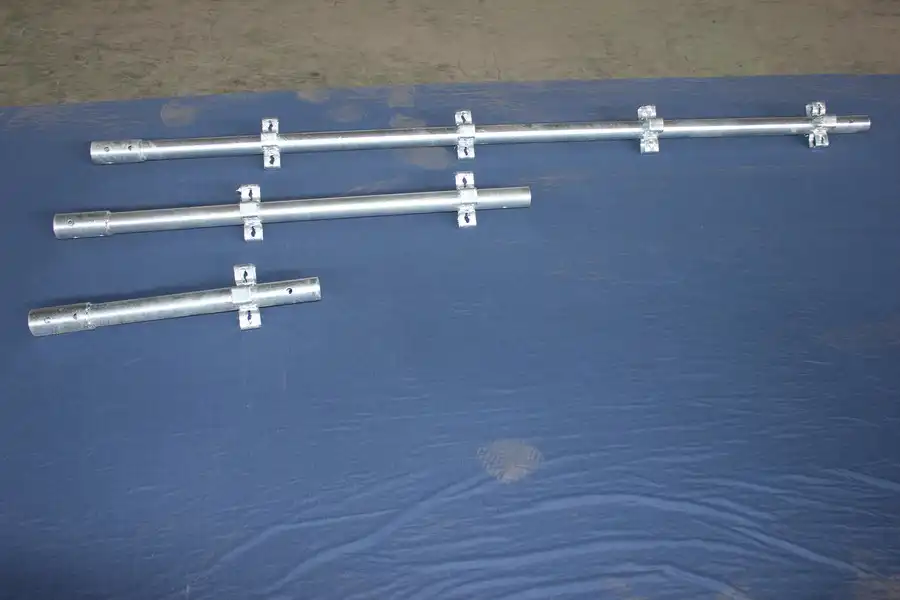
Understanding Crab System Scaffolding: Key Specifications
The 60-series disc-lock frame is based on three key ideas: the integrity of the material, the ability to change to different shapes, and the ability to be checked for compliance. You can decide if the system really fits your project load case before you place an order if you understand these rules.
Material and Dimensional Standards
| Parameter | Specification |
|---|---|
| Material | Q235 carbon steel |
| Diameter | 60 mm |
| Wall Thickness | 3.2 mm |
| Connection Type | Eight-hole disc, wedge-lock pins |
| Zinc Coating | 60–80 μm (ISO 1461) |
| Max Tower Load | 200 kN (with bracing) |
| Standards | ISO 9001 / ISO 14001 / ISO 45001 / EN 12810 / EN 12811 |
Load-Bearing Capacity
One 200 kN crab system scaffolding shoring tower can hold more weight than most cast-in-situ concrete beam uses. This is because the bracing is set up properly. With a wedge-lock system, the joint doesn't come loose when concrete is poured like it does with a normal tube-and-clamp system because it works with gravity.
Certification and Traceability
It is backed up by structural calculation reports instead of just what the manufacturer says because it meets EN 12810 and EN 12811. Buying managers in North America and Europe are paying more attention to three certifications: ISO 9001 for process quality, ISO 14001 for environmental management, and ISO 45001 for health and safety at work.
Step-by-Step Guide to Installing This Modular Shoring System
The only thing that determines how well a scaffold frame works is how well it was put together. By following these steps, you can set up heavy-duty shoring towers on a construction site.
Pre-Installation Site Assessment
Make sure the base can hold weight before any part of the crab system scaffolding hits the ground. Most of the time, this means checking a geological report to make sure the base plate loads won't be higher than the max earth pressures for tunnels and bridge piers. Based on the engineer's shoring plan, mark out where the tower grids will go. Also, make sure that the screw jack extension lengths stay within the range given by the manufacturer. Usually, this range is no more than a third of the jack's total length.
Sequential Assembly Process
Start with the bottom plates and base jacks, and then do the following:
- Place base plates and U-head base jacks on prepared substrate, torquing anchor bolts to specification where floor anchoring is required.
- Insert the first lift of vertical standards into the base jack cups, checking plumb in two axes before seating the wedge pins.
- Attach horizontal ledgers at the first working height, driving wedge pins with a 500 g hammer until the pin head sits flush with the disc face. A pin gap greater than 2 mm indicates a worn disc and the component should be quarantined.
- Add diagonal braces on every other bay face to establish the primary anti-overturning plane.
- Repeat lifts until design height is reached, then fit U-head top jacks and primary beams before placing secondary bearers and decking.
Managing Uneven Ground and Adverse Conditions
Place the horizontal ledgers at the first height that you will be working at. Drive wedge pins into the disks with a 500-gram hammer until the pin head is flush with the face of the disk. It means the disk is worn out if the pin gap is more than 2 mm. The part should be kept separate. To keep the building from falling over, put diagonal braces on every other bay face. This will make the main plane. As soon as the design height is reached, put in the U-head top jacks and primary beams. Next, put in the secondary bearers and decking.
Best Practices to Optimize Shoring Tower Performance
Setting up the system is one thing. Making sure it works safely during the whole building process is another thing. These steps will protect your crew and your property.
Safety Protocols and Routine Inspection
OSHA 29 CFR 1926.451 says that crab system scaffolding must be checked by a qualified person before each work shift and after anything that could damage its structure, like bad weather or a big load falling on it. Things that should be checked on disc-lock systems are the disc-to-pipe weld, pin wear, tube surface rust, and base jack plumb departure. Weld cracks that are more than 0.5 mm deep or pitting corrosion on parts that are in use must be fixed right away.
Training and Personnel Competency
A short on-site orientation that covers things like inserting wedge-pins, being aware of load paths, and changes that aren't allowed takes about two hours. A study from the Construction Industry Institute found that planned talks before a job cut the number of accidents involving scaffolding by about 30%. It's possible for workers who aren't familiar with modular shoring to miss how important it is to have a high number of diagonal braces, even though the eight-hole disk system is simple to understand.
Procurement Strategy: Buy vs. Lease
If you are a freelancer working on more than one job at the same time or a project lasts longer than 18 months, it is usually cheaper per use to buy and manage your own inventory than to rent, especially if the system can be used 50 times or more. When you lease from an area distributor, you lower your cash risk for jobs that will only last a short time. In either case, make sure you get a Certificate of Conformity and records of quality checks at the batch level from the source before committing inventory to a critical shoring application.
Conclusion
Crab system scaffolding with modular disc-lock shoring has been shown to be better than tube-and-clamp ways for hard infrastructure work. It's important to make sure the parts meet the rating standards before they get to your site, not after. What kind of material is it, how wide the zinc coating is, how good the node welds are, and how much the seller likes it. When those things are true, this system installs faster, holds more weight, and completes more jobs than most other systems in the same price range.
FAQ
Q1: What distinguishes a crab-type disc-lock system from ringlock scaffolding?
A: Both types of 60-series heavy-duty scaffolding use a disc-and-wedge node, but the heavy-duty form is meant to be used for shoring rather than access scaffolding. It can hold a lot more weight because the tube is 60 mm in diameter instead of the usual 48.3 mm, and the wall is much thicker. Because of this, it is the best choice for high-clearance concrete shoring instead of working on the facade.
Q2: Can the system be assembled on sloped or uneven terrain?
A: Yes. If the grade changes, base screw jacks can handle it, and U-head top jacks keep the beam seating level even if the tower base isn't flat. If you want to extend the jack, make sure it doesn't go past the range of changes shown in the load table.
Q3: How long do the components last, and how should they be stored?
A: If you hot-dip galvanize and store parts the right way, stacked off the ground on wooden platforms in a covered yard, they should last the 15 years that are written on the tags. After each use, look for damage to the zinc layer. If you find any bare steel, fix it with a zinc-rich filler before putting it back in stock.
Q4: What certifications should I request from a supplier?
A: To make sure the quality is good, make sure you get ISO 9001, CE certification with a Declaration of Performance (DoP) mentioning EN 12810/12811, and material test results for every batch. Third-party inspection certificates from companies like SGS or TÜV make projects even safer when the client wants proof from a third party.
Q5: Is custom sizing available?
A: Yes. You can get standard lengths and custom disk shapes from manufacturers you can trust. For example, curved viaduct piers or circular tank shoring can be made with custom disk shapes. To make sure your buying plan stays on track, make sure the buyer can get the drawing to you within 7–14 days.
Request a Quote from GREEN FORMWORK Today
GREEN FORMWORK buys crab system scaffolding that is CE-certified straight from the company that makes it. They have flexible minimum order amounts and full paperwork packages that come with DoP certificates and EN 12811 calculation reports. You can send us a sample shipment or sign a contract for the whole project. Our expert team is ready to look over your plans and make you a full offer. You can email us at sdxingruiqp@126.com to find out more about our products and get a price that fits your needs.
References
1. European Committee for Standardization. EN 12811-1: Temporary Works Equipment — Scaffolds — Performance Requirements and General Design. CEN, 2003.
2. European Committee for Standardization. EN 12810-1: Facade Scaffolding Made of Prefabricated Components — Product Specifications. CEN, 2003.
3. International Organization for Standardization. ISO 1461: Hot Dip Galvanized Coatings on Fabricated Iron and Steel Articles — Specifications and Test Methods. ISO, 2009.
4. Occupational Safety and Health Administration. OSHA 29 CFR 1926.451: General Industry Scaffolding Standards. U.S. Department of Labor, 2011.
5. Construction Industry Institute. Scaffold Safety and Pre-Task Planning Research Report. University of Texas at Austin, 2018.
6. International Organization for Standardization. ISO 9001: Quality Management Systems — Requirements. ISO, 2015.
Learn about our latest products and discounts through SMS or email