- English
- French
- German
- Portuguese
- Spanish
- Russian
- Japanese
- Korean
- Arabic
- Greek
- German
- Turkish
- Italian
- Danish
- Romanian
- Indonesian
- Czech
- Afrikaans
- Swedish
- Polish
- Basque
- Catalan
- Esperanto
- Hindi
- Lao
- Albanian
- Amharic
- Armenian
- Azerbaijani
- Belarusian
- Bengali
- Bosnian
- Bulgarian
- Cebuano
- Chichewa
- Corsican
- Croatian
- Dutch
- Estonian
- Filipino
- Finnish
- Frisian
- Galician
- Georgian
- Gujarati
- Haitian
- Hausa
- Hawaiian
- Hebrew
- Hmong
- Hungarian
- Icelandic
- Igbo
- Javanese
- Kannada
- Kazakh
- Khmer
- Kurdish
- Kyrgyz
- Latin
- Latvian
- Lithuanian
- Luxembou..
- Macedonian
- Malagasy
- Malay
- Malayalam
- Maltese
- Maori
- Marathi
- Mongolian
- Burmese
- Nepali
- Norwegian
- Pashto
- Persian
- Punjabi
- Serbian
- Sesotho
- Sinhala
- Slovak
- Slovenian
- Somali
- Samoan
- Scots Gaelic
- Shona
- Sindhi
- Sundanese
- Swahili
- Tajik
- Tamil
- Telugu
- Thai
- Ukrainian
- Urdu
- Uzbek
- Vietnamese
- Welsh
- Xhosa
- Yiddish
- Yoruba
- Zulu
How Does Combined Steel Formwork Compare with Aluminum Formwork Today?
When procurement managers ask me this question, my answer is straightforward: combined steel formwork and aluminum formwork each serve distinct construction scenarios, and choosing incorrectly costs real money. Combined steel formwork, Q235 carbon steel panels, can sustain loads up to 60-80 KN/m² and be reused 200-300+ times. It’s the top option for infrastructure, shear walls, and bridge piers where structural rigidity is the name of the game. Aluminium formwork is lighter and better for frequent residential floor cycles. Knowing where each system works best will dictate your project’s budget and delivery date.
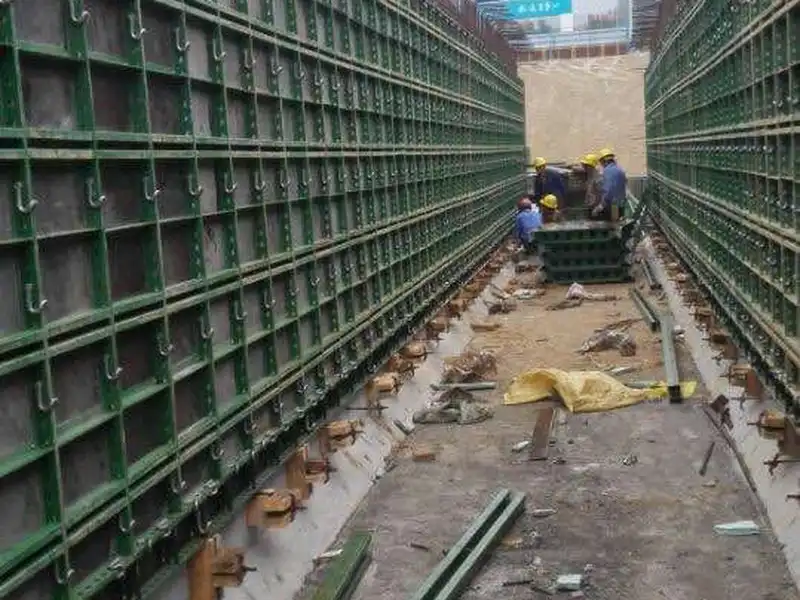
Understanding Combined Steel Formwork and Aluminum Formwork
Before comparing these two systems, it helps to understand what each one actually is and how each gets manufactured.
What Is Combined Steel Formwork?
The combined steel formwork is a modular panel system composed of Q235 carbon steel with a panel thickness of 2.5 mm to 3.0 mm. The couplings between panels are created by means of U-clips and L-shaped fasteners, which provide tight joints that prevent concrete leakage. Free assembling into walls, columns, beams and slabs with standard P-Hole spacing on the perimeter flange. The system flatness tolerance ≤2mm / GB/T 50214, therefore the surface of the poured concrete seldom needs supplementary plastering.
What Is Aluminum Formwork?
Aluminum formwork uses extruded aluminum alloy panels—typically 6061-T6 grade—fabricated through precision CNC machining. Each panel weighs roughly 20–25 kg/m², about 40% lighter than equivalent steel panels. Aluminum systems gained popularity in high-rise residential construction across Southeast Asia and the Middle East because crews can reposition panels quickly between identical floor plates. Their reuse cycles also reach 200–300 times under proper handling conditions.
Where Each System Gets Applied
Steel panel systems dominate infrastructure projects: bridge piers, tunnel linings, culvert walls, and industrial foundations. These applications demand high pouring pressure resistance and rigid joint stability. Aluminum systems are preferred where floor layouts repeat identically floor after floor—such as apartment towers—where their lighter weight reduces labor fatigue during daily stripping and re-erection cycles.
Comparative Analysis of Combined Steel vs. Aluminum Formwork
Procurement decisions rest on objective performance data, not brand preference. Here is how the two systems stack up across the criteria that matter most to engineers and supply chain managers.
Load-Bearing Capacity and Structural Rigidity
Steel carries a modulus of elasticity of 206 GPa, compared to aluminum's roughly 69 GPa. In practical terms, steel panels deflect significantly less under hydrostatic concrete pressure, which is critical for tall pours or high-slump mixes. For bridge columns or shear walls exceeding 4 meters in height, steel's rigidity eliminates the mid-pour bulging risk that aluminum panels face without additional walers.
Weight, Handling, and Labor Productivity
Aluminum's weight advantage is real. A standard aluminum panel weighs approximately half as much as its combined steel formwork counterpart, which lowers per-cycle labor hours on repetitive residential floors. However, for projects with crane access or smaller crew sizes common on infrastructure sites, the weight difference matters less. Steel's heavier panels also resist accidental displacement from wind or concrete pressure without additional bracing.
Cost Lifecycle and Per-Pour Economics
The upfront unit price of aluminum formwork typically runs 30–50% higher than equivalent steel panels. Over 200+ reuse cycles on identical layouts, aluminum can recover that gap through reduced labor. For irregular structures—retaining walls, non-standard columns, custom foundations—steel's modular flexibility and lower purchase cost produce a better total cost of ownership. Rental companies also favor steel systems because repair costs per cycle are lower; dented aluminum panels are more expensive to restore than steel panels, which can be straightened or replaced at lower cost.
Safety, Efficiency, and Environmental Impact
Safety and sustainability are no longer secondary considerations—they directly affect project certification and contractor liability.
Job Site Safety Standards
Steel formwork systems built to ISO 45001 occupational health and safety management standards provide documented safety protocols at every stage. At Shandong Xingrui, our combined steel panels undergo non-destructive weld testing to confirm joint integrity under vibration loads during concrete consolidation. Aluminum panels, if improperly connected, can fail at pin joints when subjected to dynamic vibration from immersion vibrators.
Installation Speed and Modularity
Both systems support rapid assembly, but they differ in flexibility. Here are the core efficiency traits of a modular steel panel system:
- Free assembly configuration: Standardized widths of 100/150/200/250/300mm and lengths of 900/1200/1500/1800mm combine without cutting, adapting to irregular structural geometries that aluminum's extruded profiles cannot match without custom fabrication.
- Tight joint sealing: Industrial-grade surface treatment—pickling, phosphating, and high-temperature baking—produces salt spray resistance exceeding Grade 8, meaning panels store outdoors between projects without accelerated joint deterioration.
- Fast stripping cycles: U-clip and L-bolt connections release quickly, achieving turnover rates comparable to aluminum on non-repetitive layouts.
These traits allow project teams to maintain pour schedules even when structural geometry changes between levels, which is a common challenge on mixed-use developments.
Recyclability and Environmental Credentials
Both combined steel formwork materials are recyclable at end-of-life. Aluminum carries a higher scrap value per kilogram, which some procurement teams factor into asset accounting. Steel systems, however, achieve 200–300+ reuse cycles before scrap, meaning the embodied carbon per pour is very low across a long service life. Shandong Xingrui's production facilities hold ISO 14001 Environmental Management System certification, confirming that manufacturing processes meet international environmental standards.
Procurement and Market Availability Insights
Supply chain reliability separates good suppliers from great ones, especially on projects with tight milestone schedules.
Global Supplier Availability and Lead Times
Shandong Xingrui operates from Rizhao City, Shandong Province, with direct access to Rizhao Seaport—one of China's active export hubs. This port proximity shortens inland logistics time significantly for containerized shipments to Latin America, the Middle East, and Southeast Asia. Standard production lead times run 15–30 days for large orders, with sample delivery achievable in 7–14 days from drawing confirmation.
Customization and Technical Support
Project engineers regularly submit CAD drawings requesting non-standard panel dimensions or specialized corner modules for curved walls. Our team of 180 professional technicians processes drawing-to-sample requests within 7–14 days. We also supply on-site technical guidance for first installations, reducing the learning curve for crews unfamiliar with modular steel systems.
Pricing Structure and Order Flexibility
Combined steel formwork panel systems offer more accessible entry-level pricing than aluminum, which benefits distributors expanding into new product categories or EPC contractors testing a new supplier. FOB and CIF terms are both available, with documentation packages covering CE certification and ISO 9001/14001/45001 compliance records for clients whose end-owners require third-party verification.
Making the Right Choice for Your Project
The honest answer is that neither material is always better than the other. The best choice for your job relies on its specifics.
Match Formwork Type to Structural Complexity
A combined steel panel system is better for controlling sizes and costs less overall when it comes to infrastructure projects like tunnels, bridge piers, and other structures with unique shapes. Around cycles 50 to 80, aluminum's lighter weight starts to make up for its higher starting cost in high-rise apartment towers with 20 or more identical floor plates.
Consider Reuse Cycles Against Project Volume
When a rental company buys 500 sets of formwork for a regional fleet, steel makes the assets last longer and costs less per fix. If an EPC contractor is bidding on a single 30-story tower with a set timeline, the faster speed of metal might be worth it.
Verified Performance Data Matters
Any reputable supplier should be able to provide you with batch test reports, weld inspection records, and certified dimensional accuracy data (±0.5mm tolerance). As part of our ISO 9001 quality control system, we keep full records for every lot of products we make.
Conclusion
Combined steel formwork and aluminum formwork address various issues. Steel systems are the best choice for infrastructure, heavy civil, and mixed-use developments because they can handle higher loads, can be bent to fit irregular shapes, and cost less per panel. Aluminum systems are better for residential layouts that are used over and over again because they save time and money. If procurement teams are thinking about both choices, the best thing to do is to ask for samples and detailed information before committing to big quantities. You can be sure of the performance data for GREEN FORMWORK's modular steel panel system because it has ISO 9001/14001/45001 certifications and has been exported to more than 100 countries.
FAQ
Q1: How many times can a steel formwork panel actually be reused?
A: As long as they are cleaned after each pour, given a release agent before the next pour, and stored off the ground, Q235 steel panels can usually be used 200 to 300 times. This number is based on the idea that normal concrete mixes and normal shaking methods are used. Mixes that are rough or heavy on chemicals may shorten the life of the surface, but they won't change the structure.
Q2: Can steel panels handle irregular column or curved wall shapes?
A: Yes. Standardized module widths range from 100 mm to 300 mm and can be put together in any way. Custom corner modules or filler pieces are made from CAD drawings provided by the client. For circular columns, special curved fillers are used that are made to fit the pour diameter perfectly.
Q3: What certifications should I request from a steel formwork supplier?
A: Ask for certification in ISO 9001 quality management, ISO 14001 environmental management, and ISO 45001 safety management at work. End owners and project auditors usually need CE documentation and a Declaration of Performance (DoP) for projects in Europe or the Middle East.
Q4: How long does it take to receive samples?
A: It usually takes 7–14 days from the time the drawing is confirmed until the sample is shipped. For normal panel sizes, samples from stock that is already being made may be sent out within 3–5 days.
Q5: Is aluminum always lighter to handle on-site than steel?
A: Yes, metal is about 40–50% lighter per panel. But because steel is more rigid, tall pours don't need as many walers and cross-braces. This helps to balance out the difference in weight at the system level.
Request a Quote from GREEN FORMWORK — Combined Steel Formwork Supplier
GREEN FORMWORK sells steel forms to contractors and distributors in over 100 countries. They do this with the help of Shandong Xingrui's 40,000 m² production plant and 180 skilled techs. Our modular steel building formwork system comes with full ISO and CE paperwork, the option to make custom panels, and a sample return time of 7–14 days. You can send your project drawings or RFQ to sdxingruiqp@126.com to see all of our products right away.
References
1. American Concrete Institute. ACI 347R: Guide to Formwork for Concrete. 2014.
2. Construction Industry Research and Information Association (CIRIA). Formwork: A Guide to Good Practice. 3rd ed., 2012.
3. Peng, J. L., et al. "Load and Resistance Factor Design of Shoring Frames for Concrete Formwork." Journal of Structural Engineering, ASCE, 2017.
4. European Committee for Standardization. EN 12812: Falsework — Performance Requirements and General Design. 2008.
5. Hurd, M. K. Formwork for Concrete. 8th ed., American Concrete Institute, 2005.
6. International Organization for Standardization. ISO 9001:2015 Quality Management Systems — Requirements. 2015.
Learn about our latest products and discounts through SMS or email