- English
- French
- German
- Portuguese
- Spanish
- Russian
- Japanese
- Korean
- Arabic
- Greek
- German
- Turkish
- Italian
- Danish
- Romanian
- Indonesian
- Czech
- Afrikaans
- Swedish
- Polish
- Basque
- Catalan
- Esperanto
- Hindi
- Lao
- Albanian
- Amharic
- Armenian
- Azerbaijani
- Belarusian
- Bengali
- Bosnian
- Bulgarian
- Cebuano
- Chichewa
- Corsican
- Croatian
- Dutch
- Estonian
- Filipino
- Finnish
- Frisian
- Galician
- Georgian
- Gujarati
- Haitian
- Hausa
- Hawaiian
- Hebrew
- Hmong
- Hungarian
- Icelandic
- Igbo
- Javanese
- Kannada
- Kazakh
- Khmer
- Kurdish
- Kyrgyz
- Latin
- Latvian
- Lithuanian
- Luxembou..
- Macedonian
- Malagasy
- Malay
- Malayalam
- Maltese
- Maori
- Marathi
- Mongolian
- Burmese
- Nepali
- Norwegian
- Pashto
- Persian
- Punjabi
- Serbian
- Sesotho
- Sinhala
- Slovak
- Slovenian
- Somali
- Samoan
- Scots Gaelic
- Shona
- Sindhi
- Sundanese
- Swahili
- Tajik
- Tamil
- Telugu
- Thai
- Ukrainian
- Urdu
- Uzbek
- Vietnamese
- Welsh
- Xhosa
- Yiddish
- Yoruba
- Zulu
How much weight should scaffolding be able to support
Scaffolding load capacity is one of the most consequential decisions in any construction procurement cycle. Whether you are managing a high-rise facade project in Dubai or supplying subcontractors across Southeast Asia, the structural integrity of your scaffold determines both worker safety and project profitability. Modern 8-hole disc scaffolding systems — also known as ringlock scaffolding — deliver vertical load-bearing capacity exceeding 40kN per standard, making them a compelling choice for demanding industrial environments. Understanding what drives those numbers helps buyers select the right system, avoid costly failures, and satisfy regulatory requirements across multiple markets.
Understanding Scaffolding Load Capacity: Key Concepts and Standards
There is no one number that represents load ability. It shows the interaction of different types of forces acting on a scaffold structure at the same time.
The Three Load Categories That Define Safe Working Weight
Dead load is the weight of the standards, ledgers, transoms, and planks that make up the scaffolding. Live load includes people, tools, and things that are put on work platforms. Wind pressure, earthquakes, and heat growth are all examples of environmental load. 29 CFR 1926 from OSHA Section 451 says that scaffolding must be able to hold at least four times its own weight in weight. Facade scaffolding is grouped into service classes in EN 12810-1 that range from 0.75 kN/m² to 6.0 kN/m². ISO 9001-certified manufacturing processes make sure that the dimensions are always the same, which has a direct effect on how well the structure works.
These guidelines are very important for B2B importers who send goods to suppliers in the GCC or Southeast Asia. Buyers who can show their downstream clients documentation that is CE-certified and EN-compliant win tender entries that rivals who don't have paperwork can't get to.
Features and Design Specifications of 8-Hole Disc Scaffolding That Influence Weight Support
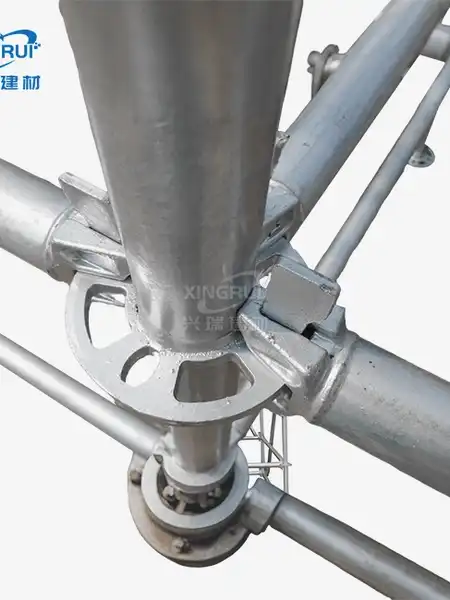
The shape of the connectors determines how well a ringlock device works mechanically. There are different kinds of rosettes, and you can tell the difference between a 4-hole and an 8-hole disc scaffolding pattern when the plate is loaded.
How the Rosette Connector Distributes Force
Each rosette has eight holes that are spread out equally. There are four narrow channels for perpendicular ledgers and four wider channels for diagonal braces, and this 8-hole disc scaffolding configuration makes it possible to do true 45-degree triangulation. When the standards are set, this shape changes horizontal forces into axial compression, which is the best way for steel to work. This diagonal load path keeps structures taller than 20 meters from deforming in a way that causes lower-tier systems to fall apart.
Shandong Xingrui Building Materials Co., Ltd. makes GREEN FORMWORK's 8-hole disc scaffolding, which is made of Q235 quality carbon steel and has wall widths of 3.2mm or 3.25mm with a 0.1mm tolerance. Hot-dip galvanization at a thickness of at least 80 microns protects against rust for 15 to 25 years, even in coastal or high-humidity work areas common in the Middle East and Southeast Asia.
This is what the main structural benefits are that make load performance possible:
- Rosette interval at 500mm: At a distance of 500 mm, the rosette interval makes sure that the load is evenly spread across the whole height of the scaffold, lowering stress buildup at any one node point.
- Gravity-fed wedge-lock mechanism: The bolt-free connection system locks itself in place, so there is no joint movement, which can lower the load capacity of tube-and-coupler options by 15–20%.
- Q235 premium steel grade: The material's yield strength and ductility profile allow the system to handle brief overloads without breaking, which is very important in building sites where live loads change all the time.
Together, these structural properties make it possible for the system to handle complicated frame assembly, irregularly curved structures, and support configurations that go in more than one direction, which would be too much for a normal frame scaffold.
How Much Weight Can 8-Hole Disc Scaffolding Support in Real-World Applications?
Theory is put into practice on the job site through specific load scenarios. The 8-hole disc scaffolding system from Shandong Xingrui can support a vertical load of up to 40kN, which is about the same as putting 4,000 kg of weight on a single pole.
Practical Load Scenarios Across Key Industry Segments
In heavy civil engineering, axial loads of 30kN to 60kN are usually put on bridge shoring and tunnel formwork. When maintaining a petrochemical plant with circular tanks, it's important to be able to connect in multiple directions at close intervals.
The 8-hole disc scaffolding geometry—specifically its 8-hole rosette—offers geometric freedom that makes it better than cuplock systems that only allow connections at set angles. High-rise wall scaffolding near the coast that gets a lot of wind needs diagonal bracing stiffness that can only be found in a true 8-hole triangulation.
For example, contractors in Dubai's building industry always ask for EN 12810-1-compliant scaffolding with recorded load test results. When importers keep certified, dimensionally accurate parts in stock, they lower their own risk of liability and get better wholesale prices from clients further down the supply chain.
The system is made to specifications and can be used more than once. This means that over a 15–25-year service life, it costs a lot less per project cycle than single-use or painted-finish options.
Comparing 8-Hole Disc Scaffolding to Other Scaffolding Systems on Weight Bearing
A clear performance matrix is needed for procurement professionals who are in charge of more than one product line. There are a lot of different competing methods on the market for scaffolding, and each one handles loads in a different way.
Where Each System Fits — and Where It Falls Short
Cuplock scaffolding can handle mild loads well, but it can only be connected at 90-degree angles, which makes it less useful for curved walls or uneven floors. Traditional tube-and-coupler systems allow for more geometric flexibility, but they require 30–50% more labor to set up and take down, and friction-dependent couplers lose their clamping force after being heated and cooled many times.
Frame scaffolding works well for low-rise domestic work where standard bay widths fit the project geometry, but it doesn't have the vertical load capacity or ability to be adjusted in more than one way that is needed for industrial uses. Standard 4-hole ringlock systems are a big step forward for frame scaffolding, but they still can't handle diagonal bracing at 45 degrees without adapter parts, which adds to the cost and complexity of the assembly process.
All of these problems can be solved by the 8-hole disc scaffolding system, which has just a few parts. It can handle both perpendicular and diagonal links from the same rosette, and it can hold more than 40kN of weight, which makes it the best flexible choice you can get at a reasonable bulk price.
Installation, Maintenance, and Procurement Considerations to Maximize Load Support Safety
To reach the stated load capacity in the field, installation must be done correctly and upkeep must be done consistently. A scaffold that is rated at 40kN according to the standard may not work at all if the order of building is wrong, and this is especially true for systems like 8-hole disc scaffolding, where even minor assembly errors can compromise the entire structure's integrity.
Installation Practices That Protect Rated Capacity
Before putting up the first lift, you should always put the base plates and movable jacks in place on flat, firm ground. It is important to add diagonal bracing with each lift and not after the fact, because adding bracing after the fact changes the load path that was set up during bottom-up assembly. Make sure the hammer hits all the way through the wedge heads; a wedge that is only partially in place reduces joint stiffness in a measurable way.
Rosette weld strength, wedge head distortion, and zinc coating state should all be checked on a regular basis. Parts that have obvious cracks at the weld zone between the rosette and the pipe must be taken out of service right away. Shandong Xingrui tests each rosette with ultrasonic waves during production to make sure the welds are strong before they are shipped. This lowers the chance that hidden flaws will get to the jobsite.
To buy something, you should ask for material test certificates that prove the grade of the steel, zinc thickness gage reports that follow ISO 1461, and records of dimensional inspections. Shandong Xingrui gives examples with full technical support, such as copies of CE certifications and paperwork for ISO 9001, ISO 14001, and ISO 45001, so importers can quickly meet the audit requirements of their clients. You can buy mixed-containers that include standards, ledgers, diagonal braces, and base jacks. This allows for one-stop cabinet consolidation, which lowers the cost of freight per unit.
Conclusion
How much weight a scaffolding can hold depends on the type of steel used, the shape of the connectors, how well they were made, and how well they were installed. In a single designed product, the 8-hole disc scaffolding system takes into account all four factors. It can hold more than 40kN vertically, is resistant to corrosion thanks to hot-dip galvanization, and can be set up in a true 45-degree triangle.
These features make it a good choice for construction and industrial uses in tough markets. Shandong Xingrui's system has been certified by ISO 9001, ISO 14001, ISO 45001, and CE. It gives importers and wholesale wholesalers the technical information and low unit costs they need to safely serve professional buyers.
FAQ
What is the maximum safe load for a single scaffold standard?
The 8-hole disc scaffolding standards from Shandong Xingrui can hold up to 40kN of vertical weight per standard when set up in a certain way. The actual safe working load on a whole scaffold depends on the ground conditions, the width and height of the bays, and the pattern of the braces.
Does this system comply with international safety standards?
EN 12810-1 and AS/NZS 1576 are met by the system. The factories that make things are certified by ISO 9001, ISO 14001, and ISO 45001 standards. All of the goods have CE approval, which means they can be used in bids for markets in Europe, the Middle East, and Oceania.
Can components from different manufacturers be mixed?
Rosette thickness and wedge angles can be 0.5mm to 1mm different from one manufacturer to the next. Mixing brands without first doing a load-bearing and compatibility test makes the joint behave in unpredictable ways. This risk is taken away by using parts from a single manufacturer.
What is the expected service life?
When parts are hot-dip galvanized at a thickness of 80 microns or more, they stay resistant to corrosion for 15 to 25 years with regular maintenance. The system can be used again and again, which lowers the long-term cost per activation cycle.
Get Competitive 8-Hole Disc Scaffolding Pricing from GREEN FORMWORK
Shandong Xingrui Building Materials Co., Ltd., a manufacturer of GREEN FORMWORK, provides bulk wholesalers in more than 100 countries with certified 8-hole disc scaffolding supplier options. Our ability to offer mixed containers, flexible T/T payment terms, and full technical documentation, which includes CE, ISO 9001, and material certificates, make the buying process easy. Visit sdxingrui.com or email our team at sdxingruiqp@126.com to get samples, specs, or a reasonable bulk price right away.
References
1. OSHA. Scaffolding Standard 29 CFR 1926.451: General Industry Scaffolding Safety Requirements. Occupational Safety and Health Administration, 2011.
2. British Standards Institution. EN 12810-1: Facade Scaffolding Made from Prefabricated Components — Part 1: Product Specifications. BSI, 2003.
3. Standards Australia. AS/NZS 1576: Scaffolding — General Requirements. Standards Australia, 2010.
4. International Organization for Standardization. ISO 1461: Hot Dip Galvanized Coatings on Fabricated Iron and Steel Articles — Specifications and Test Methods. ISO, 2009.
5. Peng, J.L., Pan, A.D., and Chan, S.L. "Scaffold Design and Failure in Construction: A Review." Journal of Constructional Steel Research, 2007.
6. Chandrangsu, T., and Rasmussen, K.J.R. "Investigation of Geometric Imperfections and Joint Stiffness of Support Scaffold Systems." Journal of Constructional Steel Research, 2011.
Learn about our latest products and discounts through SMS or email