- English
- French
- German
- Portuguese
- Spanish
- Russian
- Japanese
- Korean
- Arabic
- Greek
- German
- Turkish
- Italian
- Danish
- Romanian
- Indonesian
- Czech
- Afrikaans
- Swedish
- Polish
- Basque
- Catalan
- Esperanto
- Hindi
- Lao
- Albanian
- Amharic
- Armenian
- Azerbaijani
- Belarusian
- Bengali
- Bosnian
- Bulgarian
- Cebuano
- Chichewa
- Corsican
- Croatian
- Dutch
- Estonian
- Filipino
- Finnish
- Frisian
- Galician
- Georgian
- Gujarati
- Haitian
- Hausa
- Hawaiian
- Hebrew
- Hmong
- Hungarian
- Icelandic
- Igbo
- Javanese
- Kannada
- Kazakh
- Khmer
- Kurdish
- Kyrgyz
- Latin
- Latvian
- Lithuanian
- Luxembou..
- Macedonian
- Malagasy
- Malay
- Malayalam
- Maltese
- Maori
- Marathi
- Mongolian
- Burmese
- Nepali
- Norwegian
- Pashto
- Persian
- Punjabi
- Serbian
- Sesotho
- Sinhala
- Slovak
- Slovenian
- Somali
- Samoan
- Scots Gaelic
- Shona
- Sindhi
- Sundanese
- Swahili
- Tajik
- Tamil
- Telugu
- Thai
- Ukrainian
- Urdu
- Uzbek
- Vietnamese
- Welsh
- Xhosa
- Yiddish
- Yoruba
- Zulu
What are the advantages of using aluminum building formwork over conventional formwork?
Aluminum building formwork offers a clear performance edge over timber, steel, and plastic alternatives. Built from 6061-T6 aviation-grade aluminum alloy, this modular concrete forming system delivers a 4-day floor cycle in high-rise projects, tolerances within ±1mm, and 300+ reuse cycles—all while keeping panel weight between 20–25 kg/m². Compared to conventional systems, aluminum formwork eliminates plastering, cuts skilled labor needs by up to 40%, and reduces long-term cost per use dramatically. For subcontractors managing tight schedules across multiple live job sites, this system is a rational, numbers-backed choice.
Understanding Aluminum Building Formwork
Before you compare methods, it's helpful to know what Aluminum Building Formwork is and how it works on a real job site.
What the System Consists Of?
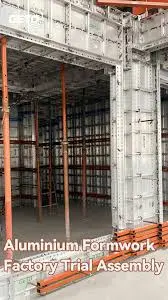
Each part of Aluminum Building Formwork—the wall panel, the slab panel, the beam side, and the prop—is carefully extruded from 6061-T6 aluminum alloy. You can get panels in lengths of 2400, 2700, or 3000mm and widths of 100, 200, 300, or 400mm. Each panel is made from a single piece of mold, so there are no holes between the pieces that let grout leak out in joined wood or steel forms made of multiple pieces.
How It Fits Into Construction Workflows
Crews set up the system and poured concrete across walls, columns, beams, and slabs all at the same time on a typical high-rise apartment floor. Within 36 to 48 hours, they used the Early Stripping System to start removing slab and beam panels while vertical props stayed in place. This single process takes the place of the many steps that are usually done in order in wood-based builds.
Design Customization and Technical Support
Aluminum Building Formwork is not like pre-cut wood sheets; it is made when you place an order. Companies like Shandong Xingrui Building Materials Co., Ltd. offer full shop drawing services, which include matching panel layouts to structure models before the panels are made. You can also get samples and technical help right where you are, which is very helpful during the trial assembly phase of a new project award.
Key Advantages of Aluminum Formwork Compared to Conventional Systems
The difference in performance between Aluminum Building Formwork systems and other systems is not just an idea; it can be seen in daily progress logs and project cost sheets.
Here are the main benefits that make high-rise living and business buildings use them:
• Speed: A normal floor can be built in 4 days with Aluminum Building Formwork. When you count the time it takes to cut, nail, strip, and clean up after installing a timber-based system, each floor usually takes 7–10 days. With the Early Stripping System, you only have to wait 36–48 hours after the pour instead of 3–5 days with regular wood block forms.
• Precision: Tolerances in dimensions of ±1mm mean that walls, columns, and slabs fit together perfectly without bowing or patching. For curtain wall installations and MEP rough-in coordination, this level of accuracy is very important. Deviations of just 5 mm can lead to expensive rework.
• Labor reduction: With the quick-lock pin connection system, you don't need to know a lot about woodworking to put it together. Field data from high-rise projects shows that 40% fewer skilled labor hours are needed than with timber shuttering. This saves money directly on labor costs.
• No plastering required: The polished metal surface makes a smooth concrete finish that is good enough to hand over without any extra work. Not using concrete on a 30-story building saves money on both materials and labor for the subcontractor.
• Durability and reuse: The cost-per-use of aluminum panels drops well below that of wood alternatives after 300+ turnover cycles with proper maintenance. Wood panels usually only last 5–10 pours before degradation affects the quality of the surface and the accuracy of the measurements.
These benefits add up over the course of a job. A subcontractor who is working on two or three jobs at the same time will see their schedules get sped up and their costs for supplies go down.
Comparative Analysis: Aluminum vs. Conventional Forming Systems
Aluminum vs. Timber Formwork
Timber formwork is still popular because it's cheap to use, but it warps in wet conditions, soaks up water, and breaks down quickly when loaded over and over again. A normal plywood form can hold between 5 and 8 pours. Based on this, the fact that Aluminum Building Formwork can be used over 300 times means that the cost per pour is much lower than the cost of wood over the life of a project. Timber also creates a lot of waste on the job site, which is becoming a bigger problem for compliance in many places.
Aluminum vs. Steel Formwork
Steel forms are heavy (usually 50–80 kg/m²), so they need to be moved with the help of a crane every time. At 20–25 kg/m², Aluminum Building Formwork panels can be moved by hand, which speeds up the process of taking them down and putting them back up. Steel also rusts without regular upkeep, which is an ongoing cost that the anodized surface treatment on aluminum completely avoids.
Aluminum vs. Plastic Formwork
Plastic systems are lighter, but they don't have the stiffness that is needed for high-up solid pours. Plastic formwork usually has maximum load ratings below 40 kN/m², while Aluminum Building Formwork has maximum load ratings of 60 kN/m². When temperatures are changed over and over, plastic panels also deform, which makes it hard for structure builders to get the consistent sizes they need.
Procurement Considerations for Aluminum Building Formwork
There's more to picking the right Aluminum Building Formwork supplier than just comparing prices per square meter.
Alloy Grade and Fabrication Quality
Demand that the 6061-T6 material approval be checked. Some low-cost providers cut the wall width below what is required, which lowers the panel's load capacity and shortens its life. Ask for material test reports and look closely at the quality of the welds, especially where pin holes are found because that's where the most stress builds up during stripping.
Deep Design Capability
A good Aluminum Building Formwork maker will do shop drawings that are a perfect match for your structural drawings. Shandong Xingrui Building Materials Co., Ltd. has a 40,000-square-meter factory with 12 welding robots and 6 automated production lines. They help clients from sending in drawings to making sure the final assembly is correct. This process usually takes one to three months, from awarding the project to delivering the first item.
After-Sales Support and Consumable Replenishment
Parts that break down faster than panels are pin rods, wedge pins, and diagonal beams. If your provider can't get these parts back to you in time for your job, the time you have to wait will cost you a lot more than the parts themselves. Before you sign a supply deal, make sure you know how long it will take to get new parts.
Why Aluminum Formwork Is the Preferred Choice in Modern Construction?
It is well known that high-rise residential construction is moving toward Aluminum Building Formwork systems. Studies in engineering and construction management journals consistently show that using Aluminum Building Formwork leads to shorter project timelines, less material waste, and better quality concrete surfaces.
When aluminum panels reach the end of their useful life, they can be melted down and re-extruded without losing any material. This closed-loop flow of materials is becoming more important for projects that want to get green building certification or have to meet trash reduction goals.
Shandong Xingrui Building Materials Co., Ltd. makes Aluminum Building Formwork systems that meet ISO 9001, ASTM B209, and GB/T 5237 standards. All of its products are CE-certified. The company ships goods to over 100 countries and can make things to order based on plans provided by the customer. This makes it a useful source for suppliers who work in markets from Southeast Asia to the Americas.
Conclusion
When it comes to speed, accuracy, worker efficiency, and total lifetime cost, Aluminum Building Formwork is clearly better than wood, steel, and plastic systems. When freelancers are in charge of high-rise residential or business projects, being able to get a 4-day floor cycle, skip plastering, and use the same set of panels for hundreds of pours has a direct effect on project margins. The important thing is to buy from a company whose metal standards have been checked, whose deep design capabilities are real, and whose consumables can be refilled reliably. These things separate a project program that works well from one that causes schedule problems.
FAQ
How many times can aluminum formwork panels be reused?
Panels made from 6061-T6 Aluminum Building Formwork alloy can go through 300 or more turning cycles if they are used normally and cleaned properly after each strip. This number suggests that the pins are stored correctly, that worn pins are replaced quickly, and that incorrect stripping methods do not cause impact damage.
Can the system be adjusted for non-standard floor layouts?
Yes. Because Aluminum Building Formwork is custom made, makers make panels that fit the structural plans you give them. If changes are made to the architecture in the middle of a project, the panels that are affected can be changed or added to with new parts. This is why it's important for suppliers to have a lot of planning experience: early teamwork lowers the risk of having to make changes during the fabrication process.
How does aluminum formwork affect total project cost?
The cost of capital up front per square meter is higher than for wood. The lifecycle cost per pour is much lower when you spread that cost out over 300+ reuse cycles and take out the costs of plastering, getting rid of waste, and extra labor that come with using wood. For workers who work on multiple projects with the same stock of panels, each extra job makes the business case stronger.
Is on-site technical support available?
Suppliers with a good reputation will help with installation and technical issues during the trial assembly process and the first floors of production use. As part of its standard project service, Shandong Xingrui Building Materials Co., Ltd. gives samples and technical help on-site.
Partner With GREEN FORMWORK for Your Next Aluminum Formwork Project
With the help of Shandong Xingrui Building Materials Co., Ltd., GREEN FORMWORK offers approved Aluminum Building Formwork maker solutions that are made to 6061-T6 standards and come with full shop drawing support, longevity that lasts for 300+ cycles, and replacement of consumables. Our 40,000 m² production space and automated lines help us meet delivery dates for large orders. To get a quote for your project right away, email your structural drawings to sdxingruiqp@126.com.
References
1. Chandgude, S., & Patil, Y. (2019). Comparative Study of Aluminum Formwork and Conventional Formwork. International Journal of Innovative Research in Science, Engineering and Technology.
2. Patel, N., & Shah, D. (2020). Analysis of Cost and Time Comparison of Aluminum Formwork vs. Conventional Formwork in Residential Buildings. Journal of Civil Engineering and Environmental Technology.
3. The Aluminum Association. (2022). Aluminum Alloy Temper Designations and Specifications: A Technical Reference. The Aluminum Association.
4. American Society for Testing and Materials. (2021). ASTM B209: Standard Specification for Aluminum and Aluminum-Alloy Sheet and Plate. ASTM International.
5. Rao, H. S., & Giri, S. (2018). Productivity Improvement in High-Rise Construction Using Aluminum Formwork Systems. Construction Management and Economics Journal.
6. Singh, A., & Verma, R. (2021). Lifecycle Cost Assessment of Reusable Formwork Systems in Concrete Construction. International Journal of Construction Management.
Learn about our latest products and discounts through SMS or email